
Her name was Relebohile. She was just 16 years old when she went into labour in the remote mountains of Thaba-Tseka.
While most teenagers her age should have been worrying about school or friends, Relebohile was fighting for her life, and that of her unborn child.
To reach Paray Hospital, she had to walk for four hours. Along the way, she crossed two rivers, swollen and raging after days of heavy rain.
She survived. Her life was saved. The baby was born healthy.
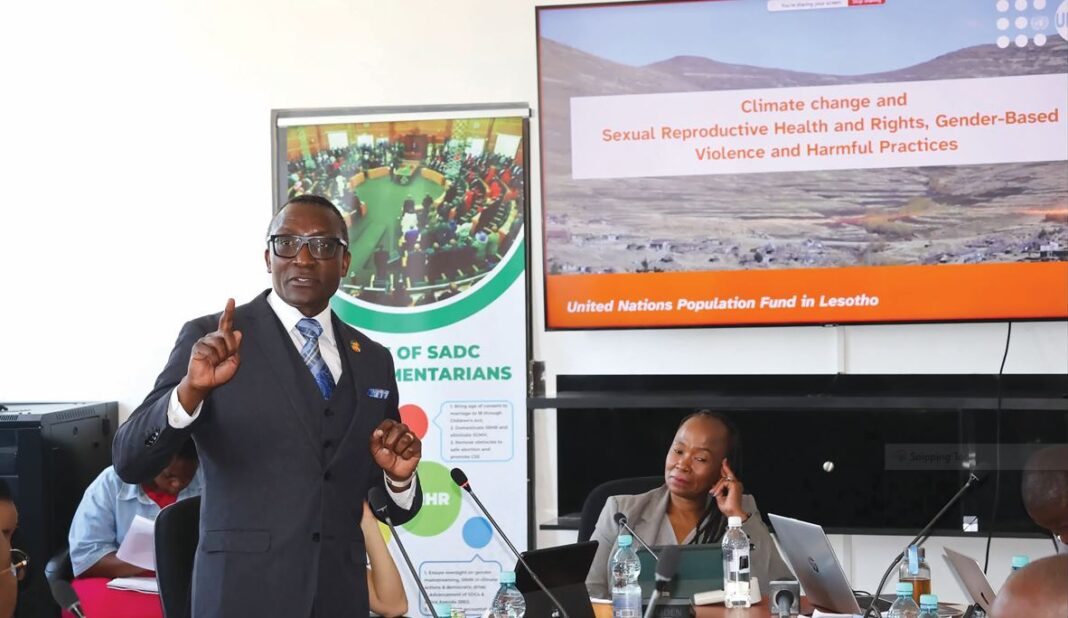
The story was shared by Kennedy Mosoti, the UNFPA Country Representative, during a high-level workshop on SDG-informed legislative scrutiny convened this week by the SADC Parliamentary Forum (SADC-PF).
Mosoti, however, reflected that Relebohile’s survival is not the reality for many women. Countless mothers endure not only long distances but also flooded rivers and impassable terrain to seek medical care. Many die during labour or shortly thereafter.
He shared these realities to highlight the severe challenges women and girls face in accessing Sexual and Reproductive Health and Rights (SRHR) services, challenges that are being intensified by the adverse effects of climate change.
In the highlands of Lesotho, where climate change has transformed seasonal rains into unpredictable deluges, a river is no longer just a water source, it is a life-threatening barrier.
The workshop opened with a stark reminder of the crisis confronting Lesotho. Despite a high literacy rate of 86 percent and an antenatal attendance rate of 92 percent, the country remains a dangerous place to give birth.
Maternal mortality stands at 530 deaths per 100,000 live births, the second highest in Africa, surpassed only by war-torn South Sudan. Furthermore, 26 infants out of every 1,000 die before reaching their first birthday.
Mosoti admitted to wincing at these national statistics.
The Secretary-General of SADC-PF, Boemo Sekgoma, noted that climate change is no longer a future threat, it is a daily struggle. Citing Cyclones Dineo (2017) and Eloise (2021), she emphasised that extreme weather events disproportionately affect SRHR.
“When climate disasters strike, they do not just destroy crops; they destroy the last mile of healthcare,” she said. “Flooded roads prevent the delivery of contraceptives, and extreme poverty driven by crop failure pushes young girls into early marriages or exposes them to increased gender-based violence.”
Member of Parliament for Hloahloeng, Katleho Mabeleng, grew emotional as he corroborated these accounts. “You spoke of a woman who walked four hours,” he said. “In my constituency, people travel eight hours to reach a clinic that does not even have a doctor. We have women giving birth along the road because hospitals are simply unreachable.”
The Deputy Speaker of the National Assembly, Tšepang Tšita Mosena, speaking on behalf of the Speaker, challenged her colleagues to view SRHR not merely as a health issue, but as a development imperative.
“Climate-related shocks disproportionately affect women and adolescents. These shocks disrupt access to essential SRHR services and exacerbate gender-based violence,” she said. She called for the institutionalisation of gender-responsive and climate-resilient approaches within parliamentary processes.
However, the path to reform is constrained by financial realities. Member of Parliament for Motimposo and SADC-PF member, ’Makatleho Motsoasele, pointed to the impracticality of constructing costly bridges across a country where land erosion is accelerating.
“We must be climate-smart,” she urged. “We need to talk about how people can be served where they are.”
As Lesotho prepares for the 2026–2027 budget speech, pressure is mounting on Parliament to move beyond rhetoric. The workshop underscored that Zero Hunger (SDG 2) is foundational. Without food security, health systems fail, and violence escalates.
The legislators agreed that the national budget must be informed by an SDG lens. This includes funding Waiting Mothers’ Homes, facilities that allow pregnant women from remote areas to stay near hospitals as their due dates approach, and ensuring these spaces are properly equipped, not merely four walls.
With SADC-PF currently developing a Model Law on Climate Action, Lesotho has an opportunity to lead the region. As Sekgoma reminded the room, “There is but one world, and we only have one shot at making it right.”
Summary
- He shared these realities to highlight the severe challenges women and girls face in accessing Sexual and Reproductive Health and Rights (SRHR) services, challenges that are being intensified by the adverse effects of climate change.
- In the highlands of Lesotho, where climate change has transformed seasonal rains into unpredictable deluges, a river is no longer just a water source, it is a life-threatening barrier.
- The Deputy Speaker of the National Assembly, Tšepang Tšita Mosena, speaking on behalf of the Speaker, challenged her colleagues to view SRHR not merely as a health issue, but as a development imperative.
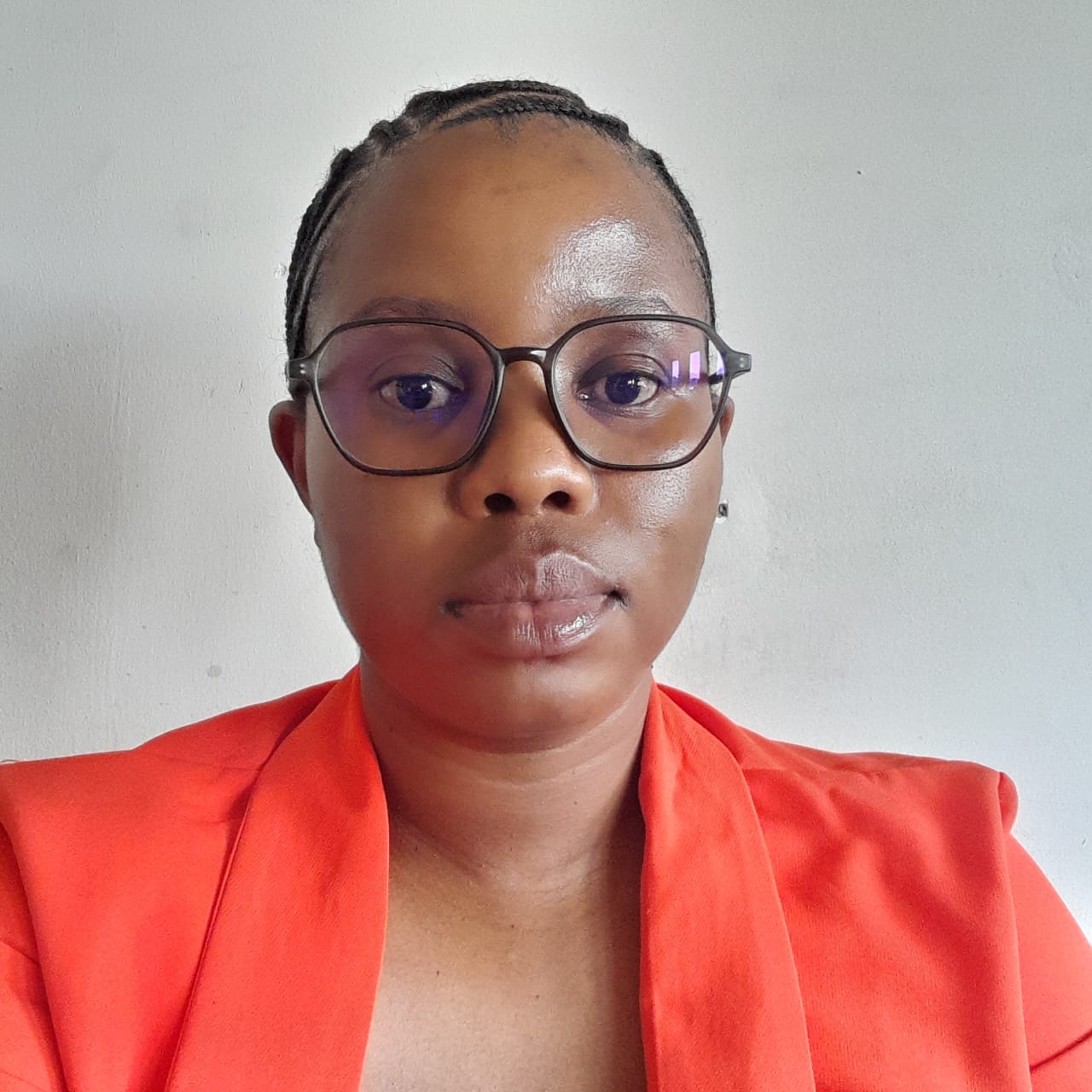
Ntsoaki Motaung is an award-winning health journalist from Lesotho, specializing in community health stories with a focus on sexual and reproductive health and rights, as well as HIV. She has contributed to platforms like “Be in the KNOW,” highlighting issues such as the exclusion of people with disabilities from HIV prevention efforts in Lesotho.
In addition to her journalism, Ntsoaki serves as the Country Coordinator for the Regional Media Action Plan Support Network (REMAPSEN). She is also a 2023 CPHIA Journalism Fellow.