Senior journalist and communications professional with extensive experience in general news reporting, specializing in business and sports journalism. Skilled in public speaking, media relations, and strategic communication, with a proven ability to deliver accurate, engaging, and impactful stories.
A strong team player who thrives in collaborative environments and adapts effectively to diverse working conditions. Passionate about continuous learning, professional growth, and enhancing communication practices to meet evolving industry demands.
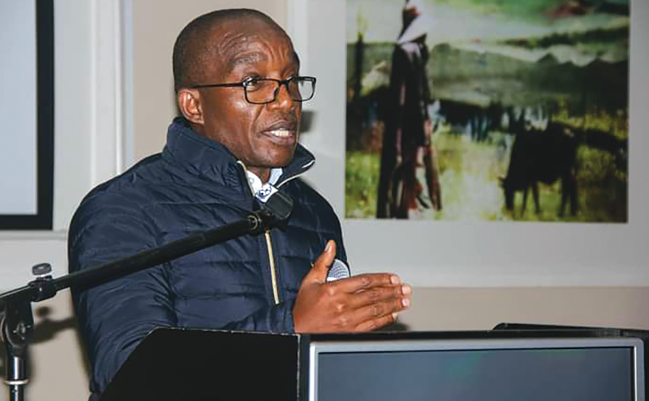
The Managing Director of the Competitiveness and Financial Inclusion (CAFI), Chaba Mokuku, says the Lesotho Horticulture Incubation and Training Centre (LHITC) in Mahobong is poised to transform the country’s agricultural landscape while uplifting local communities.
Mokuku made the remarks on Wednesday during a tour of the centre and two fruit farms in Mahobong, describing the large-scale agricultural investment as a catalyst for rising household incomes and job creation.
“This massive project has improved income levels for families, and we are witnessing a broader ripple effect within the local economy,” Mokuku said.
He noted that the benefits extend beyond farming, with informal traders, particularly street vendors who transport produce to markets, also gaining from the initiative.
“We have achieved a lot. There is a snowball effect resulting from this project,” he said.
Mokuku attributed the project’s progress to financial backing from the World Bank, which has disbursed M100 million towards the initiative. The project has also been identified by His Majesty King Letsie III as one of Lesotho’s flagship development programmes.
“Without the World Bank’s support, we would not have been able to achieve what we have achieved,” Mokuku added.
Beyond agriculture, the project is beginning to contribute to tourism by attracting visitors interested in learning about its operations and impact.
“This project has also promoted tourism, as people frequently visit the facility to learn more about its operations,” Mokuku said.
Looking ahead, he said plans are under way to establish nurseries in the area to support expansion, while fruit processing initiatives, including juice production, are being considered.
“The intention is to scale up production, and we are exploring opportunities to process fruits into juice,” he said, adding that the quality of produce from the centre compares favourably with that of neighbouring countries.
“The quality of fruits produced here is better than those in South Africa.”
The centre is expected to play a central role in promoting economic diversification, strengthening resilience and reducing vulnerability in the agricultural sector.
LHITC’s Director Mariana du Prez said the centre has intensified efforts to enhance farmers’ market-oriented skills.
“We have enhanced market-oriented competencies, including value addition and buyer negotiation,” du Prez said.
She explained that the centre is facilitating farmers’ access to domestic, regional and international markets, while promoting climate-smart agricultural practices.
“The centre is actively promoting sustainable production methods to mitigate risks associated with climate vulnerability,” she said.
Du Prez added that LHITC aims to improve farm-level competitiveness by increasing access to knowledge, technology and finance.
“Our goals include increasing productivity and farm income through sustainable intensification and diversification of horticultural production,” she said.
The centre is also facilitating access to disease-free planting material, modern orchard management practices and business planning support to help farmers meet commercial lending requirements.
World Bank’s Country Director Dr Dinara Djoldosheva reaffirmed the institution’s commitment to supporting Lesotho’s economic growth and job creation, particularly among young people.
“The World Bank remains committed to supporting the Government of Lesotho in initiatives that drive economic growth and employment, especially among the youth,” Dr Djoldosheva said, expressing satisfaction with the progress made at the centre.
“This project is about promoting private sector-led economic development, and we are very open to supporting the government’s priorities,” she added.
LHITC’s Manager Nthako Supu said the centre is currently enjoying a strong citrus harvesting season.
“We have citrus fruits in abundance during this harvesting season,” Supu said.
He revealed that the centre has secured supply arrangements with major retailers across the country, as well as markets in parts of South Africa’s Free State Province.
“We are now supplying large shops throughout Lesotho, and we have also secured markets in parts of the Free State Province,” he said.
According to Supu, 50 tonnes of produce have already been distributed this season, with projections indicating that more than 500 tonnes will reach the market.
Professor Setsomi Molapo of the National University of Lesotho (NUL) reaffirmed the institution’s commitment to collaborating with CAFI to ensure the project’s sustainability.
“We want to affirm our commitment to working closely with CAFI so that this project becomes a success,” Molapo said.
He said NUL will continue equipping Basotho farmers with technical skills, particularly in horticulture, and emphasised the critical role of research.
“Research will be critical for this project, as it broadens people’s understanding and supports better decision-making,” he said.
Molapo stressed the importance of ensuring the facility remains operational even after the project phases out.
“We would like to see this facility continue serving farmers, especially those who did not have the opportunity to attend tertiary institutions,” he said.
Describing horticulture as a key pillar of Lesotho’s economy, Molapo expressed concern over the country’s continued reliance on imported citrus fruits.
“Horticulture is one of the pillars of our economy, yet we continue to import large volumes of citrus fruits,” he said, warning that food security must remain a national priority.
“Any country that cannot feed itself is in danger.”
Summary
Mokuku made the remarks on Wednesday during a tour of the centre and two fruit farms in Mahobong, describing the large-scale agricultural investment as a catalyst for rising household incomes and job creation.
“The intention is to scale up production, and we are exploring opportunities to process fruits into juice,” he said, adding that the quality of produce from the centre compares favourably with that of neighbouring countries.
“The World Bank remains committed to supporting the Government of Lesotho in initiatives that drive economic growth and employment, especially among the youth,” Dr Djoldosheva said, expressing satisfaction with the progress made at the centre.
Senior journalist and communications professional with extensive experience in general news reporting, specializing in business and sports journalism. Skilled in public speaking, media relations, and strategic communication, with a proven ability to deliver accurate, engaging, and impactful stories.
A strong team player who thrives in collaborative environments and adapts effectively to diverse working conditions. Passionate about continuous learning, professional growth, and enhancing communication practices to meet evolving industry demands.
To ensure optimal experiences, we utilize technologies such as cookies to store and/or access information from your device. Granting consent to these technologies enables us to process data, including browsing habits or unique identifiers on this website. Conversely, not consenting or revoking consent may negatively impact specific features and functionalities.
Functional
Always active
The technical storage or access is strictly necessary for the legitimate purpose of enabling the use of a specific service explicitly requested by the subscriber or user, or for the sole purpose of carrying out the transmission of a communication over an electronic communications network.
Preferences
The technical storage or access is necessary for the legitimate purpose of storing preferences that are not requested by the subscriber or user.
Statistics
The technical storage or access that is used exclusively for statistical purposes.The technical storage or access that is used exclusively for anonymous statistical purposes. Without a subpoena, voluntary compliance on the part of your Internet Service Provider, or additional records from a third party, information stored or retrieved for this purpose alone cannot usually be used to identify you.
Marketing
The technical storage or access is required to create user profiles to send advertising, or to track the user on a website or across several websites for similar marketing purposes.