

Dr Chris N. Mokolatsie
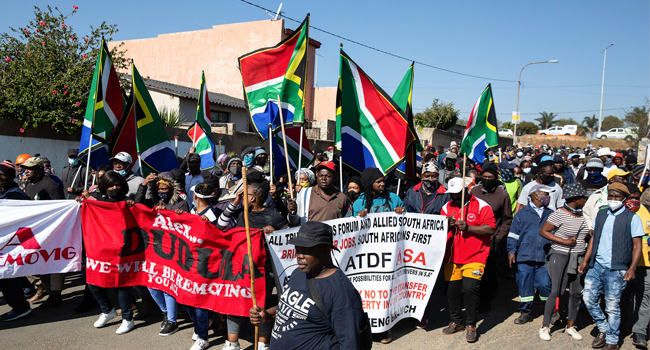
In recent months, South Africa has intensified operations against undocumented migrants, leading to arrests, detention, and deportations, including many Basotho. The images are painful: men and women bundled into trucks, families separated, workers treated as disposable, and a nation that once depended on their labour now declaring them unwanted.
For many Basotho, the humiliation cuts deeper than immigration enforcement. It raises an uncomfortable question: How did the descendants of people who helped build South Africa become strangers in the land their forefathers helped enrich?
A kingdom that once fed others
At the dawn of the twentieth century, Basotho were not known primarily as migrant labourers. Lesotho was a productive agricultural society. The fertile valleys and mountain foothills supplied grain, wool, and livestock to surrounding regions, including the growing towns and mining settlements of South Africa.
The Basotho economy was not perfect, but it was rooted in land, family production, and local markets. A people who can feed themselves possess a degree of freedom that no government can easily take away.
That freedom became the problem.
The great theft
The history of Lesotho cannot be understood without confronting the loss of land. During the nineteenth century, vast territories historically occupied and cultivated by Basotho communities were absorbed through wars, treaties, colonial manoeuvres, and settler expansion.
The alliance of imperial interests, British administrators, and Boer settlers gradually compressed the Basotho nation into a much smaller territory than that over which King Moshoeshoe I had once exercised authority.
The result was catastrophic:
- Less arable land
- Growing population pressure
- Declining agricultural productivity
- Increasing rural poverty
A country that had once exported food was pushed toward dependence.
Turning a nation into a labour reserve
Then came diamonds. Then came gold.
The discovery of mineral wealth in Kimberley and later on the Witwatersrand transformed the political economy of Southern Africa. The mines required an enormous supply of cheap labour. Colonial governments and mining capital needed workers who would accept low wages because their families remained in rural areas.
Lesotho became one of the region’s great labour reservoirs.
Young men who might have farmed, herded livestock, built local enterprises, or developed their own communities were drawn, and often economically compelled through colonial taxation into migrant labour.
This was not simply an individual choice. It was a structural design.
Taxes had to be paid in cash. Land was insufficient. Cash employment opportunities were concentrated in South Africa. The system hollowed out the very resource a nation possesses when land and capital are scarce: its people.
For generations, Basotho men descended into the mines.
They built shafts, railways, compounds, roads, and cities. They extracted the gold that financed banks, industries, suburbs, and fortunes. Many returned with damaged lungs, broken bodies, and shortened lives. Others never returned at all.
The hidden subsidy
South Africa’s mining economy benefited from a hidden subsidy: neighbouring countries bore much of the social cost of reproducing labour.
Basotho families raised children, cared for the elderly, buried the dead, and sustained rural communities, while the mines purchased labour power without carrying the full cost of maintaining the workers’ households.
In effect, Lesotho helped subsidise South Africa’s industrial rise.
When the mines declined
As mining employment contracted in the late twentieth and early twenty-first centuries, the old migrant-labour system began to unravel.
But the damage had already been done.
Lesotho had become deeply dependent on remittances. Local productive capacity had been weakened. Generations had been socialised into a regional labour market rather than a diversified domestic economy.
What happens when a country is structured to export workers, and the demand for those workers declines?
You get unemployment, poverty, and desperation.
The cruel irony of deportation
Today, many Basotho seek work in South Africa through formal and informal channels. Some lack documentation. South Africa, like any sovereign state, has the legal right to regulate immigration.
But legality is not the only question.
History is also a question.
There is a profound irony in watching the grandchildren of migrant miners being deported from the very country whose wealth was built, in part, by their grandfathers’ labour.
The issue is not that South Africa should abandon border controls. The issue is that public debate often treats migrants as though they appeared out of nowhere, detached from the historical system that created regional labour dependence in the first place.
The architects of poverty
Countries rarely fail by accident.
They fail when political and economic systems systematically remove the foundations of self-reliance.
Take away land.
Disrupt local production.
Extract labour.
Concentrate wealth elsewhere.
Create dependence.
Then blame the dependent for seeking survival.
That is how poverty is manufactured.
A different future
The tragedy of Lesotho and South Africa is that their histories are inseparable. One supplied labour; the other accumulated capital. One absorbed social costs; the other captured much of the economic gain. Yet both now face unemployment, inequality, and social tension.
The answer cannot be endless deportations, nor can it be open denial of state sovereignty.
The answer lies in something harder:
- Rebuilding productive economies.
- Investing in agriculture, manufacturing, and regional value chains.
- Creating legal pathways for labour mobility.
- Recognising the shared history of Southern Africa.
- Restoring dignity to those whose work built the region.
How did we get here?
We got here through conquest, dispossession, empire, mineral capitalism, migrant labour, and political choices made over more than a century.
And unless we are honest about that history, we will continue treating the symptoms while preserving the architecture that created the poverty in the first place.
The Mosotho migrant standing in a deportation queue is not merely an immigration statistic.
He is the final chapter of a much longer story.
A story Southern Africa has yet to fully confront.
Summary
- The alliance of imperial interests, British administrators, and Boer settlers gradually compressed the Basotho nation into a much smaller territory than that over which King Moshoeshoe I had once exercised authority.
- The discovery of mineral wealth in Kimberley and later on the Witwatersrand transformed the political economy of Southern Africa.
- Basotho families raised children, cared for the elderly, buried the dead, and sustained rural communities, while the mines purchased labour power without carrying the full cost of maintaining the workers’ households.

Welcome to Newsday Media – Your Trusted Source for News and Insights in Lesotho!
At Newsday Media, we are passionate about delivering accurate, timely, and engaging news and multimedia content to our diverse audience. Founded with the vision of revolutionizing the media landscape in Lesotho, we have grown into a leading hybrid media company that blends traditional journalism with innovative digital platforms.
Our mission is simple: to inform, inspire, and empower our readers by providing comprehensive coverage of local and global events, current affairs, and cultural happenings. Whether you’re looking for breaking news, in-depth analysis, or captivating storytelling, Newsday Media is your go-to destination for all things news-related.
With a dedicated team of journalists, editors, and multimedia experts, we are committed to upholding the highest standards of journalistic integrity and professionalism. We pride ourselves on delivering content that not only informs but also sparks conversation, fosters understanding, and drives positive change in our society.
From our flagship newspaper to our dynamic digital platforms, we offer a wide range of multimedia content to cater to the diverse interests and preferences of our audience. Whether you prefer to stay informed through print, online articles, videos, or podcasts, Newsday Media has something for everyone.
We believe in the power of storytelling to connect people, bridge divides, and inspire action. That’s why we’re dedicated to providing a platform for voices from all walks of life, championing diversity, inclusion, and authenticity in everything we do.
Thank you for visiting Newsday Media. We invite you to explore our website, engage with our content, and join us on our journey to inform, inspire, and empower our community. Together, let’s shape the future of media in Lesotho.