
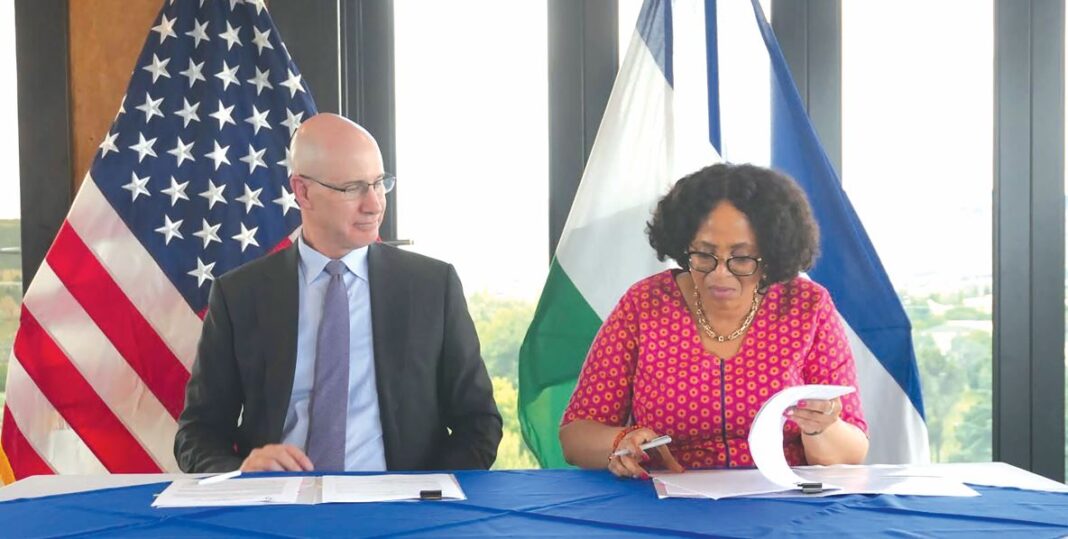
A broad coalition of civil society organisations (CSOs) has expressed deep concern over a five-year bilateral health cooperation Memorandum of Understanding (MOU) signed between the Government of Lesotho and the United States on December 10, 2025.
The agreement, valued at $364 million (approximately M6.2 billion), includes up to $232 million from the US and a $132 million commitment from Lesotho.
It aims to support HIV/AIDS response efforts, strengthen the health workforce, improve data systems, enhance disease surveillance, and promote innovations such as internet connectivity for clinics and advanced medical logistics.
The partnership builds on nearly two decades of US assistance through PEPFAR and seeks to advance Lesotho’s progress toward greater national ownership of its health system.
Lesotho has achieved notable success against HIV/AIDS, surpassing the global 95-95-95 targets.
However, in a press statement issued this week, the coalition said a stakeholder meeting held in Maseru on March 12, 2026, exposed deep unease among CSOs and media representatives over issues of sovereignty, transparency, consultation and constitutional compliance.
The civil society groups stated that they are “seriously concerned” about the MOU. They argued that its language and structure appear “to place Lesotho in a subordinate position and risk undermining the dignity and sovereignty of the country.”
“Participants emphasised that Lesotho is a sovereign and independent nation with a proud national identity and history of self-determination. Any international partnership must therefore be grounded in mutual respect, transparency, and equality between partners.”
The groups raised alarm over the lack of meaningful consultation with civil society, development partners, and other national stakeholders before the agreement was signed.
They also criticised the absence of full public disclosure, particularly Annexes 4 and 5, which reportedly deal with data sharing and biological specimen sharing.
“Equally concerning is the absence of critical documentation, such as Annexes 4 and 5, which have not been made publicly available. Stakeholders stressed that agreements with national governance implications must be transparent and accessible to citizens. Basotho taxpayers have a right to know the full terms and conditions of agreements entered into on their behalf.”
A key concern is the reported 25-year commitment to data and specimen sharing, which participants described as too long-term to be decided solely by an administration with a five-year term.
They warned of potential risks to data privacy, national security, and Lesotho’s legislative framework, including constitutional privacy rights.
They questioned whether a significant portion of “technical assistance” funding would truly strengthen local systems or primarily benefit foreign institutions.
The CSOs pointed to the Tenth Amendment to the Constitution of Lesotho, specifically provisions requiring that international agreements be tabled in and approved by Parliament, commonly referenced in relation to Section 153A.
They noted that the executive may sign agreements for expediency, but such agreements should not take full effect without parliamentary approval and an explanatory memorandum. Failure to follow this process, they argued, could render the agreement inconsistent with the Constitution.
While acknowledging potential benefits, such as financial support for health programmes, laboratory infrastructure, and technical expertise, the groups stressed that these must not come at the expense of sovereignty, constitutional order, or democratic governance.
The statement called for urgent actions, including immediate public disclosure of the full MOU and all annexes, formal tabling of the agreement in parliament for debate and approval, a comprehensive legal review of its compatibility with the constitution and national laws, and meaningful engagement with civil society.
The CSOs warned that if the government, through the Ministers of Finance and Health, fails to address these demands, they would maintain their position that undisclosed elements may be detrimental to the Basotho nation and reject them outright.
The statement was issued with the support of 19 organisations, including the Lesotho Council of Non-Governmental Organisations (LCN), Lesotho Network of AIDS Service Organisations, Transformation Resource Center, and others.
It concluded by affirming civil society’s commitment to constructive engagement while insisting that all partnerships must respect Lesotho’s Constitution, sovereignty, and democratic institutions.
The MOU is scheduled for implementation starting in April this year.
The controversy has spilled into parliament, exposing sharp divisions among lawmakers.
Member of Parliament (MP) Paul Masiu has sought to introduce a motion to reverse a previous decision halting the MoU, arguing that maintaining the suspension could have “serious adverse implications for the country.”
However, another MP, Remaketse Sehlabaka, leader of the Mpulule Political Summit, insisted yesterday in a press release that parliament has already taken a decisive stance.
“It is crucial that as a Member of Parliament and a member of the Social Cluster Portfolio Committee, I make it known to the media houses and the public at large that the Parliament of Lesotho has accepted and adopted the recommendation of the Social Cluster Portfolio Committee to ANNUL the recent G2G MoU between the Kingdom of Lesotho and the USA in the Committees Report pertaining to the MoH Budget allocation for 2026/2027.”
Sehlabaka argued that the decision effectively nullifies the agreement and accused the executive of attempting to push it back through Parliament using its majority.
He said: “However, the Minister of Health -and the whole cabinet- wishes to bring the matter back into Parliament for reconsideration. All efforts are made to have a motion to debate the matter to overturn the Parliament decision through a majority vote, which they enjoy. PREPOSTEROUS!”
While acknowledging the life-saving role of international partnerships in the fight against HIV/AIDS, Sehlabaka warned against blind acceptance.
“Evidence presented in Parliament raises serious concerns that the current structure of this agreement may unintentionally, and maybe intentionally so, create long-term dependency, weaken national systems, and expose the country to significant risk should external funding change or decline,” he said.
He called for full public disclosure of the agreement, an independent “Health Sovereignty Audit,” a clear transition plan toward domestic health financing, and stronger integration of donor-funded programmes into national systems.
Summary
- A broad coalition of civil society organisations (CSOs) has expressed deep concern over a five-year bilateral health cooperation Memorandum of Understanding (MOU) signed between the Government of Lesotho and the United States on December 10, 2025.
- The statement called for urgent actions, including immediate public disclosure of the full MOU and all annexes, formal tabling of the agreement in parliament for debate and approval, a comprehensive legal review of its compatibility with the constitution and national laws, and meaningful engagement with civil society.
- The CSOs warned that if the government, through the Ministers of Finance and Health, fails to address these demands, they would maintain their position that undisclosed elements may be detrimental to the Basotho nation and reject them outright.
Ntsoaki Motaung is an award-winning health journalist from Lesotho, specializing in community health stories with a focus on sexual and reproductive health and rights, as well as HIV. She has contributed to platforms like “Be in the KNOW,” highlighting issues such as the exclusion of people with disabilities from HIV prevention efforts in Lesotho.
In addition to her journalism, Ntsoaki serves as the Country Coordinator for the Regional Media Action Plan Support Network (REMAPSEN). She is also a 2023 CPHIA Journalism Fellow.