
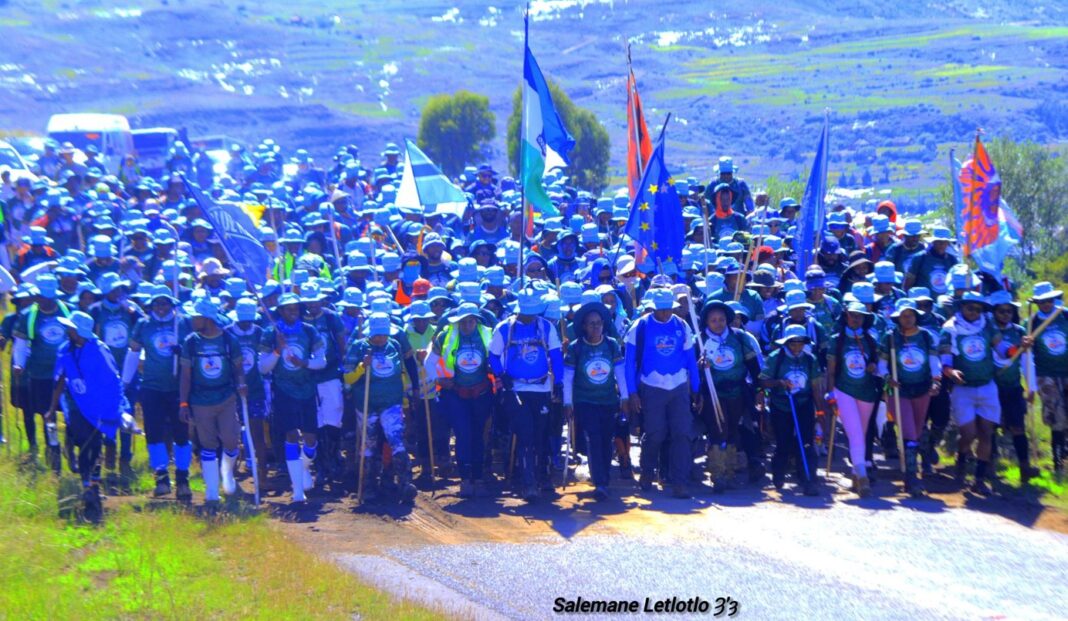
The annual walk tracing the steps of Morena Moshoeshoe is a blend of adventure, challenge and reflection. Trekkers walk through rugged mountains, cross swollen rivers and traverse vast plateaus during the 116km journey, which spans three days.
The Moshoeshoe Walk, organised by T-Connexion Marketing and Tours, started in 2007 and has since grown in leaps and bounds.
The walk is launched by King Letsie III at Menkhoaneng in the Leribe district.
Day one, which covers 31km, concludes at Thaba-Phatšoa. The following day, the toughest leg of the journey begins in the early hours of the morning at 3:30am, covering a 54km distance to the next destination in Malimong. From there, the following morning, the walkers march to Thaba-Bosiu, where the walk ends.
The walk commemorates Morena Moshoeshoe, although he and his subjects reportedly took nine days to reach Thaba-Bosiu while fleeing from enemies and seeking refuge.
Morena Moshoeshoe, the founder of the Basotho nation, is said to have set out from Menkhoaneng in 1824 to seek refuge at Thaba-Bosiu, particularly during the Lifaqane wars.
According to history, there was no unified kingdom when he was born, as Basotho lived in many separate clans. Morena Moshoeshoe united them into one nation. He is celebrated for his leadership, diplomacy, love of peace and many other admirable traits.
The hikers traverse Basotho communities, walking long distances sometimes under unfriendly weather conditions. They climb mountains and cross rivers and streams to reach their next destination. This year was no different.
On the second day of the walk this year, hikers woke up to rain, which continued throughout the day, forcing the organisers to call off the trip after lunch at ’Makhoroana. The rivers were full and posed a danger to the hikers.
One of the hikers, the Minister of Information, Communications, Science, Technology and Innovation, Nthati Moorosi, said hikers do not fear the rain as they usually come prepared with full rain gear. However, she noted that what they fear most are raging rivers.
She promised to raise the matter with the government and advocate for the construction of more footbridges. She also urged Thabo Maretlane to support the proposal to strengthen the case.
This year’s Moshoeshoe Walk was graced by the presence of several dignitaries, including Queen ’Masenate Mohato Seeiso, Moorosi, Member of Parliament and organiser of the walk Thabo Maretlane, Ambassador of the People’s Republic of China Yang Xiaokun, and Lithuanian Ambassador Rasa Jankauskaitė, among others.
Countries represented included Lesotho, Botswana, Eswatini, Malawi, South Africa, the People’s Republic of China, the United States, Austria, France, Sweden and Wales.
During the journey, this writer walked through many different landscapes. We climbed steep hills that made my legs ache, pushing my body to its limits. In some places, the path was rocky and required careful footing to avoid stumbling.
We crossed riverbeds where the water rushed by, an exciting yet frightening experience for some. The trek was both physically and emotionally demanding, and we would arrive at our destinations tired yet proud of the effort and resilience displayed throughout the journey.
During the walk, one gets to truly appreciate the beauty of Lesotho.
However, weather conditions can dramatically influence the journey, particularly when it rains. At one point, I was completely soaked and had to discontinue my walk to seek shelter.
When hiking, it is important to be prepared for all kinds of weather. Rain can come suddenly and make the journey difficult. It is always advisable to pack a good raincoat and waterproof gear so that you can continue enjoying the hike regardless of the weather.
The Moshoeshoe Walk also provides an opportunity to support local communities along the route. Many people sell a variety of items including fruits, maize, dried peaches, apples, lipabi, motoho and snacks for hikers. In this way, the walk helps boost the local economy.
For the 20th edition, Maretlane said organisers plan to collect 20,000 pairs of school shoes to be distributed to schools near the walking route.
Communities along the route have also benefited from various initiatives over the years, including donations of educational materials, support for building churches and classrooms, as well as tree-planting projects.
However, there are some concerns. Corporates sometimes reserve blocks of classrooms for their workers, effectively competing with individual hikers for accommodation. As a result, some participants struggled to find places to sleep because classrooms were already full. In some cases, there were no blankets or mattresses available.
Morena Moshoeshoe was known for sharing. Perhaps organisers could encourage communities to prepare for larger numbers of hikers so that everyone can find accommodation.
Homestays offer a particularly meaningful option, especially for international hikers who want to experience the lives of Basotho people.
I personally enjoyed my homestays in places such as ’Mate, Ha-Selebalo and Thaba-Phatšoa, where we were warmly welcomed and well taken care of by the families who hosted us.
Organisers could also consider formally registering homestay providers so that hikers know their accommodation is safe and accountable. This would also strengthen the tourism experience while benefiting local families.
Local communities are always supportive of hikers during the trek, guiding them and cheering them on along the way. Hikers are often greeted with joy and cheerful ululations. Children run alongside them, waving and smiling, while shepherds also show their support through friendly gestures.
Tourists often marvel at how peaceful and welcoming Basotho are. The warmth of the communities makes the journey even more memorable, creating a sense of connection between hikers and locals.
It is a powerful reminder of the spirit of unity and peace that Morena Moshoeshoe, the founder of the Basotho nation, fought for and aspired to.
This year, hikers were also encouraged to walk in solidarity with those affected by the war in the Middle East and to promote diplomacy, tolerance and peace.
During the closing ceremony at Thaba-Bosiu, the King praised the resilience of the hikers and commended their dedication to completing the demanding journey. Fortunately, there were no casualties reported.
Summary
- The following day, the toughest leg of the journey begins in the early hours of the morning at 3.
- Morena Moshoeshoe, the founder of the Basotho nation, is said to have set out from Menkhoaneng in 1824 to seek refuge at Thaba-Bosiu, particularly during the Lifaqane wars.
- On the second day of the walk this year, hikers woke up to rain, which continued throughout the day, forcing the organisers to call off the trip after lunch at ‘Makhoroana.

Thoboloko Ntšonyane is a dedicated journalist who has contributed to various publications. He focuses on parliament, climate change, human rights, sexual and reproductive health rights (SRHR), health, business and court reports. His work inspires change, triggers dialogue and also promote transparency in a society.