

The Lesotho Highlands Development Authority (LHDA) has reaffirmed its resolve to ensure that water from the Lesotho Highlands Water Project (LHWP) increasingly benefits Basotho communities, stressing that inclusive access to water within Lesotho is now a strategic priority rather than a secondary consideration.
This commitment is firmly anchored in the Authority’s 10-year strategic plan, which was officially launched in March 2024. The strategy identifies inclusive access to water and electricity as its first and most important strategic goal, signalling a deliberate policy shift to ensure that, while Lesotho continues to honour its international obligations to supply water to South Africa, tangible water benefits are also realised within the country, particularly by communities directly affected by the project.
Against this backdrop, LHDA is steadily advancing Phase II of the LHWP, which centres on the construction of the Polihali Dam and the 38-kilometre Polihali–Katse transfer tunnel. The transfer tunnel is expected to be substantially complete by 2028, while the Polihali Dam is projected to reach the same milestone a year later, in 2029. By the end of September 2025, construction progress stood at 37 percent for the dam and approximately 46 percent for the tunnel.
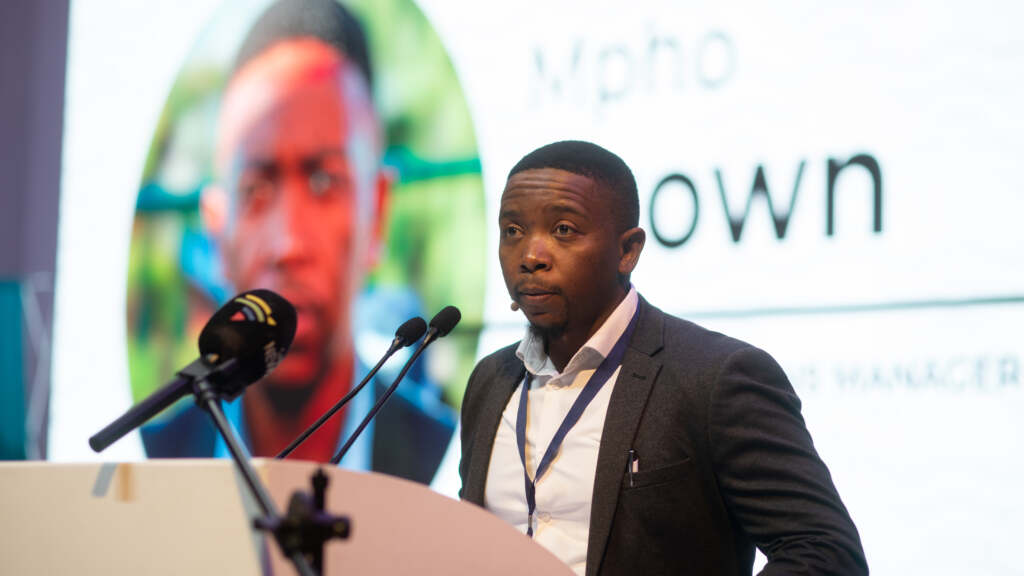
LHDA Public Relations Manager, Mpho Brown, told Creamer Media’s Engineering News that Phase II will unlock multiple long-term benefits for both Lesotho and South Africa. These include increased water transfers to South Africa, expanded hydropower generation for Lesotho through higher flows at the existing Muela Hydropower Station, and the planned Oxbow Hydropower Scheme, which is currently at the detailed design and engineering stage.
Brown noted that these developments will significantly reduce Lesotho’s dependence on imported electricity while strengthening domestic energy security.
He further explained that water stored in the 5 053-hectare Polihali reservoir will be transferred by gravity through the tunnel into the Katse reservoir. From there, the water will pass through existing infrastructure, including tunnels and the Muela Hydropower Station, before ultimately reaching South Africa’s Gauteng region.
At the same time, the project allows for an incremental increase in water availability for domestic, agricultural and industrial use within Lesotho, rising from the current 780 million cubic metres per year to a maximum of 1 270 million cubic metres annually.
Significant construction milestones had already been achieved at the Polihali Dam site during the third quarter of the 2025/26 financial year. Excavation of the main dam abutments, saddle dam, intake tower and plinth had been completed, while spillway excavation continued to advance steadily.
Rockfill placement at the main dam was proceeding at an average rate of nearly 18 900 cubic metres per day, equivalent to about seven and a half Olympic-size swimming pools of material daily. By the end of November, more than 4.88 million cubic metres of rock had been placed in the main dam, while the saddle dam had recorded over 100 700 cubic metres of rockfill.
Internal plinth consolidation grouting on both the main and saddle dams has been completed, enabling the commencement of curb extrusion and upstream rockfill placement. These works required the excavation of approximately 2.5 million cubic metres of hard rock. Once complete, the spillway approach, chute tunnel and permanent roadway bridge over the dam crest will require the pouring of about 95,300 cubic metres of concrete.
Progress has also been recorded on the dam’s bottom outlet tunnel, which measures approximately 9.25 metres high, six metres wide and 500 metres long. Excavation of both the top and bottom headings is nearing completion, with the top heading advancing at an average rate of 2.7 metres per day using the drill-and-blast method.
Construction of the Polihali–Katse transfer tunnel is similarly progressing. Tunnel boring machines (TBMs) are being used to excavate the main tunnel, while drill-and-blast techniques are applied to access adits and gate shafts.
At the Katse end, excavation of the TBM access remembers was completed in early October, allowing the TBM to advance more than 170 metres into the main tunnel.
At the Polihali end, assembly of the second TBM has been completed, with its entry into the tunnel expected to precede a formal launch early this year, marking the start of full-scale excavation from that side.
Looking ahead, Brown said Phase II will not only deploy modern construction technologies but will also place strong emphasis on environmental compliance, including properly designed wastewater and sewage treatment systems.
The project is also contributing to livelihoods through job creation, with Phase II having generated employment for 3 791 unskilled workers, 12 226 skilled and semi-skilled workers, and 68 young professionals to date.
He stressed that these socio-economic gains align directly with the LHDA’s new strategic direction. “A key tenet of the ten-year strategy, and the first of the five strategic goals, is inclusive access to water and electricity,” Brown said.
“The word ‘inclusive’ reflects a deliberate effort by the LHDA to ensure that, without undermining the project’s obligation to deliver water to South Africa, the LHWP also delivers water within the borders of Lesotho, especially to communities most affected by the project.”
Summary
- The strategy identifies inclusive access to water and electricity as its first and most important strategic goal, signalling a deliberate policy shift to ensure that, while Lesotho continues to honour its international obligations to supply water to South Africa, tangible water benefits are also realised within the country, particularly by communities directly affected by the project.
- The transfer tunnel is expected to be substantially complete by 2028, while the Polihali Dam is projected to reach the same milestone a year later, in 2029.
- At the same time, the project allows for an incremental increase in water availability for domestic, agricultural and industrial use within Lesotho, rising from the current 780 million cubic metres per year to a maximum of 1 270 million cubic metres annually.

Authored by our expert team of writers and editors, with thorough research.