

Lesotho’s lobbying campaign for the renewal of the Africa Growth and Opportunity Act (AGOA) has made visible inroads within the United States (US) Congress, but a glaring and potentially costly gap has emerged: the apparent failure by authorities to directly engage the one office that ultimately determines the fate of the legislation, the US President.
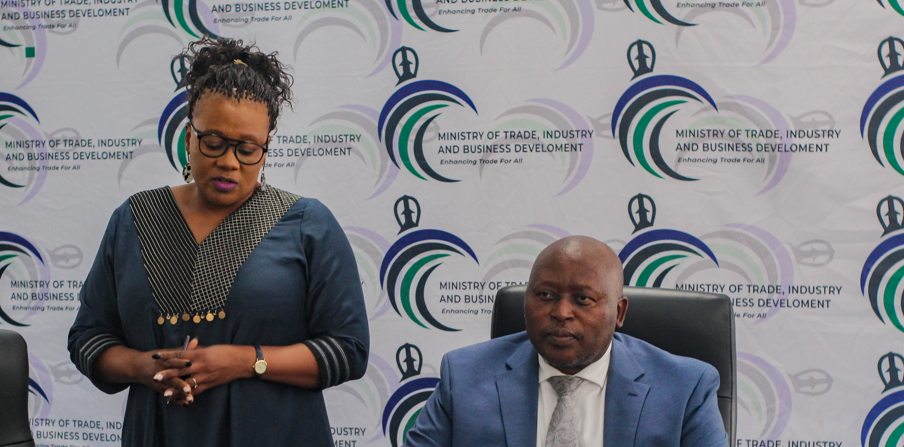
While Lesotho government officials led by the Trade, Industry and Business Development Minister Mokhethi Shelile, have combed Washington meeting lawmakers and senior officials to drum up support for the AGOA Extension Act, the campaign appears to have fallen short of the final and most decisive stage of the US legislative process.
The AGOA Extension Act (H.R. 6500) proposes extending trade preferences through December 31, 2028, granting continued duty-free access to the US market for most exports from eligible sub-Saharan African countries. Currently, 32 countries qualify for AGOA benefits.
The bill also seeks to extend customs user fees and merchandise processing fees through December 31, 2031, ensuring continuity in the administration of US trade imports.
Once passed by both chambers of US Congress, the bill must still be signed into law by the US President, a step that Lesotho’s lobbying efforts have so far failed to meaningfully address.
This omission is particularly striking given that the presidency is currently held by Donald Trump, a leader widely regarded as unpredictable and transactional in his approach to trade policy.
But to date there has been no official report on either Prime Minister Samuel Matekane or Shelile having had any direct engagement with President Trump aimed at securing his support for the AGOA renewal.
Shelile recently travelled to the United States as part of a broader African push to lobby for AGOA’s extension, holding meetings with members of the US Congress and other government authorities.
The objective was to persuade lawmakers to support the so-called AGOA Extension Act, which seeks to prolong the trade preference scheme that underpins Lesotho’s textile and apparel exports to the US market.
Those efforts would appear to have yielded some success as only last week, the US House of Representatives approved a three-year extension of AGOA by an overwhelming 339–54 vote, renewing optimism across Africa that the programme, which has anchored US–Africa trade relations for more than two decades, will not be allowed to lapse.
However, the bill must still pass through the US Senate and then be presented to the President for assent. It is at this final juncture that the weakness of Lesotho’s lobbying strategy becomes most apparent. Without explicit presidential buy-in, all prior gains remain vulnerable.
In the US system, the President plays a constitutionally entrenched gate-keeping role in the law-making process. Once a bill has passed both the House of Representatives and the Senate, it is transmitted to the President, who may sign it into law, allow it to become law without a signature, or veto it outright.
A presidential veto can only be overturned by a two-thirds majority in both chambers of Congress, a threshold that is notoriously difficult to achieve, even for broadly supported legislation.
This means that regardless of how favourable the votes in Congress may be, the AGOA Extension Act can still be derailed at the final step. This would spell bad news for Lesotho, whose economy is deeply exposed to the outcome.
Upon his return to Maseru this week, Shelile acknowledged the uncertainty surrounding the President’s role, conceding that there are no guarantees the bill will ultimately be signed into law.
“We have no control on whether President Trump will not oppose the bill, however we are encouraged by the fact that he was the one who gave the go ahead to the chairperson of the Ways and Means Committee of the House of Representatives to draft the bill,” Shelile said.
“President Trump has the final say on whether to signed off the bill or oppose it,” he added.
While the Minister’s remarks underline an awareness of presidential authority, they also indirectly highlight the absence of a direct strategy to influence President Trump.
Shelile explained that during their stay in the US, his delegation worked alongside other major AGOA beneficiary countries namely Madagascar, Mauritius and Tanzania, under the Textile Five (T5) grouping to lobby more than 30 US lawmakers.
“We are expecting the US Senate to vote on AGOA before the end of this month, bearing no unforeseen circumstances, where if it is passed, will go before President who will consider it to become a law,” Shelile said.
He said the calibre of lawmakers engaged, particularly those serving on the Senate Finance Committee, gave him confidence that the bill would clear the upper chamber.
“We are optimistic and expect it to pass before the US Senate given the amount of lobbying meetings with the caliber of people that we met. They include legislators from the relevant Finance Committee of the Senate among others.”
Lesotho, can ill afford to lose AGOA, whose renewal would be an economic lifeline of sorts. Lesotho’s textile and apparel industry has for years been anchored on duty-free access to the US market. The prolonged uncertainty surrounding AGOA’s renewal has already taken a heavy toll.
Lingering uncertainty over factory job cuts
Since questions over AGOA’s expiry emerged ahead of mid-2025, several textile factories exporting to the US have either closed or significantly downsized operations. Investors have adopted a wait-and-see approach, reluctant to commit capital without clarity on future market access.
At the height of AGOA, Lesotho’s US-exporting factories were estimated to employ up to 40 000 workers, the majority of them women. That number has now fallen sharply to about 12 000, with the social and economic consequences reverberating through households and communities.
Bearing these in mind, the absence of a clear strategy to engage the US President is difficult to ignore. Should the bill reach the Oval Office without sustained diplomatic pressure or assurances, Lesotho risks watching years of congressional lobbying unravel at the stroke of a pen.
AGOA challenge a blessing in disguise for market diversification
Shelile has, however, sought to frame the AGOA uncertainty as an opportunity for diversification. He noted that while employment in US-focused factories has declined, new markets have begun to open elsewhere.
Over the past two years, the Minister has overseen the reopening of at least 13 factories now exporting garments to the Southern African Customs Union (SACU) market. As a result, Lesotho’s export profile has shifted, with exports to the US declining from significantly.
Meanwhile, despite not being in a position to divulge further details, the US Embassy in Maseru informed this publication that the prospective Act under review could significantly differ from the past Act to reflect the US’s current direction trade of trade.
“The Trump Administration is supportive of a short-term extension of AGOA in order to modernise and align the program with the President’s America First Trade Policy,” the Embassy said this week.
Summary
- While Lesotho government officials led by the Trade, Industry and Business Development Minister Mokhethi Shelile, have combed Washington meeting lawmakers and senior officials to drum up support for the AGOA Extension Act, the campaign appears to have fallen short of the final and most decisive stage of the US legislative process.
- Once a bill has passed both the House of Representatives and the Senate, it is transmitted to the President, who may sign it into law, allow it to become law without a signature, or veto it outright.
- “We have no control on whether President Trump will not oppose the bill, however we are encouraged by the fact that he was the one who gave the go ahead to the chairperson of the Ways and Means Committee of the House of Representatives to draft the bill,” Shelile said.