
… As China cancels two interest-free loans
Following the Forum on China-Africa Cooperation (FOCAC) summit held in September 2024 in Beijing, where China announced the cancellation of interest-free loans to developing countries, the People’s Republic of China has written off Lesotho’s RMB 89.976 million, equivalent to about M214.5 million.
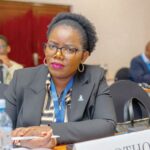
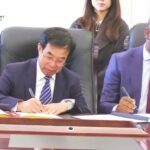
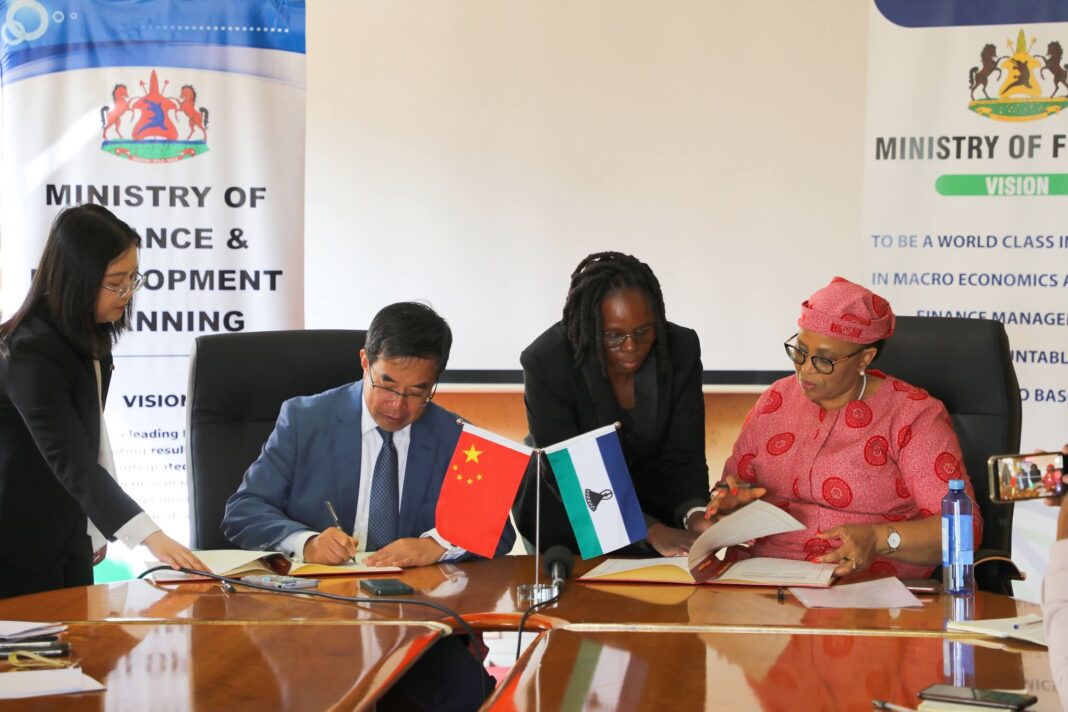
The announcement came this week during the signing of the Waiver of Two Interest-Free Loans between the government of Lesotho and China, a ceremony attended by the Minister of Finance and Development Planning, Dr Retšelisitsoe Matlanyane, and the Chinese Ambassador, Yang Xiaokun.
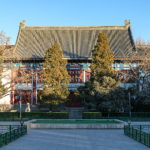
Lesotho had taken two interest-free loans: one in 2011 for the Maintenance and Renovation Project of the Manthabiseng Convention Centre and another in 2012 for the JUNCAO (mushroom) Cultivation and Technical Cooperation Project. Both loans were due for repayment by the end of December 2024, but the government had not yet settled them.
Speaking at the event, Ambassador Yang highlighted that the signing reflects China’s longstanding principles in its cooperation with Africa. “China has always respected the sovereignty and independent choice of African countries and never interferes in their internal affairs. Our cooperation is guided by sincerity and good faith, with the sole purpose of supporting Africa’s development. At the same time, China is committed to ensuring that our cooperation responds to the real needs and priorities of African partners, with particular emphasis on strengthening local capacity for sustainable growth,” he said.
Dr Matlanyane described the signing as both timely and significant, reflecting the accomplishments of the long-standing friendship between the two nations.
She welcomed the gesture, noting that it provides important relief to Lesotho’s public debt portfolio and contributes positively to debt management and fiscal consolidation efforts. She emphasised that the government remains committed to ensuring that public debt is sustainable, transparent, and aligned with the country’s development priorities.
“We regard this loan waiver not merely as a financial transaction, but as a gesture of partnership and trust. It underscores China’s continued commitment to supporting Lesotho’s development goals and reinforces the principles of South-South cooperation,” Dr Matlanyane said. She further assured that the relief will be well-managed, demonstrating Lesotho’s commitment to prudent fiscal management.
Lesotho’s reliance on external debt, particularly from China, has been a recurring concern.
In April last year, Newsday reported that Lesotho’s debt continued to climb despite the country running fiscal surpluses, and indicated that the nation was more indebted to China than to any other creditor, citing the World Bank’s economic analysis.
The publication noted that according to the Lesotho Economic Update, titled “Transforming Fiscal Policy into an Engine of Inclusive Growth,” the public debt-to-GDP ratio rose from 55.1 percent in the 2023/2024 financial year to an estimated 59 percent in 2024/2025, as the government kept borrowing both locally and abroad.
Although most of the external debt was concessional, the World Bank warned it was “still vulnerable to exchange-rate risk.” External debt made up about 80 percent of the country’s total debt, and one creditor, in particular, stood out: China. “China is Lesotho’s primary non-Paris Club bilateral creditor and accounts for 70 percent of the country’s bilateral debt,” the report noted, underscoring the kingdom’s growing reliance on Beijing’s purse strings.
On 18 February 2026, while tabling the budget speech, Dr. Matlanyane announced a new fiscal rule introducing a limit on public debt at 60 percent of gross domestic product (GDP). The move was welcomed by some, who viewed it as a government-imposed constraint to make debt servicing easier. She stated that Lesotho’s total government debt stock as of the end of January in the 2025/2026 financial year amounted to M22.7 billion (50 percent of GDP), a decline of M667.2 million from M23.4 billion at the end of the 2024/2025 financial year.
This reflected a three percent reduction in debt stock, with the debt-to-GDP ratio falling from 54.3 percent to 50 percent.
“The composition of public debt also shifted during the period, with the share of domestic and external debt moving from 15.4 and 84.6 percent to 16.9 and 83.1 percent respectively,” she said. The external debt portfolio remained mostly concessional, at a share of 88.4 percent, despite the country graduating from an IDA low-income to a lower-middle-income country, which presented the nation with harder, higher costs of borrowing from international financial markets.
“The country’s debt risk rating remains unchanged from the 2024/2025 fiscal year, at a moderate level of debt distress with limited space to absorb shocks,” she added.
The 2025/2026 annual borrowing plan report highlighted that the government had a financing gap of M7,528.2 million, which was to be covered through grants and debt.
“Historically, it has been proven that there is generally poor implementation of government-financed projects, usually leading to positions of surpluses from planned deficits,” the report read.
Meanwhile, during the budget presentation for the current 2026/2027 financial year, the Minister indicated that funds will only be disbursed for projects ready to be implemented.
Summary
- Following the Forum on China-Africa Cooperation (FOCAC) summit held in September 2024 in Beijing, where China announced the cancellation of interest-free loans to developing countries, the People’s Republic of China has written off Lesotho’s RMB 89.
- The announcement came this week during the signing of the Waiver of Two Interest-Free Loans between the government of Lesotho and China, a ceremony attended by the Minister of Finance and Development Planning, Dr Retšelisitsoe Matlanyane, and the Chinese Ambassador, Yang Xiaokun.
- At the same time, China is committed to ensuring that our cooperation responds to the real needs and priorities of African partners, with particular emphasis on strengthening local capacity for sustainable growth,” he said.
Thoboloko Ntšonyane is a dedicated journalist who has contributed to various publications. He reports on accountability, human rights, exposes corruption and wrong doing by those in power. He reports have exposed corruption, abuse of power, fraud, misconduct and negligence. He subscribes to evidence-based reporting. He reports on governance, parliament, courts, climate change, human rights, sexual and reproductive health rights (SRHR), health, business and agriculture. He gives a voice to the marginalised while also demanding accountability. His work inspires change, triggers dialogue and also promote transparency in a society.