
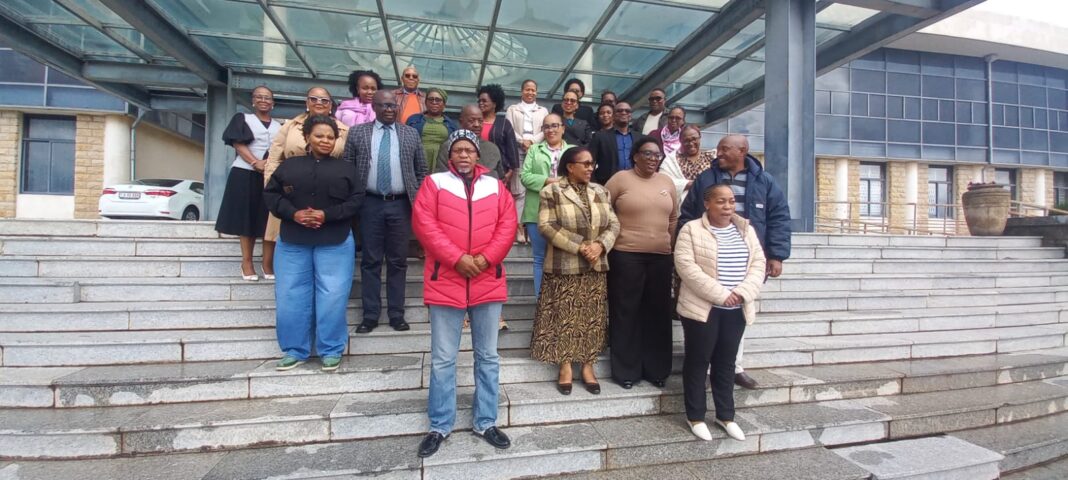
Members of Parliament from both houses have called for the alignment of Lesotho’s laws with Southern African Development Community (SADC) Model Laws to strengthen governance, protect rights and unlock socio-economic benefits.
The call was made during a two-day meeting convened by the SADC Parliamentary Forum (SADC-PF), which brought together legislators, civil society organisations, government officials and the Office of Parliamentary Counsel (OPC).
Participants agreed that harmonising national legislation with regional frameworks could improve cross-border movement and cooperation, particularly between Lesotho and South Africa.
The meeting discussed several SADC Model Laws, including those on HIV and AIDS, eradicating child marriage and protecting children already in marriage, gender-based violence, elections, and public financial management.
Parliamentary Counsel Advocate Nthabiseng Sekokotoana outlined the process of integrating Model Laws into Lesotho’s legislative framework.
She said the OPC is developing a digital platform to serve as a repository for legislation and emphasised that all proposed laws must be constitutionally sound, implementable and enforceable.
Sekokotoana clarified that while the OPC cannot alter the substance of Model Laws, it plays an advisory role on constitutional requirements, existing legal frameworks and legislative gaps.
“For Model Laws, they can serve as a structural backbone or guiding tool,” she said, calling for stronger collaboration through multi-stakeholder drafting committees.
She also urged the fast-tracking of an Act of Parliament to strengthen the domestication and implementation of international agreements.
Clare Musonda, SADC-PF Programme Manager for Model Laws, said the forum promotes regional integration, democracy, human rights and good governance.
Although SADC-PF does not have binding law-making powers, she said it advances its work through standing committees and plenary assemblies held at least twice a year.
Health sector stakeholders highlighted key gaps in legislation and service delivery.
Mampho Mafereka from the Ministry of Health cited findings from the Lesotho Demographic and Health Survey 2023/2024, showing that 18 percent of children are married before the age of 18, while 33 percent of women aged 15 to 49 experience intimate partner violence.
She noted that while laws such as the Sexual Offences Act of 2013 and the Penal Code address aspects of sexual violence, they fall short of the comprehensive protections envisioned under the SADC Model Law on Gender-Based Violence.
The data also shows that only 20 percent of women who experience violence report it to authorities, with fewer than 30 percent of rape survivors coming forward.
Blandina Motaung of the United Nations Population Fund (UNFPA), together with MP Itumeleng Rantšo, emphasised the need to prioritise village health workers (VHWs).
Rantšo argued that primary health care remains weak and urged the Ministry of Health to demonstrate commitment by reflecting such priorities in the national budget.
“I might be sitting here and being told that as a parliamentarian I pass the budget, but you come with the budget already with priorities,” she said.
Meanwhile, MP ‘Mope Khati, who is also a member of SADC-PF, reminded participants of the Regional Parliamentary Model Laws Oversight Committee (RPMLOC) benchmarking visit to Lesotho held from 8 to 9 October 2025.
He said the committee monitors progress on the domestication of Model Laws and regional policies.
Khati noted that Lesotho was selected to host the inaugural RPMLOC visit based on reports presented at the SADC-PF 56th and 57th Plenary Assemblies, which indicated notable progress in aligning national laws with regional standards.
He added that, with support from the SADC-PF Sexual and Reproductive Health Rights, Governance and Climate Action project, Parliament has undertaken capacity-building initiatives aimed at strengthening legislation in line with SADC Model Laws.
Summary
- She said the OPC is developing a digital platform to serve as a repository for legislation and emphasised that all proposed laws must be constitutionally sound, implementable and enforceable.
- She noted that while laws such as the Sexual Offences Act of 2013 and the Penal Code address aspects of sexual violence, they fall short of the comprehensive protections envisioned under the SADC Model Law on Gender-Based Violence.
- He added that, with support from the SADC-PF Sexual and Reproductive Health Rights, Governance and Climate Action project, Parliament has undertaken capacity-building initiatives aimed at strengthening legislation in line with SADC Model Laws.
Thoboloko Ntšonyane is a dedicated journalist who has contributed to various publications. He reports on accountability, human rights, exposes corruption and wrong doing by those in power. He reports have exposed corruption, abuse of power, fraud, misconduct and negligence. He subscribes to evidence-based reporting. He reports on governance, parliament, courts, climate change, human rights, sexual and reproductive health rights (SRHR), health, business and agriculture. He gives a voice to the marginalised while also demanding accountability. His work inspires change, triggers dialogue and also promote transparency in a society.