
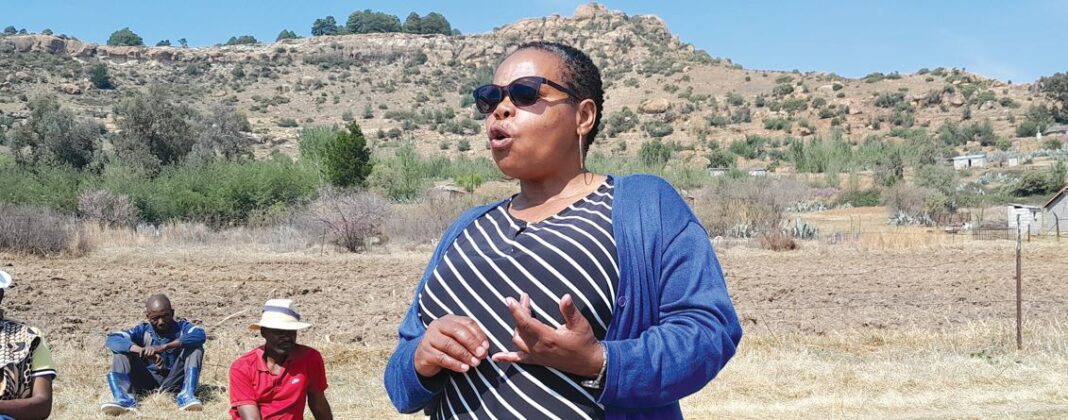
On a bright, hot day in Mokema, a small village on the outskirts of Maseru, scores of people gathered at the local clinic.
They had come together for a special event focused on gender-based violence (GBV), organised by Portia Benedict, a non-profit organisation seeking to create conversations around GBV and find ways to prevent it.
For many in the gathering, it was the first time they had heard such experiences of violence being shared publicly.
Sitting quietly among them was Limakatso (not her real name), a 26-year-old woman whose story of suffering and survival embodies both the pervasive crisis of GBV in Lesotho and the resilience of its survivors.
Her experience reflects the pain endured by many women in Lesotho, but also the extraordinary resilience required to survive years of abuse.
A childhood stolen
Limakatso’s life changed when she was still a child. She lost both her parents and went to live with her grandmother and two uncles.
Although her grandmother tried to care for her, Limakatso said she often felt alone and unprotected.
“I think the violence started when I was seven years old,” she said.
“Whenever I needed something for school, I would ask at home and my uncles would provide. But soon, they took advantage of that. I had to be violated before I got the money to go to school.”
She said one of her uncles sexually assaulted her by penetrating her with his fingers. As she grew older, she said, another uncle also began sexually abusing her, including raping her.
“It became normal to me,” she said.
The abuse continued for years, leaving Limakatso feeling isolated, frightened and depressed.
“It was very difficult for me because this whole thing took me into depression. I would not listen in class and was always thinking about what I had to go through at home, especially when we were told to bring something from home,” she said.
Even school, which should have provided a refuge from the abuse, became a source of anxiety.
“I was always worried about what I would have to go through if I asked for anything for school,” she said.
She became increasingly withdrawn and stopped enjoying life. Over time, Limakatso said, she lost hope that her circumstances could change.
The abuse finally ended in 2018, after she completed her school examinations.
By then, however, years of abuse had taken a heavy psychological toll. Limakatso was struggling with depression and found it difficult to concentrate while writing her Lesotho General Certificate of Secondary Education (LGCSE) examinations.
Despite everything she had endured, she completed them.
After finishing school, Limakatso moved in with an aunt who had learned about the abuse she had suffered at the hands of her uncles.
Her aunt warned her against having a boyfriend, but Limakatso said years of sexual abuse had profoundly affected her understanding of relationships and intimacy.
“I think it was too late. The abuse from my uncles was normal and I always had the urge of having sex. So, a boyfriend was the only way I would fulfil the urge. I continued with my boyfriend despite being told not to,” she recalled.
She soon became pregnant.
Limakatso left her aunt’s home and moved in with her boyfriend, hoping to build a happier life. Instead, she found herself trapped in another abusive relationship.
“He made me feel small because I told him about my past. He told me he was the only one who cared about me. He clouded my mind with that and I believed that he was the only person to take care of me,” she said.
As time passed, the situation deteriorated. Financial difficulties were accompanied by increasing violence.
“One morning, he beat me so badly that I could not move,” Limakatso said.
“He used to beat me so much that I would lie on the floor, unable to move. When people came, he would tell them not to get involved because I was just an orphan he took in when I even wanted to kill myself.”
Even when she became seriously ill, she said, her boyfriend showed little concern. At times, he would bring other women into the house and have sex with them in her presence while she lay there in pain.
Eventually, a neighbour became concerned and asked Limakatso’s boyfriend about her whereabouts.
“He said I was sick inside the house,” she recalled.
The neighbour found Limakatso and learned what had been happening. She obtained the contact details of Limakatso’s aunt and called her.
Her aunt came and took her home, helping her recover.
But the cycle of abuse was not yet over.
A brush with death
After some time, Limakatso returned to her boyfriend.
“After I got back to him, he threatened me. He said if I left again, he would kill me. He continued to abuse me,” she said.
Then came what she describes as the worst incident of her ordeal.
Following an argument over food, her boyfriend allegedly attempted to kill her.
“He hanged me on the roof and left,” she said.
Fortunately, a neighbour’s child saw her through a window and alerted their mother. People broke down the door and rescued her.
Limakatso reported the incident to the police, but said her boyfriend told officers that she had attempted to kill herself.
She said no action was taken.
A turning point
With nowhere else to go, Limakatso remained with him until she met another man. She eventually left the abusive relationship and tried to rebuild her life.
But another ordeal followed.
Not long after moving in with her new boyfriend, Limakatso was arrested for allegedly neglecting her child after leaving the child with the child’s father — the same man she said had previously abused her.
“He had told the police that he was the grandfather of the child and he got a call while at work that I had left the baby where he was staying. The police did not even investigate the matter further. They concluded that I had neglected the child,” she said.
While in police custody, Limakatso said she was severely beaten by police officers.
But one female officer listened to her story and intervened.
“One woman officer listened to my story. She promised to help me and later that day of the arrest I was told to go home and come back to the police station again the following day,” she said.
“I stayed at the police station the whole day until it was late and I was taken to sleep at the chief’s house. In the morning, I was called to the police station and sent to a safe house in Maseru.”
At the safe house, Limakatso received three months of counselling.
For the first time in years, she began to see herself and her future differently.
“I was now able to cherish the fact that I have a child and need to take care of them. It was like my mind was reset,” she said.
She was also assisted to return to school.
“Now, I am a student at a tertiary institution,” she said.
A community-wide crisis
Khauhelo Kamohi, a representative of Portia Benedict, explained that the organisation was established primarily to assist underprivileged high school learners to access education by securing sponsorships from individuals, companies and organisations.
However, Kamohi said the organisation recognises GBV as one of the urgent challenges affecting women, children and other vulnerable people in Lesotho.
“Portia Benedict has also felt the impact of GBV when one of our beneficiaries was raped towards the end of May 2026. So, we share in the responsibility to fight and end it,” she said.
“Therefore, through this campaign, we aim to spark dialogue, strengthen partnerships and mobilise resources to create lasting protection and support systems in our communities.”
Mamolibeli Ngakane, an officer in the Department of Gender, Youth and Social Development, said Lesotho continues to record high levels of GBV, with sexual violence among the most prevalent forms.
Ngakane urged residents of Mokema to report GBV cases, stressing that reports can also be made anonymously.
“Violence has effects on the survivor, including depression, diseases and sometimes death, and that is why we need to work towards zero cases if we want a better future for our country,” she said.
She also stressed that women can be perpetrators of GBV, noting that the problem cannot simply be framed as men being perpetrators and women being victims.
Women Police Constable ‘Maseabonga Sekantši of the Child and Gender Protection Unit in Mazenod said more than 300 GBV cases were recorded in rural Maseru during August alone.
The rural Maseru policing area comprises 12 police stations.
“Of all the cases that were recorded, sexual assault cases were the most affecting children, women, as well as boys and men,” Sekantši said.
She also urged members of the public to report cases of GBV.
Sekantši cautioned survivors and members of the public against discussing details of ongoing cases publicly, particularly through the media and radio, saying this could interfere with police investigations.
Signs of progress, but violence remains widespread
The Mokema campaign comes against the backdrop of evidence suggesting that GBV prevalence in Lesotho has declined, although the levels remain deeply concerning.
According to a nationwide study conducted by Gender Links in partnership with the Bureau of Statistics and supported by the European Union, lifetime GBV prevalence among Basotho women declined from 86 percent in 2013 to 66.7 percent in 2025.
Lifetime intimate partner violence (IPV) also fell from 62 percent to 45.7 percent, while past-year IPV nearly halved, declining from 28 percent to 14.8 percent.
Despite the improvement, the figures mean that violence remains a pervasive reality for a significant proportion of women in Lesotho.
The country has several laws intended to protect people from GBV, including the Sexual Offences Act, 2003; the Children’s Protection and Welfare Act, 2011; and the Prevention of Domestic Violence Act, 2022.
Lesotho has also committed itself to international and regional instruments aimed at protecting women and children from violence and discrimination. These include the United Nations Convention on the Elimination of All Forms of Discrimination Against Women (CEDAW), the African Charter on the Rights and Welfare of the Child, and the United Nations Convention on the Rights of the Child (UNCRC).
Summary
- On a bright, hot day in Mokema, a small village on the outskirts of Maseru, scores of people gathered at the local clinic.
- I would not listen in class and was always thinking about what I had to go through at home, especially when we were told to bring something from home,” she said.
- He clouded my mind with that and I believed that he was the only person to take care of me,” she said.
Ntsoaki Motaung is an award-winning health journalist from Lesotho, specializing in community health stories with a focus on sexual and reproductive health and rights, as well as HIV. She has contributed to platforms like “Be in the KNOW,” highlighting issues such as the exclusion of people with disabilities from HIV prevention efforts in Lesotho.
In addition to her journalism, Ntsoaki serves as the Country Coordinator for the Regional Media Action Plan Support Network (REMAPSEN). She is also a 2023 CPHIA Journalism Fellow.