Lesotho targets textile, leather and footwear industries under new WTO-Linked trade programme
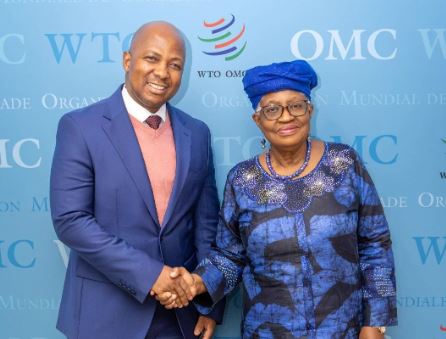
Lesotho is preparing a new phase of trade development assistance targeting its textile and apparel, leather and footwear industries, as the country seeks to expand productive capacity, strengthen domestic value chains and improve its participation in regional and international markets.| Photo: Lesotho Trade Minister Motlatsi Maqelepo with World Trade Organisation DG, Dr Ngozi Okonjo Iweala
Co-Owner and Managing Editor of Newsday Media Lesotho. PEPFAR Media champion, Award wining features journalist, an Investigative journalist, REPSSI CAB member. Maseru, Lesotho Joined November 2009.
GENEVA, SWITZERLAND— Lesotho is preparing a new phase of trade development assistance targeting its textile and apparel, leather and footwear industries, as the country seeks to expand productive capacity, strengthen domestic value chains and improve its participation in regional and international markets.
The country’s Minister of Trade, Industry and Business Development, Motlatsi Maqelepo, outlined the proposed programme during the 10th Global Review of Aid for Trade at the World Trade Organization (WTO) headquarters in Geneva, where he presented Lesotho’s experience alongside trade development initiatives implemented across African, Caribbean and Pacific economies.
The proposed programme falls under Phase Three of the Enhanced Integrated Framework (EIF), a multilateral partnership supporting the trade development of least-developed countries through institutional strengthening, policy development and investment in productive sectors.
Maqelepo said Lesotho was advancing its country programme development proposal, which would prioritise upgrading the textile and apparel, leather and footwear value chains.
Addressing the gathering as Lesotho’s trade minister and a ministerial coordinator for the African, Caribbean and Pacific (ACP) group, Maqelepo said the effectiveness of international trade assistance should be measured by the economic opportunities it creates for businesses and communities.
“For the ACP Group, Aid for Trade is turning market access into livelihoods, or should I say, it should turn market access into livelihoods, especially for women, young people, small and medium enterprises,” he said.
Referring to the nearly USD800 billion disbursed globally under Aid for Trade between 2006 and 2024, the minister said the investment’s significance lay in its ability to strengthen enterprises.
“The test is how that support helps businesses produce, compete and reach markets,” Maqelepo said.
His presentation formed part of discussions following the launch of the joint WTO and Organisation for Economic Co-operation and Development (OECD) report, Two Decades of Trade and Development Partnerships: Trends and Impact of the Aid for Trade Initiative.
The report examines how international assistance has supported trade infrastructure, productive capacity, institutional reforms and market access over the past two decades, while identifying persistent challenges affecting poorer economies.
Presenting Lesotho’s experience, Maqelepo said EIF supported 572 farmers through greenhouse production training and installed five greenhouse technology packages, with women and young people identified as direct beneficiaries.
He said agricultural produce from the intervention had reached hotels, schools, supermarkets and surrounding communities, helping participating farmers establish connections with buyers.
“These numbers may sound low, but for small economies like Lesotho, they make an impact,” the minister said.
“Produce from this programme reaches hotels, schools, supermarkets and communities, helping smallholders connect production with buyers.”
He described the intervention as contributing to Lesotho’s efforts to develop commercial agriculture and diversify economic activity.
“These are concrete steps towards commercial agriculture and diversification, building a foundation for participation in wider markets,” Maqelepo said.
The agricultural initiative was presented as trade development assistance that supports domestic production and market connections, rather than solely financing infrastructure or trade policy reforms.
Maqelepo did not provide figures for the total investment in the greenhouse intervention, the value of produce sold or the income generated by participating farmers.
Beyond agriculture, Maqelepo said the second phase of EIF support had contributed to the development of Lesotho’s National Trade Policy Framework and national export-related policy work.
He said the experience had demonstrated the importance of connecting national trade policies with the productive capabilities of domestic businesses.
“The experience has demonstrated that sustainable trade development requires not only sound policies, but also stronger productive capacity, improved market access and increased domestic value chains,” he said.
The proposed third phase, he said, would focus on strengthening the textile and apparel, leather and footwear industries.
The announcement comes as the Enhanced Integrated Framework enters a new programme cycle aimed at supporting least-developed countries to strengthen their trade institutions and develop productive sectors with export potential.
According to the OECD–WTO report, the EIF has disbursed more than USD340 million since 2008 to support trade ministries, trade diagnostics and productive-sector development across least-developed countries.
The partnership brings together 44 least-developed countries, 26 development partners, and eight international organisations, and its work has included establishing National Implementation Units within trade ministries, supporting Diagnostic Trade Integration Studies, and helping governments incorporate trade priorities into national development strategies.
The report states that 45 least-developed countries have integrated trade into their development strategies, while an independent evaluation attributed approximately one-quarter of trade reforms in those countries to EIF support.
The third phase of the programme, which runs until December 2031, is seeking to mobilise USD200 million for trade development in least-developed countries.
The report records initial funding pledges of USD37.9 million and describes a revised approach to resource mobilisation, project implementation and results measurement.
The minister’s presentation took place during a session examining Aid for Trade’s contribution to Africa’s economic development and regional integration.
Introducing the discussion, the session moderator highlighted the opportunities associated with the African Continental Free Trade Area (AfCFTA), which seeks to expand trade among African countries by reducing barriers and strengthening regional economic integration.
The moderator cited projections that the agreement could increase intra-African trade by up to 25% by 2040 and create as many as 30 million jobs.
The OECD–WTO report records that Africa received approximately USD19.8 billion in Aid for Trade disbursements in 2024, making it the largest recipient region ahead of Asia, which received USD18.7 billion.
Despite this financing, African countries still account for about 3% of global merchandise exports and 2% of services exports.
Least-developed countries, including Lesotho, account for around 1% of global merchandise exports.
Maqelepo said investments in economic corridors, customs systems and productive capacity have helped connect smaller enterprises with regional markets and improve access to international ports for landlocked economies.
He referred to improvements in African border-crossing procedures, including projects supported through TradeMark Africa and other development partnerships, which had reduced waiting times and trading costs.
The OECD–WTO report also highlights the Kazungula border crossing between Zambia and Botswana, where a bridge and one-stop border facilities reduced clearance times from as long as seven days to about 16 hours.
The project, supported by the Japan International Cooperation Agency and the African Development Bank, is identified as an example of infrastructure and border-management reforms contributing to regional trade integration.
Maqelepo also presented examples from the Caribbean and Pacific regions to illustrate the impact of trade assistance on agricultural producers, small enterprises and services industries.
In the Caribbean, he cited an initiative supported by the European Union and implemented through the International Trade Centre (ITC), which trained more than 2,000 farmers in the coconut sector across 11 countries.
“Approximately one-quarter of the participating farmers were women, while 13 processors were connected with small-scale producers.”
He said partnerships involving producers and cooperatives had mobilised approximately USD40 million in investment commitments; however, he emphasised that investment commitments must be converted into actual implementation to deliver economic benefits.
In the Pacific, the minister highlighted Australia’s Market Development Facility, which reported that its work in Fiji had benefited more than 24,000 people and generated over USD45 million in additional income by the end of 2025.
“The programme supported economic activities involving agriculture, tourism, services and small-enterprise development.”
Maqelepo also cited the Automated System for Customs Data (ASYCUDA), developed by the United Nations Conference on Trade and Development (UNCTAD), as an example of digital technology improving border administration.
He said support for customs modernisation in Pacific economies, including Palau, reduced customs processing times from about one day to one to two hours.
“Across our regions, these experiences show why infrastructure, skills, finance and market connection must work together, and we must expand successful approaches and measure the benefits,” Maqelepo said.
Maqelepo’s presentation followed opening remarks by WTO Director-General Dr Ngozi Okonjo-Iweala, who called for a new approach to international trade assistance that places greater emphasis on domestic reforms and developing economies’ ability to add value to their products.
Okonjo-Iweala said the USD795 billion disbursed through Aid for Trade over two decades had contributed to infrastructure development, modernised customs systems, regulatory reforms and improved trading capacity.
However, she acknowledged that Africa and the world’s least-developed countries had not substantially increased their shares of global trade.
“Nevertheless, despite significant Aid for Trade inflows, the shares of African countries and LDCs in global trade remained stuck around 3% and 1% respectively, though at least they kept pace with global trade growth,” she said.
She urged development partners to support reforms that enable poorer economies to move into higher-value production and manufacturing.
“Beneficiary countries need further support with domestic reforms and behind-the-border issues that can unleash value addition to their goods and services and move them increasingly up the production and manufacturing ladder,” Okonjo-Iweala said.
“This is how they can measurably increase their shares of global trade.”
The Director-General also highlighted the importance of partnerships involving governments, development banks, businesses and other investors to strengthen productive capacity and expand trading opportunities.
Summary
GENEVA, SWITZERLAND— Lesotho is preparing a new phase of trade development assistance targeting its textile and apparel, leather and footwear industries, as the country seeks to expand productive capacity, strengthen domestic value chains and improve its participation in regional and international markets.
The country’s Minister of Trade, Industry and Business Development, Motlatsi Maqelepo, outlined the proposed programme during the 10th Global Review of Aid for Trade at the World Trade Organization (WTO) headquarters in Geneva, where he presented Lesotho’s experience alongside trade development initiatives implemented across African, Caribbean and Pacific economies.
Addressing the gathering as Lesotho’s trade minister and a ministerial coordinator for the African, Caribbean and Pacific (ACP) group, Maqelepo said the effectiveness of international trade assistance should be measured by the economic opportunities it creates for businesses and communities.
Co-Owner and Managing Editor of Newsday Media Lesotho. PEPFAR Media champion, Award wining features journalist, an Investigative journalist, REPSSI CAB member. Maseru, Lesotho Joined November 2009.
To ensure optimal experiences, we utilize technologies such as cookies to store and/or access information from your device. Granting consent to these technologies enables us to process data, including browsing habits or unique identifiers on this website. Conversely, not consenting or revoking consent may negatively impact specific features and functionalities.
Functional
Always active
The technical storage or access is strictly necessary for the legitimate purpose of enabling the use of a specific service explicitly requested by the subscriber or user, or for the sole purpose of carrying out the transmission of a communication over an electronic communications network.
Preferences
The technical storage or access is necessary for the legitimate purpose of storing preferences that are not requested by the subscriber or user.
Statistics
The technical storage or access that is used exclusively for statistical purposes.The technical storage or access that is used exclusively for anonymous statistical purposes. Without a subpoena, voluntary compliance on the part of your Internet Service Provider, or additional records from a third party, information stored or retrieved for this purpose alone cannot usually be used to identify you.
Marketing
The technical storage or access is required to create user profiles to send advertising, or to track the user on a website or across several websites for similar marketing purposes.