
New OECD–WTO report reveals widening financing pressures as Africa receives the largest share of trade assistance but continues to account for just three percent of global merchandise exports.
GENEVA, SWITZERLAND— Nearly US$800 billion in international assistance has been disbursed to strengthen developing countries’ participation in global trade over the past two decades, yet the world’s poorest economies continue to account for a disproportionately small share of global exports, according to a new report by the World Trade Organization (WTO) and the Organization for Economic Co-operation and Development (OECD).
The findings, which come as development financing faces significant cuts, raising concerns about the ability of poorer economies to overcome longstanding barriers to international trade while adapting to new technological, environmental and investment demands.
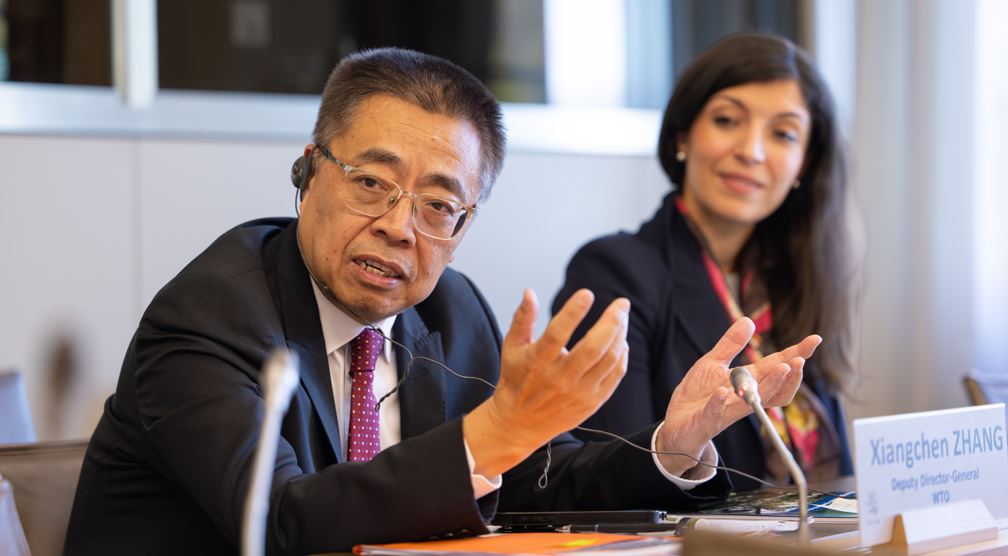
Speaking at a joint media briefing in Geneva, WTO Deputy Director-General Xiangchen Zhang and OECD Development Co-operation Director Pilar Garrido presented the findings of Two Decades of Trade and Development Partnerships: Trends and Impact of the Aid for Trade Initiative, a comprehensive assessment of international efforts to help developing countries build their capacity to trade.
The report reveals that US$795 billion was disbursed between 2006 and 2024, contributing to improvements in trade infrastructure, productive capacity and regulatory systems.
Over the same period, developing economies increased their share of global merchandise exports from 38% to 48%, while their share of services exports rose from 25% to 33%.
However, these gains have been unevenly distributed.
The findings reveal that Africa continues to account for approximately 3% of global merchandise exports and 2% services exports, while least-developed countries (LDCs) account for around 1% and 0.5% respectively.
Zhang said the figures demonstrated that increased participation by developing economies had not translated into meaningful export transformation for many of the world’s poorest countries.
“While we have seen some of the success stories, we have not seen a qualitative expansion of their exports. We need to do more to help these economies lift their share in global trade,” Zhang said.
The findings expose a persistent challenge for international development cooperation—improving countries’ ability to trade has not necessarily enabled them to capture a significantly greater share of international markets.
Development finance faces sharp reductions
The report’s release comes against a deteriorating global development financing outlook, with official development assistance (ODA) falling by 8.5% in 2024 and approximately 23% in 2025. Further reductions are expected in 2026.
Although Aid for Trade disbursements remained relatively resilient in 2024, increasing by 2% to US$51 billion, the OECD warns that bilateral financing could decline by approximately 22% between 2024 and 2026 if current allocation patterns continue.
The findings indicate that the multilateral development banks helped sustain financing in 2024 as bilateral assistance declined, but continued pressure on development budgets could also affect their future contributions.
Garrido said the international community was confronting a difficult moment for development cooperation, requiring greater attention to the effectiveness of available resources.
“Twenty years ago, the international community made a commitment to help developing countries build the capacity to trade, so that trade could drive growth, jobs and poverty reduction, therefor with fewer resources, every dollar must count.”
The report notes that financing challenge is particularly acute for least-developed countries, whose assistance has grown at a considerably slower pace than international commitments require.
According to the OECD, Aid for Trade support to LDCs increased by approximately 2% annually between 2020 and 2024, compared with the 9% annual growth required to meet the United Nations objective of doubling support by 2031.
While LDCs received 30% of Aid for Trade disbursements in 2024, their ability to attract private investment remains severely constrained.
Africa receives the most assistance, but export gains remain limited
The report reveals that Africa emerged as the largest regional recipient of Aid for Trade in 2024, receiving US$19.8 billion, followed by Asia at US$18.7 billion.
The increase represented a recovery in financing to Africa following declines between 2020 and 2023.
Nevertheless, the continent’s share of global merchandise exports remains around 3%, underscoring the continuing difficulties African economies face in expanding their presence in international markets.
The report indicates that the contrast between the continent’s share of development assistance and its global export performance reflects the broader structural challenges identified in the report, including limited productive capacity, infrastructure constraints, regulatory barriers and difficulties meeting international standards.
The findings do not establish that Aid for Trade has been ineffective. Rather, they demonstrate that improvements in infrastructure and trading systems have not been sufficient to deliver comparable export gains across all developing economies.
Zhang said developing countries must also prepare for changes in the international trading environment, particularly the expansion of digital commerce, shifting supply chains and the transition towards cleaner production.
“Digitalisation, reconfiguration of supply chains and transition to net zero offers new opportunities to developing economies and LDCs, and taking advantage of these opportunities requires stronger digital connectivity, relevant skills and the ability to meet evolving international standards,” he said.
Trade reforms yield results despite limited funding
The joint assessment identifies trade policy and regulatory reform as one of the areas where relatively modest financing has produced measurable benefits.
Implementation of the WTO Trade Facilitation Agreement is estimated to have contributed to a 5% reduction in global trade costs over the past decade.
The findings note the reforms include measures aimed at simplifying customs procedures, improving transparency and reducing administrative barriers to the movement of goods across borders.
Yet support for trade policy and regulation accounted for less than 2.7% of Aid for Trade disbursements in 2024.
Zhang said strengthening institutional and negotiating capacity was equally important in enabling developing countries to participate effectively in shaping international trade rules.
According the report, over the past two decades, the African Group, the African, Caribbean and Pacific Group and the LDC Group submitted more than 200 proposals within the WTO, contributing to negotiations covering trade facilitation, agricultural export competition, fisheries subsidies and special provisions for developing economies.
“The lesson is clear: investing in trade capacity is also investing in a stronger multilateral trading system,” Zhang said.
The report also highlights practical examples of trade assistance delivering improvements.
At the Kazungula border crossing between Zambia and Botswana, clearance times declined from as long as seven days to as little as 16 hours, while assistance to Ethiopia’s honey sector helped more than 3,600 young people establish beekeeping businesses and over 1,000 producers obtain certification.
These examples illustrate how targeted interventions can reduce trading costs and create economic opportunities.
Private investment cannot replace development assistance
As traditional development financing declines, the WTO and OECD are calling for stronger partnerships involving governments, bilateral agencies, multilateral development banks and private investors.
The report notes that private finance mobilised through official interventions in trade-related sectors reached US$68 billion in 2024, exceeding the official development assistance provided to those sectors.
However, the distribution of this investment remains heavily concentrated in more developed markets.
Middle-income countries attracted 74% of mobilised private finance, while LDCs received only 6%.
Garrido cautioned that efforts to attract private investment must not divert concessional resources away from the countries and sectors where financing needs are greatest.
“Scarce concessional resources must be channelled to where needs are greatest and financing gaps are widest,” she said.
She also identified digital trade, sustainability standards, trade facilitation and economic corridors as priority areas requiring more targeted international support.
Despite a 60% increase in financing for information and communication technologies over five years, the sector accounted for only around 3% of Aid for Trade disbursements in 2024.
Similarly, support to help producers comply with due-diligence and sustainability requirements has more than doubled since 2022 but remains modest at approximately US$216 million.
Garrido stressed the importance of strengthening cooperation among development institutions and private investors while ensuring that the needs of the most vulnerable economies remain central.
“Aid for Trade matters more, not less, in today’s world,” she said.
Summary
- GENEVA, SWITZERLAND— Nearly US$800 billion in international assistance has been disbursed to strengthen developing countries’ participation in global trade over the past two decades, yet the world’s poorest economies continue to account for a disproportionately small share of global exports, according to a new report by the World Trade Organization (WTO) and the Organization for Economic Co-operation and Development (OECD).
- Trends and Impact of the Aid for Trade Initiative, a comprehensive assessment of international efforts to help developing countries build their capacity to trade.
- According to the OECD, Aid for Trade support to LDCs increased by approximately 2% annually between 2020 and 2024, compared with the 9% annual growth required to meet the United Nations objective of doubling support by 2031.

Co-Owner and Managing Editor of Newsday Media Lesotho. PEPFAR Media champion, Award wining features journalist, an Investigative journalist, REPSSI CAB member. Maseru, Lesotho Joined November 2009.