
The long-delayed Belo Industrial Estate in Botha-Bothe is close to becoming operational after the completion of key electrification infrastructure.
The works had kept its factories idle for years. Their completion raises hopes of jobs, investment and economic growth in the district.
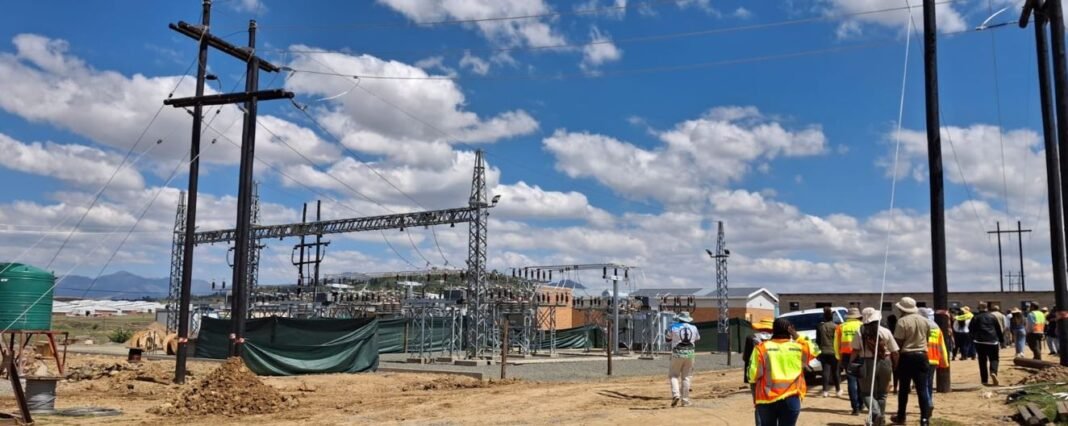
The factory structures at Ha-Belo have stood finished for years, but they could not operate without a reliable electricity supply. Minister of Energy and Mining Lejone Mpotjoane announced the progress this week during a media tour of the Belo Substation and Industrial Estate.
He said government is working to ensure that infrastructure investments translate into real opportunities for communities, particularly young people.
The estate has missed one deadline after another. In February 2021, completion of the project was pushed back to August 2021. The Lesotho National Development Corporation (LNDC) blamed a series of challenges that emerged midway, including the founding conditions of the buildings, and said outstanding work included electrical reticulation and switching stations for the whole estate.
The estate was initially expected to open in 2021, but the lack of water and electricity supply held up its completion.
The Ministry of Energy awarded the contract for the Ha Belo 33/11kV substation and 33kV line to Phaks JV on 18 August 2021, with an 18-month completion period. Work began in November 2021 and was due to finish by April 2023, at an initial cost of M86.6 million.
The project had three main parts including a line from Ha Mopeli to Ha Belo, a second line from Hlotse, and a substation at the estate.
The promised dates kept slipping. In 2023, an official of the Lesotho Renewable Energy and Energy Access Project (LREEAP) said the estate would have electricity by February 2024. The LNDC later said the estate was expected to open in January 2025, with the water and power projects due to finish by the end of 2024. Neither deadline was met.
When fully operational, it will need an estimated 7.5 megavolt amps of power and about four million litres of water a day. Water was a separate challenge. The LNDC opted for a dedicated pipeline drawing from the confluence of the Mohokare and Moroeroe rivers, after concluding that urban water projects in Botha-Bothe would take too long to serve the factories.
The electrification project is part of the World Bank-financed Lesotho Renewable Energy and Energy Access Project. It soon ran into trouble. The cost climbed to more than M121 million while the work remained incomplete, and the project became mired in allegations of corruption and financial mismanagement. Parliamentary committees investigated how a contractor received M35 million without delivering the agreed work.
In January 2025, former Energy Principal Secretary Themba Sopeng was charged with corruption, embezzlement and money laundering in connection with the project, alongside other officials and Phaks JV representatives.
In June 2025, government refunded M22 million to the World Bank after failing to account for funds meant for the substation.
The idle estate also suffered vandalism and theft, with security personnel deployed to guard it. Residents who had built rental rooms in anticipation of factory workers struggled to repay loans as the rooms stood empty.
In September 2025, the Ministry of Energy signed a contract worth about M49.7 million with Actom (Pty) Ltd, which Phaks JV had originally subcontracted as equipment manufacturer, to complete the outstanding work.
Project Manager Leloko Mokhutšoane said the first phase of the Ha-Belo project, extending electricity to surrounding communities and the factories, is now complete. More than 800 households have been connected.
Principal Secretary in the Ministry of Energy and Mining, Tankiso Phapano, said the Belo Substation is designed to receive power through two supply lines, one from Khukhune and another from Hlotse. The second line provides an alternative route if one develops technical problems, so the factories are not left without power.
Work is not entirely finished. The Khukhune-to-Mopeli section is still being inspected after the current contractor found defects in work done by the first contractor. An indoor substation will also be built at Khukhune to strengthen supply to the estate.
Phapano acknowledged that government faces financial constraints in completing the Khukhune-Belo line because of the losses suffered earlier in the project. He added that the World Bank was dissatisfied with how the project had been implemented, particularly the unnecessary costs incurred.
During Monday’s tour, journalists were shown the substation and switching room. They also saw concrete blocks the current contractor demolished after finding they did not meet quality standards.
Mokhutšoane said the factories will benefit from a reliable supply through infrastructure running from Leribe District to Ha-Belo. He said 254 people affected by the installation of electricity poles along the route have been compensated.
Phapano described the electrification project as the major obstacle to operationalising the estate. Now that it is complete, he said, the Prime Minister is expected to officially hand over and launch the factories.
Government says completing the project is not enough. Mpotjoane said suspending or dismissing implicated officials would not suffice, and that government must establish the extent of the losses and recover the money. He stressed that public officials must understand that failing to do their work properly has consequences.
Phapano said the Ministry has started legal proceedings after finding that the previous contractor had unlawfully received some payments. A financial reconciliation is needed to establish the amounts involved. Officials who led the project have been suspended, while others are still going through legal processes.
“Money can be retrieved, but time lost can never be replaced. Many people who were supposed to be working in the factories, had they started operating at the initially planned time, would have earned a living during that period, and we cannot replace that,” Phapano said.
He said the Ministry is strengthening monitoring and inspection. Officials will conduct regular site inspections to assess progress and quality before projects are handed over. The Ministry is also recruiting more qualified personnel and transferring technical skills to existing staff.
Botha-Bothe District Administrator Tšepa Chaba welcomed the developments. He noted that the district has long suffered from inadequate infrastructure and limited electricity, particularly in Ha-Belo.
He urged young people to acquire technical skills and pursue the entrepreneurial opportunities the estate will create. He said it should be seen not merely as an infrastructure project but as a chance for communities to take part in economic transformation.
The programme also included stakeholder engagements, community awareness activities and a career guidance walk for Grade 10 learners. It encouraged young women in particular to consider careers in energy, engineering and manufacturing.
Mpotjoane said Lesotho is working to increase household connections through Mission 300, which aims to expand access to clean energy by 2030.
Mokhutšoane said the long-term strategy is to generate more power domestically from hydropower, wind and solar, and eventually export surplus electricity. He noted that reliance on imported power burdens the economy.
Trade, Industry and Business Development Minister Maqelepo Maqelepo disclosed earlier this year that about M1.1 billion had been spent on the estate even though its factories remained idle. For years, MPs, parliamentary committees, ministers and other officials have previously visited the site asking when the investment would start paying off.
Summary
- The project had three main parts including a line from Ha Mopeli to Ha Belo, a second line from Hlotse, and a substation at the estate.
- The LNDC later said the estate was expected to open in January 2025, with the water and power projects due to finish by the end of 2024.
- The LNDC opted for a dedicated pipeline drawing from the confluence of the Mohokare and Moroeroe rivers, after concluding that urban water projects in Botha-Bothe would take too long to serve the factories.

Senior journalist and communications professional with extensive experience in general news reporting, specializing in business and sports journalism. Skilled in public speaking, media relations, and strategic communication, with a proven ability to deliver accurate, engaging, and impactful stories.
A strong team player who thrives in collaborative environments and adapts effectively to diverse working conditions. Passionate about continuous learning, professional growth, and enhancing communication practices to meet evolving industry demands.