
Okonjo-Iweala says international trading rules continue to provide predictability for investors as conflicts and tariff measures disrupt global commerce.
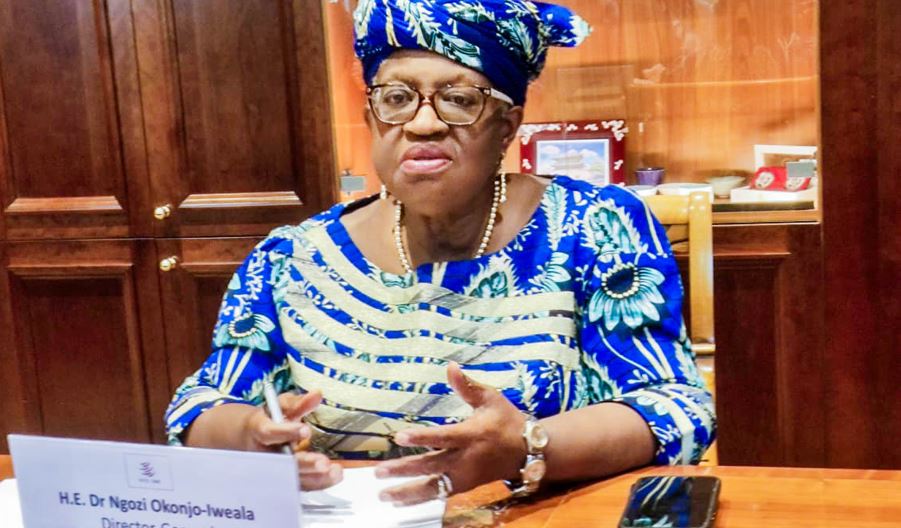
GENEVA, SWITZERLAND – World Trade Organization (WTO) Director-General Dr Ngozi Okonjo-Iweala says the global trading system has demonstrated considerable resilience despite mounting tariff pressures, geopolitical conflicts and disruptions to international shipping routes.
Speaking to journalists at the WTO headquarters in Geneva on Tuesday, 27 October 2026, Okonjo-Iweala described the current international trading environment as one of the most challenging in decades.
She identified increasing tariffs and disruptions affecting the Black Sea, Red Sea and Strait of Hormuz among the developments placing pressure on international commerce.
“These are among the most serious challenges to the global trading system in decades. Yet the system has proved resilient,” she said.
The Director-General acknowledged that recent tariff measures had reduced the proportion of international trade conducted under WTO terms.
“Before the recent tariff actions, approximately 80% of world trade took place on WTO terms; the figure is now about 72%,” she said.
Despite this decline, Okonjo-Iweala maintained that the multilateral trading system continued to provide stability for businesses operating across international markets.
“WTO rules continue to provide an island of predictability amid uncertainty,” she said.
“For businesses and investors, uncertainty is the greatest challenge.”
Her remarks highlighted the importance of predictable international trading rules at a time when governments and businesses are adjusting to changes in trade policies and supply-chain disruptions.
The Director-General also reported that global merchandise trade had performed better than earlier forecasts suggested.
She indicated that trade growth had exceeded initial projections, demonstrating the ability of international commerce to adapt despite the pressures affecting major economies.
However, she cautioned that the strength of global trade was not evenly distributed across sectors.
A significant share of recent growth was being driven by demand for artificial intelligence-related products, including semiconductors, processors and data-centre equipment.
“This strength may mask weakness in other sectors affected by tariffs and conflicts,” she said.
Okonjo-Iweala also distinguished between a trading system capable of surviving disruptions and one able to respond effectively to them.
“Resilience is not the same as robustness. Robustness means being able to respond positively to shocks. The WTO must anticipate chokepoints, modernise its rules and reform so it can respond quickly.”
The Director-General also addressed concerns about the WTO’s dispute settlement system, which has faced difficulties since the Appellate Body ceased functioning in 2019.
Responding to a question from an Indonesian journalist, she rejected the suggestion that the organisation’s entire dispute settlement mechanism had become dysfunctional.
“It is a myth to say that the WTO dispute settlement system is not functioning at all,” she said.
Okonjo-Iweala explained that WTO committees, consultations and dispute settlement panels continued to operate, while arbitration and mediation remained available as alternative mechanisms.
She also referred to the Multi-Party Interim Appeal Arbitration Arrangement, established by participating members to provide an alternative appeals process.
“The goal remains a functioning two-tier system, although reforms are proceeding slowly,” she said.
The Director-General further encouraged countries to diversify their international trading relationships to reduce excessive dependence on individual markets and suppliers.
Responding to a question from the Philippines about the Association of Southeast Asian Nations (ASEAN), she emphasised the importance of developing new commercial partnerships.
“My message is: diversify, diversify, diversify,” she said.
She encouraged ASEAN economies to look beyond their established dependence on the United States and China, identifying Africa, Central Asia and Latin America as regions offering opportunities for expanded trade and investment.
The discussion took place during the WTO’s Aid for Trade Global Review Week, which marks 20 years of efforts to help developing and least-developed countries participate more effectively in international trade.
The initiative has supported improvements in trade infrastructure, institutional capacity and technical expertise, while helping countries address barriers to international market participation.
As the WTO reviews two decades of Aid for Trade, Okonjo-Iweala maintained that preserving predictable international trading rules and strengthening the system’s ability to respond to disruptions remain essential to global commerce.
Summary
- Speaking to journalists at the WTO headquarters in Geneva on Tuesday, 27 October 2026, Okonjo-Iweala described the current international trading environment as one of the most challenging in decades.
- Her remarks highlighted the importance of predictable international trading rules at a time when governments and businesses are adjusting to changes in trade policies and supply-chain disruptions.
- “It is a myth to say that the WTO dispute settlement system is not functioning at all,” she said.
Co-Owner and Managing Editor of Newsday Media Lesotho. PEPFAR Media champion, Award wining features journalist, an Investigative journalist, REPSSI CAB member. Maseru, Lesotho Joined November 2009.