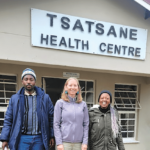

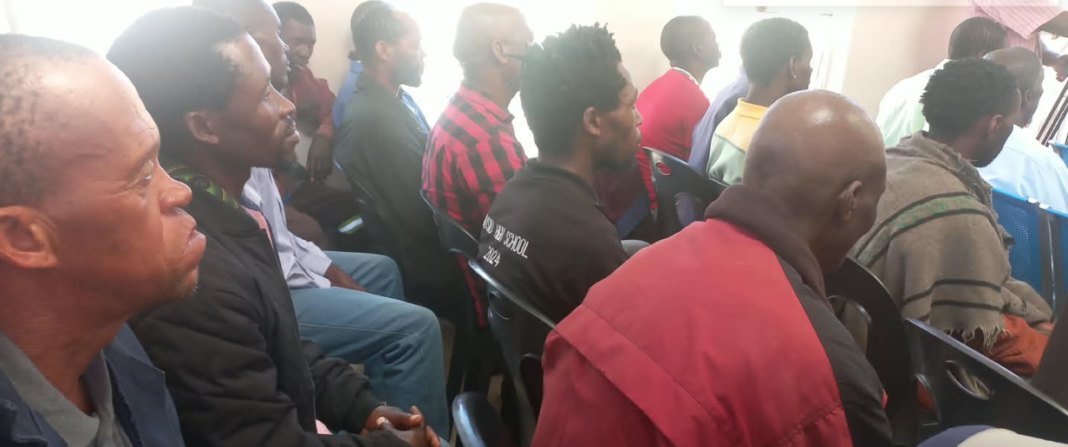
Men in Linakeng, in Thaba-Tseka District, and surrounding areas have pledged to challenge gender-based violence (GBV), support family planning and oppose child marriage.
They acknowledged that men must take responsibility for the harm caused in families and communities. The commitments followed a three-day male engagement supported by the United Nations Population Fund (UNFPA). Participants discussed mental health, relationships, sexual and reproductive health, and healthy masculinity.
The men spoke openly about challenges including mental health, extramarital relationships and violence in the home. They welcomed information about family planning, saying the current economic situation makes it important for families to plan how many children they can support.
Thaba-Tseka has some of the country’s most serious problems with teenage pregnancy and child marriage. According to the Lesotho Demographic and Health Survey, the district has the highest rate of teenage childbearing in the country, at 32%, compared with 12% in Leribe.
It also has the highest rate of forced child marriage, at 22%, which is often linked to teenage pregnancy.
Participants pledged to reject abuse in all its forms. They also promised to form support groups where men can discuss family planning and healthy masculinity with their peers, including men at animal posts.
Pii Lelaka said men recognise that they can be a source of problems in their families. He linked extramarital relationships to sexually transmitted infections (STIs) and spoke about the effects of abuse on children.
“We abuse our families and make angry children who grow up in anger,” he said.
He added that some women are afraid to tell their partners that they are using family planning.
UNFPA acting Resident Representative Motšelisi Phakisi commended the men for speaking openly about their challenges and frustrations. Thai Makhele, Deputy Principal Secretary at the Ministry of Gender, Youth and Social Development, challenged them to consider how they could restore men’s dignity in their own lives and within their families.
Mosito Mokhabi said men can help restore trust by being present and responsible in their families.
“We are going to restore the dignity of men by living in our families. We will see to it that even children trust us,” he said.
Fusi Khalala said family planning helps families decide how many children they can provide for. He said a lack of support from a partner could leave women feeling abandoned.
“We need to be supportive in our families and sing a song that men are now to be trusted,” he said.
Motlalepula Nyakane said decisions about family planning should be made by both partners. He pledged to accompany his wife to a health centre. He added that men’s reluctance to visit health facilities does not help families, and that he had learned about the importance of using contraceptives during sex with a partner.
“I will have to take responsibility to accompany my wife to the health centre so that she should not say that I have abandoned her and not say she has made the child alone,” he said.
Tsotleho Fako said what he learned about HIV and AIDS had strengthened his understanding, and that he is now sharing the information with others. He said men need to support family planning and stop abusing children.
Masilo Hele also stressed the importance of family planning in the current economic circumstances. He said people have the right to be tested for STIs, and warned against stopping medication or avoiding health facilities for testing.
On child marriage, participants said they had learned that it is wrong, and pledged to report cases to the police. Tselohelo said participants were now aware of this. Nokoane Phatšoane acknowledged that child marriage exists in Linakeng and said men must work together to end it.
“We are going to report it to the police, and it is also good that we unite against it as men in this area,” he said.
Hele raised concerns about underage children attending initiation school and committing offences after returning. Health Minister ‘Mamokete Ntšekhe, who is also the MP for Mphosong, said she reports cases of child marriage to the police and works with the chief and councillor to address the practice.
Semena MP Tšepo Mosotho challenged men to question social expectations that label supportive men as having been “pacified”. He urged them not to stop taking prescribed medication and said that caring for a family and making plans together are signs of responsibility.
“Go to our respective communities and be a salt that will season other males,” he said.
Mashai MP Sekhele Mosebetsane said the engagement offers hope for change in the Mashai constituencies.
“Everyone is a leader. A person is a leader in their respective capacities, from the herders who take care of our livestock. It says if your conscience tells you that a thing is wrong, leave it,” he said.
Rahlao Rahlao, the men’s health focal person at the Thaba-Tseka District Health Management Team and one of the facilitators, said he was concerned that few men visit health facilities. He said men’s preference for unprotected sex puts their partners at risk of STIs. However, he was encouraged that participants had learned that STIs can affect a pregnancy and expose an unborn child to infection. He urged men to stand against child marriage.
Dr ‘Mamotena Sekhobe, from the Family Health Division at the Ministry of Health, commended the men who committed to becoming champions of family planning and restoring dignity in their families.
Phakisi said UNFPA was encouraged that mature men attended and could share what they learned with their sons.
“We are particularly encouraged as UNFPA that matured men could come to this male engagement to teach their sons and engage meaningfully with them to tell them that they should not abuse girls and hurt them with the lure that they love them,” she said.
She urged young men to wait until girls have completed school and are older before marrying them. She also encouraged men to space their children to avoid placing an unreasonable economic burden on families.
Minister of Gender, Youth and Social Development Pitso Lesaoana said the Government prioritises education through free primary and secondary schooling. He added that the Ministry of Social Development supports double-orphaned children and those whose parents cannot provide for them. He urged parents to make sure their children complete school, warning that failing to do so can perpetuate poverty.
Lesaoana said young men should ideally attend initiation school after completing high school, when they have reached at least 18 years of age.
The Protection and Administration of Custom at Initiation School Bill, 2022, is under development. If passed, it is intended to introduce legal safeguards, prevent initiates from being forced out of school and ensure that no child under 18 is initiated.
Summary
- According to the Lesotho Demographic and Health Survey, the district has the highest rate of teenage childbearing in the country, at 32%, compared with 12% in Leribe.
- “I will have to take responsibility to accompany my wife to the health centre so that she should not say that I have abandoned her and not say she has made the child alone,” he said.
- “We are going to report it to the police, and it is also good that we unite against it as men in this area,” he said.
Thoboloko Ntšonyane is a dedicated journalist who has contributed to various publications. He reports on accountability, human rights, exposes corruption and wrong doing by those in power. He reports have exposed corruption, abuse of power, fraud, misconduct and negligence. He subscribes to evidence-based reporting. He reports on governance, parliament, courts, climate change, human rights, sexual and reproductive health rights (SRHR), health, business and agriculture. He gives a voice to the marginalised while also demanding accountability. His work inspires change, triggers dialogue and also promote transparency in a society.