
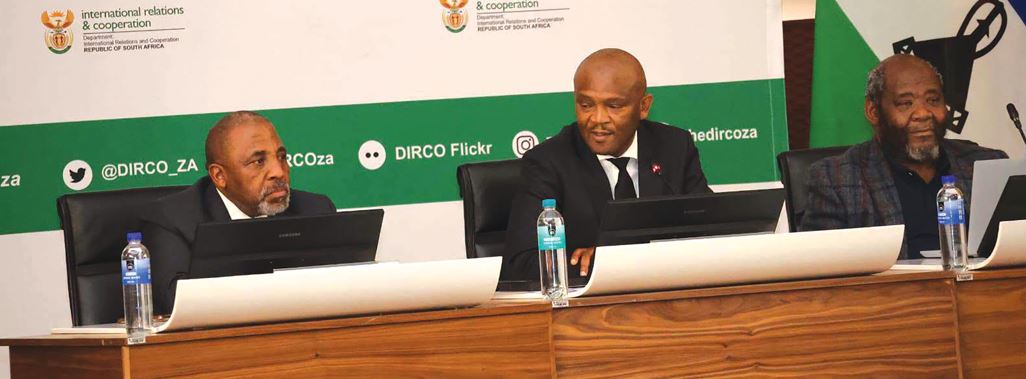
The inaugural Mid-Term Review of the Second Session of the Lesotho–South Africa Bi-National Commission (BNC) recently concluded in Pretoria on 9 September 2026, following three days of intensive deliberations aimed at accelerating the implementation of commitments between the two sister countries.
The Lesotho delegation was led by Mr Thabang Lekhela, Principal Secretary of Foreign Affairs and International Relations, who served as Co-Chair of the Mid-Term Review alongside Ambassador Tebogo Seokolo, Deputy Director-General of the Department of International Relations and Cooperation (DIRCO) of the Republic of South Africa.
According to the Ministry of Foreign Affairs, key outcomes of the review were progress towards a New Migration Model to address persistent migration challenges and enhanced labour mobility; advancement of Phase II of the Lesotho Highlands Water Project, including the Polihali Dam; and efforts to accelerate Smart One-Stop Border Posts at Maseru and Ficksburg.
The two countries also advanced economic cooperation through measures aimed at strengthening cross-border value chains, Special Economic Zones and clean energy cooperation.
On political and strategic cooperation, Lesotho and South Africa reaffirmed their harmonised positions within SADC, the African Union and the United Nations, including cooperation on peace and security, conflict prevention and the silencing of guns on the African continent.
In his closing remarks, Lekhela expressed appreciation to the government and people of South Africa for their hospitality and highlighted the significant progress achieved across the five Sectoral Clusters.
He emphasised that the review provided an opportunity for both countries to move decisively “from dialogue to implementation” and to ensure that bilateral commitments translate into tangible benefits for their peoples.
The BNC mechanism itself is relatively young. South Africa and Lesotho held their inaugural Bi-National Commission session in 2025 in Maseru, with President Cyril Ramaphosa at the time describing the summit as a “great opportunity to take stock of our bilateral relations as well as cooperation in a number of fields.”
In his closing remarks on that occasion, Ramaphosa noted that the two countries’ common interests, historical links and shared heritage remain strong, and that South Africa and Lesotho would continue to play constructive roles in SADC, on the African continent and globally.
The Mid-Term Review in Pretoria was therefore the first formal stocktaking exercise since that inaugural session, designed to check progress against commitments made and to ensure the relationship does not stall between full BNC sittings.
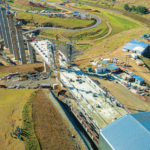
The Polihali Dam featured prominently in the discussions, and for good reason: it is the centrepiece of Phase II of the Lesotho Highlands Water Project (LHWP), the decades-old bilateral scheme that supplies water to South Africa’s Gauteng province while generating hydroelectricity for Lesotho.
According to the Lesotho Highlands Development Authority (LHDA), the dam is a concrete-faced rockfill structure that will create a reservoir on the Senqu and Khubelu rivers, adding 2.325 billion cubic metres in storage capacity and increasing the current yearly water supply rate from 780 million cubic metres to 1.27 billion cubic metres a year.
Recent progress reports indicate the project is advancing steadily, if not without earlier delays. By July 2026, construction of the 166-metre-high dam had reached 50% completion and remained on track for the start of impoundment in the 2027/28 rainy season.
Engineering data show that 9.6 million cubic metres of rock had been placed at an average rate of 26,000 cubic metres per working day, bringing the dam’s rockfill component to 67% completion, with full completion of the dam expected in 2029. Notably, 2026 also marks the 40th anniversary of the signing of the original LHWP Treaty, giving added symbolic weight to this year’s progress milestones.
On the border management front, the Smart One-Stop Border Posts initiative discussed at the Mid-Term Review builds on a Joint Action Plan signed earlier by the two governments to modernise the Maseru Bridge and Ficksburg crossings.
The initiative forms part of a broader regional push by South Africa’s Border Management Authority (BMA) to introduce coordinated, electronic border-processing systems that reduce congestion and reliance on physical infrastructure.
BMA commissioner Dr Michael Masiapato has previously said such systems would “significantly improve the facilitation of both goods and people at critical ports of entry” by consolidating border control procedures into a single location, enhancing coordination and reducing waiting times.
Maseru Bridge and Ficksburg are among six land ports across the region earmarked for this redevelopment, alongside crossings into Zimbabwe, Mozambique, Eswatini and Botswana.
For ordinary travellers and traders, congestion at Maseru Bridge in particular has long been a source of frustration, given that it is one of the busiest land border posts in Southern Africa. The push toward a “juxtaposed” one-stop model, in which officials from both countries work from shared facilities, is intended to allow goods and people to be cleared for exit and entry in a single stop, rather than undergoing separate processes on each side of the border.
On political and strategic cooperation, Lesotho and South Africa reaffirmed their harmonised positions within the Southern African Development Community (SADC), the African Union and the United Nations, including cooperation on peace and security, conflict prevention and the silencing of guns on the African continent.
This alignment reflects the two countries’ longstanding practice of coordinating positions in multilateral forums, given Lesotho’s status as a country entirely encircled by South African territory and its consequent economic and political interdependence with its neighbour.
Ambassador Tebogo Seokolo echoed the importance of turning the commitments reached through the BNC into practical action, reinforcing the shared resolve of both countries to deepen bilateral cooperation and deliver meaningful outcomes for the people of Lesotho and South Africa.
The Agreed Minutes endorsed at the conclusion of the Review set out clear timelines and accountability mechanisms to ensure that decisions translate into economic opportunities, secure borders, enhanced social protection and improved human development.
The outcomes of the Mid-Term Review lay a strong foundation for the Third Session of the Lesotho–South Africa Bi-National Commission, scheduled to be convened in South Africa in 2027.
Ramaphosa, addressing the inaugural session that set this cycle of engagement in motion, had already signalled his government’s intention to keep the relationship on a structured, forward-looking track, closing his remarks by saying he looked forward to receiving his Lesotho counterpart in South Africa for the third session of the Bi-National Commission.
The review in Pretoria appears to have kept that timeline intact, with officials from both sides expressing confidence that the sectoral progress logged from migration policy to dam construction to border modernisation, will carry through to next year’s full session.
Summary
- On political and strategic cooperation, Lesotho and South Africa reaffirmed their harmonised positions within SADC, the African Union and the United Nations, including cooperation on peace and security, conflict prevention and the silencing of guns on the African continent.
- South Africa and Lesotho held their inaugural Bi-National Commission session in 2025 in Maseru, with President Cyril Ramaphosa at the time describing the summit as a “great opportunity to take stock of our bilateral relations as well as cooperation in a number of fields.
- In his closing remarks on that occasion, Ramaphosa noted that the two countries’ common interests, historical links and shared heritage remain strong, and that South Africa and Lesotho would continue to play constructive roles in SADC, on the African continent and globally.

Authored by our expert team of writers and editors, with thorough research.