
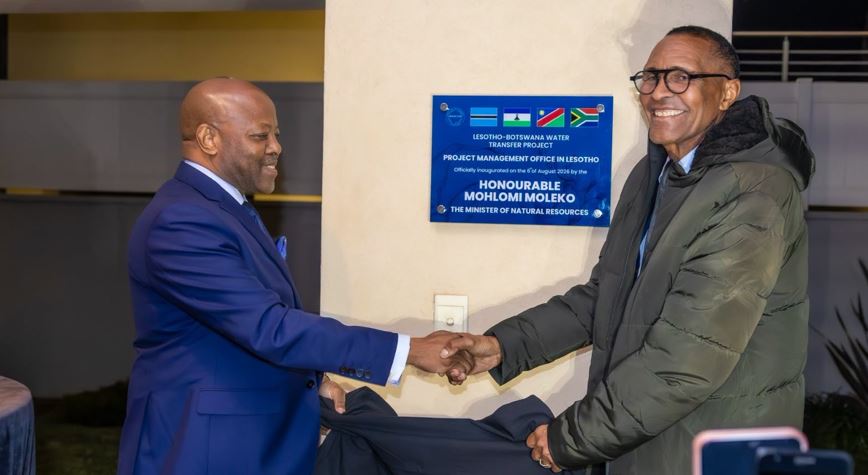
The Lesotho-Botswana Water Transfer Project (LBWTP) has taken another step forward with the official inauguration of its Project Management Office (PMO) in Lesotho, marking progress in the coordination of the multi-billion-maloti project that will see Lesotho supply water to Botswana.
Botswana is set to become the second country to receive water from Lesotho, following South Africa.
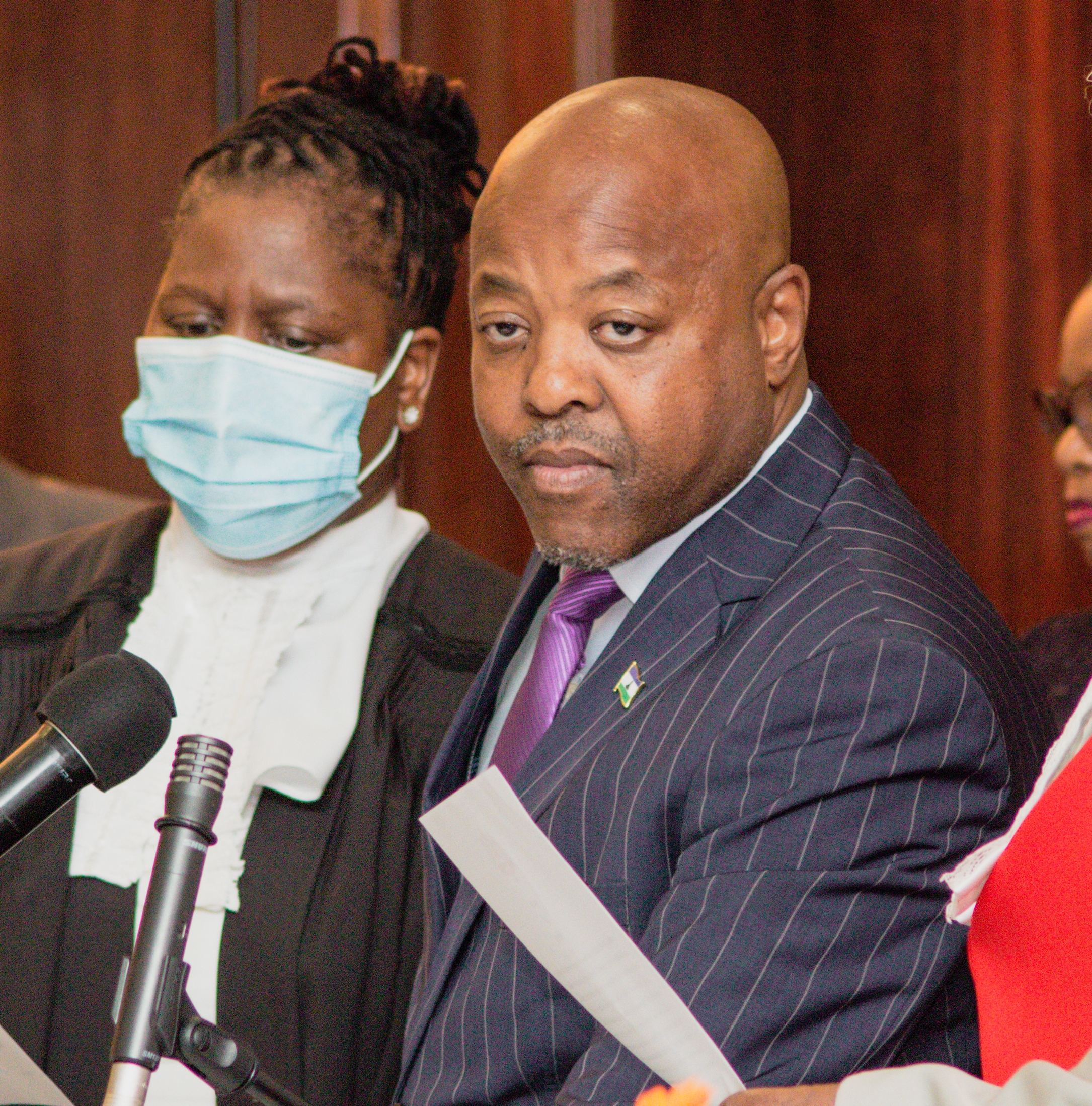
The LBWTP PMO was inaugurated in Maseru last week by the Minister of Water, Mohlomi Moleko, in collaboration with the Orange-Senqu River Commission (ORASECOM).
Although the office was initially established in 2023 and accorded diplomatic status by Lesotho, its formal launch and inauguration coincided with the ORASECOM governance meetings hosted by Lesotho under its chairmanship.
Moleko underscored the water scarcity facing the region, saying Southern Africa is among the most water-constrained regions in the world.
“Southern Africa is one of the most water-constrained regions in the world. At the same time, our economies, our communities and our ecosystems are increasingly affected by climate variability and growing demand for water. These realities remind us that water security can no longer be pursued by countries acting alone. It requires partnership, trust and institutions that enable us to plan together and invest together,” he said.
The minister said the project presents Lesotho with an opportunity to contribute to regional water security.
He said water remains a strategic resource capable of supporting economic growth, strengthening regional partnerships and improving livelihoods. However, he stressed that large infrastructure projects should ultimately be judged by their impact on people’s lives.
Botswana President Advocate Duma Boko visited Lesotho from July 15 to 18, 2025, during which he, among other activities, toured the proposed water project site at Makhalaneng.
As the project progresses, the PMO is expected to continue engaging governments, communities, development partners and other stakeholders during the remaining feasibility phase to ensure that the project is developed transparently and responsibly and in accordance with international environmental and social safeguard standards.
ORASECOM Executive Secretary Comfort Molosiwa described the inauguration of the office as a milestone in cooperation among the participating member states.
“The establishment of this Project Management Office demonstrates the confidence of the participating governments in the value of a dedicated institution to coordinate this important preparatory phase. The office exists to facilitate, coordinate and manage the completion of the feasibility studies that will enable informed decisions on the future implementation of the project,” he said.
Molosiwa said significant progress had already been made, noting that the pre-feasibility studies had been completed, providing the strategic basis for the project.
He said the Technical Feasibility Study for the proposed dam on the Makhaleng River had also been completed, marking another milestone in project preparation.
However, four critical studies remain before the project can advance to the next phase. These are the Environmental and Social Impact Assessment (ESIA) for the proposed dam; the ESIA for the water conveyance system; the Technical Feasibility Study for the water conveyance system; and the Financial, Legal and Institutional Structure Study.
Molosiwa said the outstanding studies would provide the technical, environmental, financial, legal and institutional foundations upon which future investment decisions would be based.
“We recognise that major water infrastructure has the potential to transform lives, strengthen economies and enhance regional resilience. At the same time, we recognise that these types of projects can have profound implications for the communities and environments in which they are developed. It is therefore our collective responsibility to ensure that project preparation is rigorous, transparent and responsive to the needs and aspirations of those who may be affected,” he said.
Last year, the Southern African Development Community (SADC) Project Preparation and Development Facility (PPDF) approved US$1.83 million, approximately M29.5 million, in funding to advance the LBWTP.
The funding will support two critical preparatory components: the ESIA covering the proposed dam and water conveyance infrastructure, and a comprehensive feasibility study addressing the financial, legal and institutional frameworks required for the project’s long-term sustainability.
Molosiwa said that while the LBWTP is being developed within the ORASECOM framework and involves Lesotho, Botswana and South Africa, Namibia participates in the Joint Study Management Committee as an “Official Observer”.
The project is expected to span more than 700 kilometres, channelling water from Lesotho’s highlands through South Africa to Botswana.
Summary
- The Lesotho-Botswana Water Transfer Project (LBWTP) has taken another step forward with the official inauguration of its Project Management Office (PMO) in Lesotho, marking progress in the coordination of the multi-billion-maloti project that will see Lesotho supply water to Botswana.
- As the project progresses, the PMO is expected to continue engaging governments, communities, development partners and other stakeholders during the remaining feasibility phase to ensure that the project is developed transparently and responsibly and in accordance with international environmental and social safeguard standards.
- The office exists to facilitate, coordinate and manage the completion of the feasibility studies that will enable informed decisions on the future implementation of the project,” he said.
Thoboloko Ntšonyane is a dedicated journalist who has contributed to various publications. He reports on accountability, human rights, exposes corruption and wrong doing by those in power. He reports have exposed corruption, abuse of power, fraud, misconduct and negligence. He subscribes to evidence-based reporting. He reports on governance, parliament, courts, climate change, human rights, sexual and reproductive health rights (SRHR), health, business and agriculture. He gives a voice to the marginalised while also demanding accountability. His work inspires change, triggers dialogue and also promote transparency in a society.