

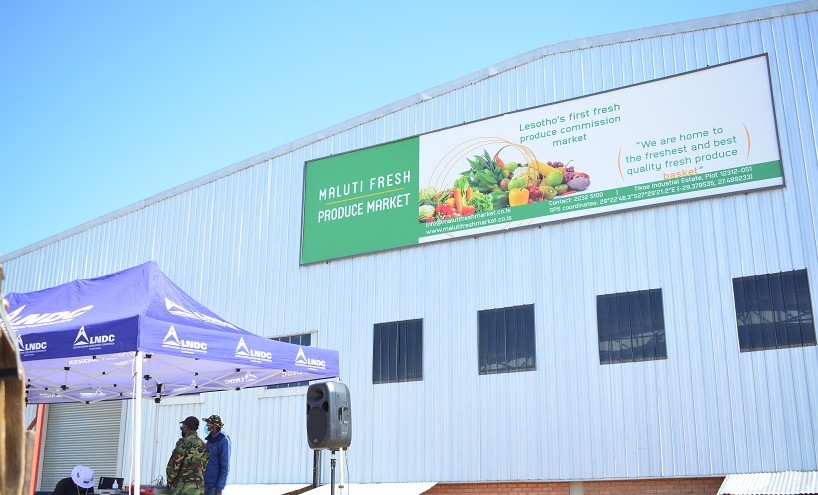
…LNDC refutes this, claiming the facility is merely relocating
…Agricultural ministry is unaware of either closure or relocation
Barely five years into operations, Maluti Fresh Produce Market is reportedly facing closure, a decision that is likely to directly affect local fresh-produce farmers.
According to insider information obtained by this reporter, the Lesotho National Development Corporation (LNDC), which manages the centre, has instructed employees to prepare for closure, with the facility set to shut down on March 31, 2026.
Launched in October 2021, the Fresh Produce Market employs approximately nine full-time staff members.
“They were informed verbally that March 31, 2026, would be their last day at work, following a management decision to close the facility due to its lack of sustainability,” a source familiar with the situation revealed.
“They were told that the market would remain closed pending an investor to finance daily operations,” the source added.
Maluti Fresh Produce Market was established to provide farmers with market access, offer post-harvest services (washing, sorting, packaging), primary processing (peeling, cutting, dicing), cold room storage, a transparent trading platform, consultation and advice, job creation, and advantageous location and facilities.
The nine employees were reportedly waiting for an announcement regarding their relocation to the Masianokeng/Basotho Canners Facility, a move announced last year. However, to their shock, they now face unemployment in the coming month.
Affectionately known as Tikoe, the market served as a hub for various Basotho farmers producing cash crops. Some farmers have confirmed to this paper that they were turned away when attempting to deliver their consignments since last Monday, being informed that the facility is closing down.
Many farmers have invested significant resources in production, as this centre served as a one-stop shop for the country’s farming value chain.
“This shutdown will threaten our income and disrupt our businesses. What is worse is that no one thought it necessary to inform the farming community about this; it is very angering,” said one farmer who wished to remain anonymous.
Maluti Fresh Produce Market is a unique facility in Lesotho, designed specifically to meet the needs of local farmers and ensure they have a reliable marketplace for their fresh produce. It also provides agricultural producers with solutions for storage, processing, and trading under one roof.
The market allows farmers to bring their produce directly to consumers, ensuring prompt payment for their goods. This has enabled farmers to scale their operations and engage in international trade as well as with established retailers.
The construction and establishment of this facility were made possible through the support of funders and LNDC via the Enhanced Integrated Framework (EIF) Project, initiated by the International Trade Centre (ITC).
It plays a vital role in meeting market demands and supporting the sustainability of local farmers.
In response to questions from this publication, Tiisetso Moremoholo, the LNDC’s Corporate Communication Manager, denied reports of the market’s closure, stating that the facility is instead relocating.
“The Lesotho National Development Corporation has not decided to close the Maluti Fresh Produce Market Centre. Rather, the Market Centre is being relocated to the Masianokeng Cannery building. The equipment at the Market Centre will be dismantled and reassembled at the new location, which will necessitate a temporary halt in input from Basotho farmers, as the produce would spoil without adequate storage facilities.
“This move has been prompted by the opening of a textile factory that will commence immediately after the refurbishment of the outgoing Market Centre, creating 500 jobs,” said Moremoholo.
She further emphasised that the Maluti Fresh Produce Market Centre remains a priority for the LNDC and will continue to serve farmers across the country while assisting them in accessing markets.
“The Corporation is also seeking a private investor to acquire and optimally operate the market centre at its new location,” Moremoholo revealed.
However, Moremoholo did not address questions regarding stakeholder involvement in the LNDC’s decision regarding the Market Centre.
When contacted for a reaction on the impact of the relocation, Lekhooe Makhate, the Director of Marketing in the Ministry of Agriculture, Food Security and Nutrition, expressed ignorance of any developments.
Makhate stated that, to his knowledge, there have been no decisions regarding either the relocation or closure of the Market Centre.
“While there is a new directive that all communications to the ministry be routed through the office of the Principal Secretary, I am not aware of this issue you are mentioning.
“My department is responsible for licensing market centres in the country, and if any changes were to be made, I trust we would have been officially informed. As far as I know, we do not have any information regarding this matter; however, I have heard the naysays, and I am not at liberty to take them to heart as I believe LNDC would have officially communicated any decision that would directly impact farmers,” he said.
Summary
- Maluti Fresh Produce Market is a unique facility in Lesotho, designed specifically to meet the needs of local farmers and ensure they have a reliable marketplace for their fresh produce.
- The equipment at the Market Centre will be dismantled and reassembled at the new location, which will necessitate a temporary halt in input from Basotho farmers, as the produce would spoil without adequate storage facilities.
- She further emphasised that the Maluti Fresh Produce Market Centre remains a priority for the LNDC and will continue to serve farmers across the country while assisting them in accessing markets.

Thoboloko Ntšonyane is a dedicated journalist who has contributed to various publications. He focuses on parliament, climate change, human rights, sexual and reproductive health rights (SRHR), health, business and court reports. His work inspires change, triggers dialogue and also promote transparency in a society.