

Blame late government payments for low wagesAllege firms with links to ministers enjoy preferential treatment
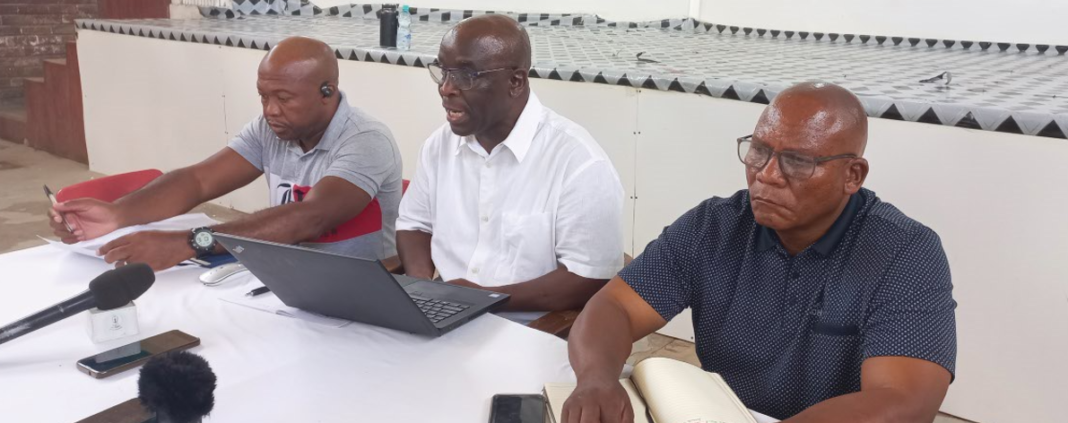
The Association of Private Security Companies has sounded the alarm over what it describes as crippling structural problems threatening the survival of the industry, placing the blame squarely on delayed and partial payments by government entities.
The association’s chairperson, Mike Nkuatsana, said private security firms are required to pay hefty annual licence fees and comply with strict regulatory requirements, yet are pushed to the brink of collapse by chronic non-payment, especially on government contracts.
His remarks come amid mounting complaints from security officers who accuse some companies of delayed salaries, underpayment and poor working conditions. While acknowledging these grievances, Nkuatsana said the sector has been infiltrated by “bad actors” whose conduct should not be used to condemn the entire industry.
“Even when companies are contracted by government, payments take unreasonably long to be processed,” Nkuatsana said. “In some cases, companies are only paid for a few months of work already performed. This forces them to scramble for survival.”
He said the local private security industry is further disadvantaged by what he described as a lack of protection against international competitors, adding that local companies are increasingly locked out of lucrative tenders.
“We are experiencing unfair competition,” he said, claiming that some institutions, including banks he declined to name, systematically exclude local firms from tender processes. As a result, some companies no longer bother to tender at all.
Nkuatsana also alleged that nepotism has taken root in the sector, claiming that certain security companies enjoy preferential treatment due to their links with politically connected individuals, including ministers. These claims could not be independently verified by the publication at the time of going to print.
He noted that high unemployment continues to push many Basotho into the private security sector, often under difficult conditions that breed conflict and instability in the workplace.
Nkuatsana further criticised the industry’s lack of representation at the Wages Board under the Ministry of Labour, describing private security as one of the lowest-paid sectors in the country despite its risks and responsibilities.
Although the Private Security Officers Act of 2002 provides for a regulatory board, Nkuatsana said many disputes bypass the Private Security Board and end up in court. He stressed that security officers are legally required to hold certificates and register with the board, yet enforcement remains weak.
He also raised concern over the installation of alarms and CCTV systems, saying this work falls within the mandate of licensed security companies, but is effectively unregulated due to gaps in the law.
While conceding that some companies have mistreated workers and faced consequences, Nkuatsana said the association distances itself from such practices.
“As an association, we do not defend exploitation,” he said.
Another association member, Teboho Molapo, said companies’ ability to pay incentives or improve working conditions is directly tied to timely payments from clients.
“The life of a security company depends on payments from clients,” Molapo said, adding that incentives and benefits are determined by contractual agreements.
Nkuatsana said there is currently no law stipulating a minimum wage for security officers, a gap he said leaves workers vulnerable to exploitation.
“We will not abandon this industry,” he said. “In other countries, it functions properly. We want to put it in order.”
He added that most companies that delay payments to workers are those contracted by the government.
The government, however, could not provide a specific timeframe for settling outstanding payments to service providers. Ministry of Finance Assistant Information Officer, Keneuoe Mojaki, said payment delays may arise from several factors and that Treasury processes payments only after invoices are submitted, audited and approved by contracting ministries.
“If invoices are incorrect, Treasury queries them,” Mojaki said, adding that while some payments are processed within 30 days, others may take up to 90 days depending on the contract.
Responding to allegations of politically linked companies, the association’s secretary, Tlali Tlali, said compiling such a list would be difficult, but confirmed that the association has scheduled a meeting next Wednesday for affected companies to present their cases.
He further cited nepotism, alleging that some companies enjoy an advantage due to their connections with the government of the day. Thus the publication had not verified his allegations at the time of going to print last night when he alleged that some security companies are owned by Ministers he could not divulge their names.
Nkuatsana noted that due to the high unemployment rate, many people seek jobs in the private security sector. However, he warned that conflicts often arise when people work together under difficult conditions.
He also lamented the industry’s lack of representation at the Wages Board, which falls under the Ministry of Labour, saying the private security sector remains one of the lowest-paid industries.
The Private Security Officers Act of 2002 provides for a board that oversees the industry. However, Nkuatsana said most complaints are not taken to the Private Security Board for resolution. Instead, disputes often end up in the courts.
He said security officers are required by law to hold certificates and register with the Private Security Officers Board in order to comply with regulations.
Nkuatsana also raised concern about the installation of alarms and CCTV systems, saying this falls under the mandate of security companies, yet the law is silent on the matter, allowing anyone to undertake such work.
He conceded that some companies have ill-treated their workers and have since faced consequences.
“As an association, we distance ourselves from such companies,” he said.
A member of the association, Teboho Molapo, said even where companies wish to provide incentives, this depends on how promptly clients pay them.
“The life of a security company depends on payments from clients,” he said, adding that incentives are determined by agreements with those who hire security companies.
Nkuatsana added that some companies provide food and transport allowances, but this is also based on agreements with clients. He said security officers’ wages are not fixed and depend on tender agreements.
Molapo said clients do not determine how much security officers are paid, as this is set by security companies. However, he noted that some companies are forced to compromise and settle for the bare minimum.
Tlali said the association is working with the Ministry of Education and Training on an education programme aimed at professionalising the sector and ensuring officers meet minimum qualifications. He added that a draft law has been prepared which, if passed, would require all security officers to be vetted by the Ministry of Home Affairs.
He said the current law prohibits security officers from wearing berets and highlighted the high cost of compliance, noting that a full uniform costs about M2,500, while a pump-action firearm costs roughly M20,000.
Tlali also criticised weak inspections and said the association is engaging the Ministry of Labour to prevent wages as low as M1,200. According to the 2025/2026 gazetted minimum wages, workers in sectors such as manufacturing, retail and hospitality earn no less than M2,700.
This publication established that some security companies pay officers as little as M700.
Tlali advised aggrieved officers to approach the Directorate of Dispute Prevention and Resolution (DDPR), while also noting cases where officers abandon their posts and disappear with company uniforms.
Summary
- The Association of Private Security Companies has sounded the alarm over what it describes as crippling structural problems threatening the survival of the industry, placing the blame squarely on delayed and partial payments by government entities.
- He said the local private security industry is further disadvantaged by what he described as a lack of protection against international competitors, adding that local companies are increasingly locked out of lucrative tenders.
- Nkuatsana further criticised the industry’s lack of representation at the Wages Board under the Ministry of Labour, describing private security as one of the lowest-paid sectors in the country despite its risks and responsibilities.
Thoboloko Ntšonyane is a dedicated journalist who has contributed to various publications. He focuses on parliament, climate change, human rights, sexual and reproductive health rights (SRHR), health, business and court reports. His work inspires change, triggers dialogue and also promote transparency in a society.