
Every administration has its survivors, officials who, by any ordinary political logic, should have fallen. Some survive scandals. Others outlast ministers. A few appear to operate beyond consequence, insulated from accountability by power, proximity, or political convenience.
In 2025, Prime Minister Ntsokoane Samuel Matekane presided over an administration that promised discipline, professionalism, and clean governance.
However, as the year draws to a close, a small but conspicuous group of senior officials remains firmly in place despite sustained public criticism, parliamentary rebuke, and serious allegations of misconduct.
This series, Untouchables of 2025, examines those figures many believed would, or should, have been dismissed, but were not. Whether by design, indecision, or quiet political calculation, they survived.
Their continued presence raises uncomfortable questions about accountability, political will, and the true limits of reform under the Matekane administration.
The first name on that list is unavoidable.
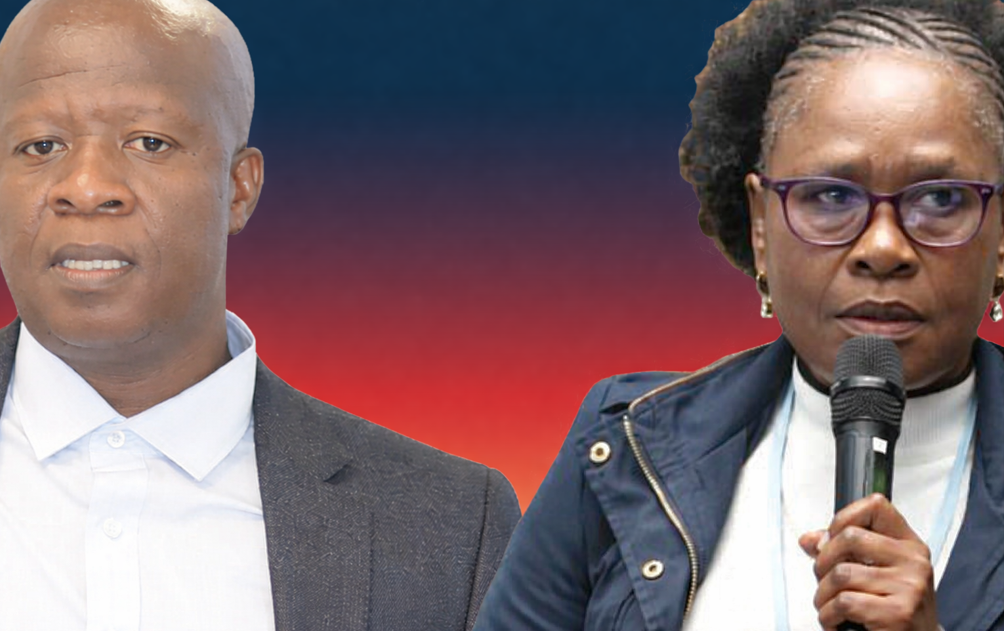
Untouchable No. 1: Tankiso Phapano
When one speaks of a name that dominated headlines throughout 2025, Tankiso Phapano rolls easily off the tongue.
Phapano is the Principal Secretary of the Ministry of Energy, a ministry that, over the past year, has been synonymous with administrative dysfunction, controversy, and open institutional conflict. From Parliament to the Public Accounts Committee (PAC), from ministerial offices to public debate, his name has surfaced repeatedly at the centre of scandal.
His relationship with the former Minister of Energy, Professor Nqosa Mahao, deteriorated sharply and publicly. What began as internal friction escalated into one of the most visible power struggles between a political head and a senior civil servant in recent memory.
By the end of it, in 2024, the minister was gone, and the Principal Secretary remained.
Mahao had repeatedly raised alarm over Phapano’s conduct, accusing him of interference in the operations of the Lesotho Electricity Company (LEC).
At one point in 2025, Phapano stunned Parliament’s Public Accounts Committee by stating that he owned a 50 percent stake in LEC – a government-owned entity directly accountable to the Ministry of Energy.
The controversies did not end there. Phapano was heavily criticised by the PAC for unilaterally dismissing Mokheseng Mokuoane, a project manager for the Lesotho Renewable Energy and Energy Access Project (LREEAP), a World Bank–funded programme. The committee questioned both the legality and propriety of the decision, especially given the sensitivities attached to donor-funded projects.
PAC members openly expressed frustration with Phapano’s conduct during his appearances before the committee. At one heated session, PAC Chairperson ‘Machabane Lemphane-Letsie rebuked him bluntly: “Your problem is that you want to do as you please, and I will not allow that. This does not make you a hero, but a zero.”
Another member, Dr Tšeliso Moroke, was equally direct: “MPs are sent by the people, while you were hired based on your qualifications. This behaviour won’t take us anywhere. You are going to respect Basotho.”
Yet even parliamentary condemnation appeared to have little effect.
Phapano is reportedly the only Principal Secretary with a government vehicle fitted with a blue light and a dedicated security detail, privileges typically reserved for political office-bearers, not career civil servants.
Questions around his political neutrality have further complicated his profile.
PSs are senior public officers and administrative heads of government ministries. In the Public Service Act, public officers, including PSs, with no stated exceptions, must not be an active member of a political party; speak in public on any party political matter; take an active part in supporting any candidate in an election; or do anything by word or deed calculated to further the party political interests of any political party.
Despite legal prohibitions on “active” politics, Phapano was recently seen attending a rally of the ruling Revolution for Prosperity (RFP), raising speculation that he may be politically active in violation of the law.
Professor Mahao, before his dismissal, repeatedly complained about corruption within the Ministry of Energy and at LEC. Despite the seriousness of these allegations, no public investigation has been launched, no findings released, and no corrective action taken by the government.
Instead, it was Mahao who ultimately paid the political price. He was removed from the energy portfolio after unsuccessfully seeking Prime Minister Matekane’s intervention to resolve his increasingly toxic relationship with Phapano.
As 2025 ends, the most striking fact is not the volume of allegations or the intensity of public criticism. It is the outcome. Despite repeated controversies, parliamentary rebukes, and sustained calls for accountability, Tankiso Phapano remains firmly in office.
Prime Minister Matekane’s reluctance to act against the Principal Secretary is telling. Whether it reflects political calculation, institutional weakness, or quiet endorsement, the message is unmistakable: in the Matekane era, some officials are simply untouchable.
Untouchable No.2: Principal Secretary ’Maphakamile Xingwana – The Environment Ministry’s Iron Hand
If Lesotho’s bureaucracy were a battlefield, ’Maphakamile Xingwana would be its unmovable fortress. In 2025, she became the epicentre of controversy, her name synonymous with the Ministry of Environment and Forestry’s chaos. Staff whisper of a reign of terror, minister’s plead in vain for intervention, and yet she remains firmly in place, untouchable.
The year began with a familiar pattern. Contradictory communications about her whereabouts sowed confusion not just among ministry directors, but also at the very top. In late August, Xingwana requested permission from Government Secretary Teboho ’Mokela to be away from September 8 to 10 to attend the Second Africa Climate Summit in Addis Ababa, Ethiopia.
She named her deputy, Apesi Ratšele, as acting PS.
Two days later, she sent a separate memo internally, claiming she would be away from September 1 to 12 on “other official duties” and appointed Nkuebe Lerotholi, Director of Soil and Water, to oversee her office. The minister, directors, and staff were left scratching their heads, unsure who, if anyone, was in charge.
This confusion was hardly new.
In 2024, Minister Letsema Adontši formally requested her removal, citing obstructionist behaviour and a toxic management style that prevented him from effectively running the ministry. He reported that she barred directors from accessing his office without her permission, delayed or refused authorisation of documents, and hoarded government resources, including no fewer than four vehicles, despite being entitled to only one.
Insiders painted a picture of a ministry frozen under her iron grip. Officers who spoke up faced retaliation: transfers, stalled projects, or outright exclusion from decision-making. Requests for professional development or participation in international conferences were blocked at the last minute, sometimes without explanation. Donor-funded projects suffered when vehicles or funds were withheld, and morale plummets.
“She crushes initiative and punishes professionalism,” one senior officer said, echoing the sentiments of many within the ministry.
Yet, despite repeated pleas from both the minister and senior staff, Xingwana remains firmly in her position. Prime Minister Matekane’s apparent indifference, or careful political calculation, has allowed her to survive scandals that would topple most. Each act of audacity, each contradictory memo or confiscated vehicle, reinforces her image as untouchable.
By the end of 2025, Xingwana has not merely weathered controversy; she has become its defining figure within the environmental bureaucracy. Critics argue that her continued presence undermines accountability and public trust.
Supporters, or those who dare not speak, see a tenacious civil servant navigating a difficult and complex ministry in a country where political intervention is often uneven. Whatever the truth, she remains a singular force: unbowed, unrepentant, and, for now, untouchable.
Summary
- Phapano is the Principal Secretary of the Ministry of Energy, a ministry that, over the past year, has been synonymous with administrative dysfunction, controversy, and open institutional conflict.
- At one point in 2025, Phapano stunned Parliament’s Public Accounts Committee by stating that he owned a 50 percent stake in LEC – a government-owned entity directly accountable to the Ministry of Energy.
- Despite legal prohibitions on “active” politics, Phapano was recently seen attending a rally of the ruling Revolution for Prosperity (RFP), raising speculation that he may be politically active in violation of the law.

Authored by our expert team of writers and editors, with thorough research.