
In the quiet highlands of Mokhotlong’s Mangaung village, a young woman is transforming tradition, resilience and creativity into a livelihood, one stitch at a time.
Katleho Duma (20) is steadily carving a name for herself in the arts and crafts space, turning locally sourced mohair into beautifully knitted products, despite limited resources and significant challenges.

Duma’s journey is one shaped by determination rather than convenience. She attended Seeiso High School and later completed her Grade 11 at Senkoese High School. Like many young Basotho, her path after school was disrupted by financial constraints.
In 2024, she enrolled at a hand craft school where she learned practical skills such as working with wood planks, installing ceilings and tiles, and interior and exterior decoration. However, a lack of funds forced her to discontinue her studies before completing the course.
Rather than surrendering to circumstance, Duma redirected her energy to a skill she had known since childhood, working with wool. In May last year, she began knitting seriously as a way to earn a living. Although she had basic knowledge of knitting, her experience was limited at the time.
The turning point came when she met Matšitso Sefate, a fellow craft enthusiast who encouraged her to pursue knitting with purpose and consistency.
Through mentorship and collaboration, Duma’s skills rapidly evolved. Together with Sefate, she began learning advanced techniques from online platforms such as TikTok, proving that digital spaces can be powerful tools for skills development, even in remote rural areas. The duo shared ideas, experimented with techniques and gradually refined their craft.
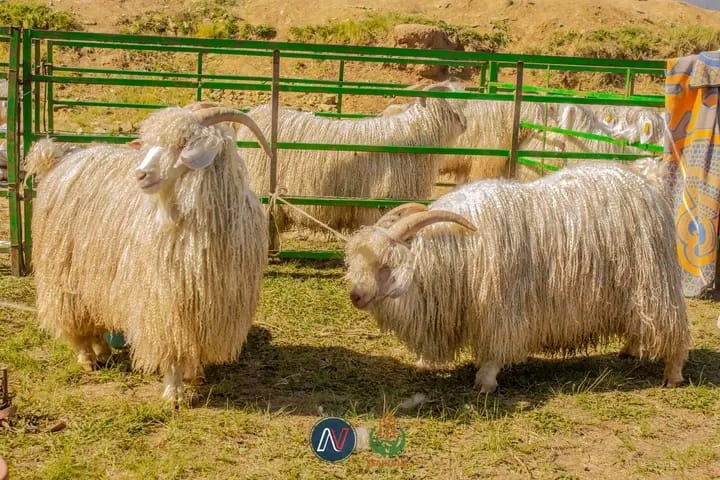
One of the most remarkable aspects of Duma’s work is her use of local mohair to create yarn from scratch. She explained that they rely on simple, accessible methods passed down through practice and innovation.
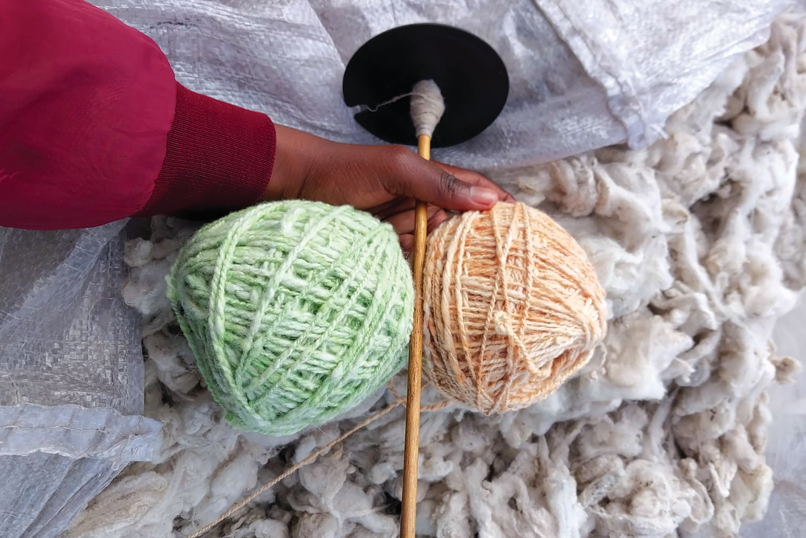
The mohair is first washed using ordinary liquid soap and left to dry naturally. Once dry, the wool is brushed to stretch and soften it. Using handmade tools known locally as mankalanyane, the wool is then spun and rolled into yarn by hand.
Colouring the wool is equally creative and resourceful. With no access to industrial dyes, Duma and her peers use whatever is available, drink powders such as Op-Op, beetroot water and other natural or household colouring agents to produce vibrant hues. The result is uniquely coloured yarn that reflects both creativity and local ingenuity.
However, the journey has not been without challenges. Duma notes that maintaining consistent measurements while spinning yarn remains a difficulty. Variations in thickness, sometimes too thin or too thick, which can affect the quality of the final product. Despite this, she views each challenge as a learning opportunity rather than a setback.
For her, knitting is more than a means of survival; it is a statement of independence. She is clear about her motivation of not wanting to sit idle, waiting for government assistance in a country grappling with high unemployment. Instead, she is focused on using her hands, knowledge and determination to put food on the table and build a future.
Looking ahead, Duma and her collaborators share an ambitious vision. They dream of opening a handicraft school where they will teach others how to knit and produce high-quality looping yarn. Their long-term goal is to establish a company that produces premium wool products locally, adding value to Lesotho’s mohair instead of exporting raw materials to other countries.
She believes Lesotho has the potential to lead in wool production beyond farming, by empowering young people with processing and creative skills. Her story is a reminder that arts and crafts are not merely cultural expressions but viable economic opportunities.
Duma concludes her journey with words of encouragement to fellow youth: never be afraid to start small, start late, or even start over. What matters is beginning and continuing. Every skill learned, every lesson faced and every step taken builds the future. She urges young people to work hard even when unseen, stay hungry for knowledge, and remain persistent.
“Success doesn’t always come fast,” she says, “but those who keep showing up, who learn, unlearn and start again, become unstoppable. Your dreams are valid. Chase them with courage.”
Summary
- In the quiet highlands of Mokhotlong’s Mangaung village, a young woman is transforming tradition, resilience and creativity into a livelihood, one stitch at a time.
- In 2024, she enrolled at a hand craft school where she learned practical skills such as working with wood planks, installing ceilings and tiles, and interior and exterior decoration.
- Instead, she is focused on using her hands, knowledge and determination to put food on the table and build a future.

I am an IT officer by day, immersed in the world of technology, troubleshooting systems, and ensuring everything runs smoothly. Now, my passion lies in storytelling. I am a writer at heart, fascinated by the power of words to inform, engage, and inspire.