
In a rare moment of visibility for one of Lesotho’s most invisible workforces, herd boys have broken their silence to deliver a searing indictment of a system that has left their wages frozen for generations while they guard the nation’s livestock under brutal highland conditions.
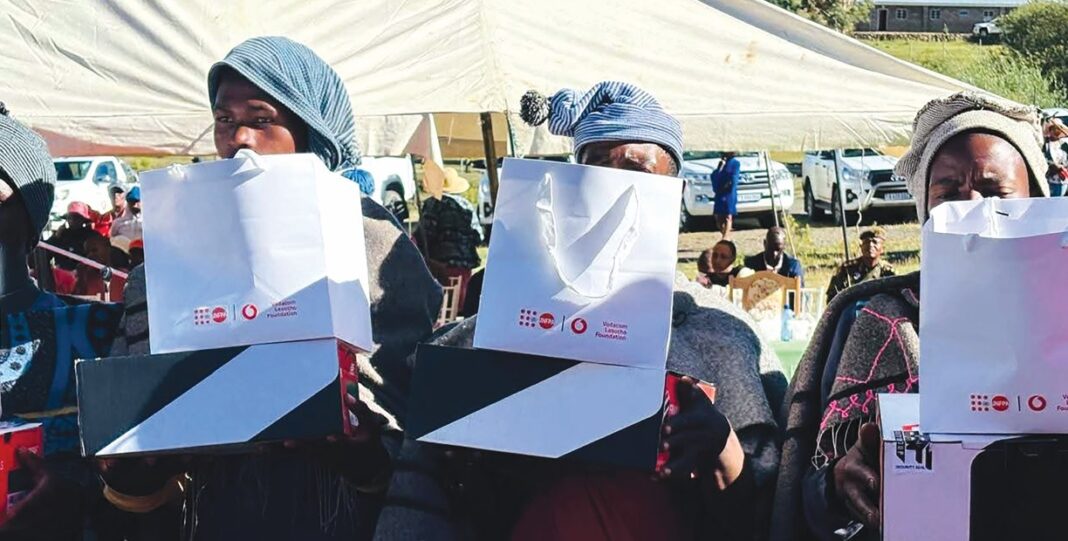
The outcry erupted during a ceremony at Matsoaing Herd Boy School, where 130 shepherd learners received hygiene kits from Vodacom Lesotho (VCL). But what began as a celebration quickly became a platform for confronting decades of systemic neglect.
“The herd boys are the most wounded among us because of how they are treated. They are frequently violated and overlooked,” declared Chief Mofoka Letsie, speaking on behalf of the Area Chief for Matsoaing.
The chief’s words carried the weight of half a century of witnessing the same exploitation repeat itself.
“I am nearly 60 years old, yet the payment for a herd boy has remained ten sheep or one cow per year for as long as I can remember,” Letsie revealed.
“When we fight for salary increments across national sectors, the herd boys are forgotten. Their pay remains frozen in time.”
‘We are generally not cared for’
Rapelang Rapheello, a herd boy from Maphiring, stood before the gathering to represent his peers. He expressed gratitude to UNFPA, Vodacom Lesotho, and the educators teaching them about hygiene, land conservation, and their fundamental rights. But Rapheello refused to sanitise the reality of their existence.
“We are generally not cared for,” he shared bluntly. “When we depart for the cattle post, we are often provided with nothing but maize meal and salt. We are expected to figure out how to survive on our own. On top of that, our payment is entirely unsatisfying, especially considering we work under such extreme and harsh conditions.”
The image he painted was of boys as young as eight or nine dispatched to remote mountains for months at a time, equipped with minimal food, no wage security, and zero legal protection, all while safeguarding the primary wealth of Basotho families.
A call for law, not charity
Chief Letsie directed a pointed plea to the Minister of Youth, Gender, and Social Development, Pitso Lesaoana, who was present at the gathering. He did not ask for handouts. He demanded legal protection.
“We plead with the government to enact a law that protects herd boys. It should explicitly state that anyone herding animals, whether for their parents or an employer, must be paid a fair wage,” he insisted.
“Furthermore, their salaries must be reviewed periodically, just like any other professional sector.”
Lesaoana, did not mince words in response.
“It is unacceptable that some children do not even know how much they earn or where their salaries go,” Lesaoana stated. “When parents take their children’s wages, that is pure human trafficking and exploitation.”
His acknowledgment that parents themselves are often the exploiters laid bare the uncomfortable truth at the heart of the herd boy crisis which is that the system of abuse is intergenerational, normalised, and protected by silence.
Beyond charity: A structural crisis
The handover of boots, overalls, towels, and hygiene products by the Vodacom Foundation brought temporary relief. The United Nations Population Fund (UNFPA) has mobilised partners including Letšeng Diamond Mine, Nedbank Lesotho, and SolidarMed to address the needs of marginalised youth in the highlands.
But UNFPA Country Representative John Kennedy Mosoti made clear that material aid is only the beginning.
“Our role is to ensure that no young person is left behind, especially those in remote areas like Mokhotlong,” Mosoti said, stressing the need to tackle structural inequalities including gender-based violence and limited access to reproductive health services.
The visit followed a high-level stakeholder tour last November, where partners engaged directly with students to understand their socio-economic hardships.
That these discussions are now translating into tangible support is progress. But as Chief Letsie’s words underscored, dignity cannot be donated, it must be guaranteed.
Education as liberation
Sister Elizabeth Lerotholi acknowledged the ongoing challenges at Matsoaing School, including resource constraints and unpaid staff. However, Lerotholi praised the learners’ determination.
The success seen so far, many learners can now read and write, is a direct result of sustained partner support. Through specialised workshops, students are learning that their circumstances are not inevitable and that their rights exist, even if unrecognised by law.
The question that remains
As the ceremony concluded and the herd boys returned to their posts, one question hung in the cold Mokhotlong air. Why, in a nation that proudly calls itself the Kingdom in the Sky, are those who safeguard its primary source of wealth forced to survive on maize meal, salt, and the hope that this year’s ten sheep might actually be paid?
Chief Letsie’s voice echoed long after he stopped speaking: “Their pay remains frozen in time.”
For Lesotho’s herd boys, the thaw cannot come soon enough.
Summary
- In a rare moment of visibility for one of Lesotho’s most invisible workforces, herd boys have broken their silence to deliver a searing indictment of a system that has left their wages frozen for generations while they guard the nation’s livestock under brutal highland conditions.
- The image he painted was of boys as young as eight or nine dispatched to remote mountains for months at a time, equipped with minimal food, no wage security, and zero legal protection, all while safeguarding the primary wealth of Basotho families.
- His acknowledgment that parents themselves are often the exploiters laid bare the uncomfortable truth at the heart of the herd boy crisis which is that the system of abuse is intergenerational, normalised, and protected by silence.
Ntsoaki Motaung is an award-winning health journalist from Lesotho, specializing in community health stories with a focus on sexual and reproductive health and rights, as well as HIV. She has contributed to platforms like “Be in the KNOW,” highlighting issues such as the exclusion of people with disabilities from HIV prevention efforts in Lesotho.
In addition to her journalism, Ntsoaki serves as the Country Coordinator for the Regional Media Action Plan Support Network (REMAPSEN). She is also a 2023 CPHIA Journalism Fellow.