
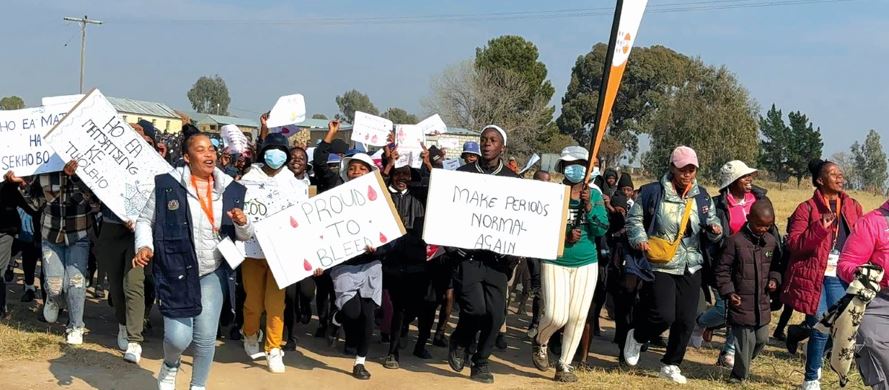

In Mafeteng, a new chapter began for girls and young women on Friday as the Ministry of Gender, Youth and Social Development, with support from the United Nations Population Fund (UNFPA), launched the Menstrual Health and Hygiene Model. Among the many voices at the event, it was the words of young Polo Letsie that touched the hearts of everyone present, reminding the nation of the real impact this initiative has on young lives.
The launch brought together government officials, local leaders, development partners, teachers, parents, and students, all united by a common mission: to ensure that no girl in Lesotho misses school or loses her dignity because of menstruation.
Letsie, speaking on behalf of her fellow adolescent girls and young women, expressed deep gratitude for the dignity kits, packs containing sanitary towels, distributed during the event.
“We are very proud to be part of this commemoration,” she said. “These sanitary towels may seem like a simple gift, but for many of us, they mean dignity, comfort, and peace of mind. Your support reminds us that we are not alone. We are seen. We are cared for.”
For Letsie and countless girls like her, access to menstrual products is far more than a matter of convenience; it is the difference between attending school each day with confidence or staying home in fear and shame.
She shared how, at her school, teachers are already helping girls understand their bodies and manage menstruation with dignity. Special rooms in the girls’ toilets allow for privacy and cleanliness, and teachers ensure that girls have the products and support they need.
“From Grade 4 to Grade 7, we are taught about physical changes in boys and girls. Our teachers are creating a pure and friendly world by doing so. To all boys, brothers, and fathers, let us support the girls,” Letsie said, calling on everyone in the community to play their part.
The new Menstrual Health and Hygiene Model aims to extend this support beyond Polo’s school, reaching across Mafeteng and, eventually, the entire country. The programme is being piloted in five community councils, covering 68 primary and high schools, as well as out-of-school girls. Approximately 3,000 women and girls are set to benefit from a year’s supply of menstrual products through this initiative.
According to Sister Challa from the Mafeteng District Health Management Team (DHMT), menstruation has long been a source of worry, shame, and even danger for many girls in Lesotho.
“Without access to proper sanitary products, some girls are forced to miss school, use unsafe materials, or even risk their health. In some cases, girls have had to make risky choices just to get pads, putting them at risk of early pregnancy, disease, and sexual exploitation,” she said.
The statistics shared at the launch underscore the severity of these challenges. Sister Challa reported that in 2025 alone, there were 1,328 young people already on antiretroviral therapy (ARVs) in the district, reflecting the ongoing struggle with HIV among the youth.
“Early and unintended pregnancies remain a concern: five cases were recorded among girls aged 15 and under, 389 among girls aged 15–19, and 531 in the 20–24 age group. There were also 83 cases of miscarriage or abortion-related complications. Cases of sexual assault remain troubling. In 2025, there were seven reported cases of sexual assault among girls aged 10–14, 19 among those aged 15–19, and five among those aged 20–24,” she explained.
Sister Challa noted, however, that many more cases likely go unreported.
Inspector ‘Mamosa Maile from the Child, Gender and Protection Unit (CGPU) highlighted additional challenges. She said that in 2025, 29 cases of sexual assault were reported among girls aged 2–14, and 55 among girls aged 15–35. In 2026 so far, there have already been 10 cases among girls aged 2–14 and 26 in those aged 15–35.
“These numbers show the urgent need for education, support, and protection for girls across Lesotho,” she said.
Letsie’s story, and those of her classmates, highlight the critical need for education and support, not only for girls, but for boys, parents, and the wider community. “Our teachers talk to us about our body changes, give us sanitary towels, and make sure we are cared for. This calls for thanksgiving to our government,” she said.
The importance of this new programme was echoed by many speakers at the event. UNFPA Country Representative John Kennedy Mosoti declared, “These are not just pads; they are dignity restoration.” He stressed that girls in rural areas face the greatest challenges and called on everyone, parents, teachers, leaders, and boys, to support girls and end the stigma surrounding menstruation.
Bernard Mokhachane of the Ministry of Gender, Youth and Social Development explained that the programme is being piloted in Mafeteng, Mokhotlong, and Maseru before being rolled out to the rest of the country. He emphasised that the model will also support out-of-school girls, ensuring no one is left behind.
The event also highlighted the need for inclusion. Refiloehape Sesinyi from the Lesotho National Federation of Organisations of the Disabled (LNFOD) spoke about the challenges faced by women and girls with disabilities, who often have less access to information and support. She welcomed the programme’s commitment to inclusivity, regardless of age or ability, and called for greater awareness among families and caregivers.
Deputy Prime Minister Justice Nthomeng Majara reminded everyone that menstruation is a natural part of life and encouraged parents to talk openly with their children. “Girls should not miss school because of their periods,” she said. “Let us make sure our children know they are supported.”
The Menstrual Health and Hygiene Model in Lesotho is more than a project. It is a promise to every girl like Polo Letsie that her dignity matters, her dreams are important, and her future is bright. As Letsie herself said, “Your support reminds us that we are not alone. You gave us comfort, hope, and respect.”
Summary
- In Mafeteng, a new chapter began for girls and young women on Friday as the Ministry of Gender, Youth and Social Development, with support from the United Nations Population Fund (UNFPA), launched the Menstrual Health and Hygiene Model.
- Among the many voices at the event, it was the words of young Polo Letsie that touched the hearts of everyone present, reminding the nation of the real impact this initiative has on young lives.
- According to Sister Challa from the Mafeteng District Health Management Team (DHMT), menstruation has long been a source of worry, shame, and even danger for many girls in Lesotho.
Ntsoaki Motaung is an award-winning health journalist from Lesotho, specializing in community health stories with a focus on sexual and reproductive health and rights, as well as HIV. She has contributed to platforms like “Be in the KNOW,” highlighting issues such as the exclusion of people with disabilities from HIV prevention efforts in Lesotho.
In addition to her journalism, Ntsoaki serves as the Country Coordinator for the Regional Media Action Plan Support Network (REMAPSEN). She is also a 2023 CPHIA Journalism Fellow.