
Illegal occupation of road reserves continues to hinder infrastructure development in Lesotho, prompting authorities to intensify clearance operations as part of a M1.86 billion roads and transport programme for the 2026/27 financial year.
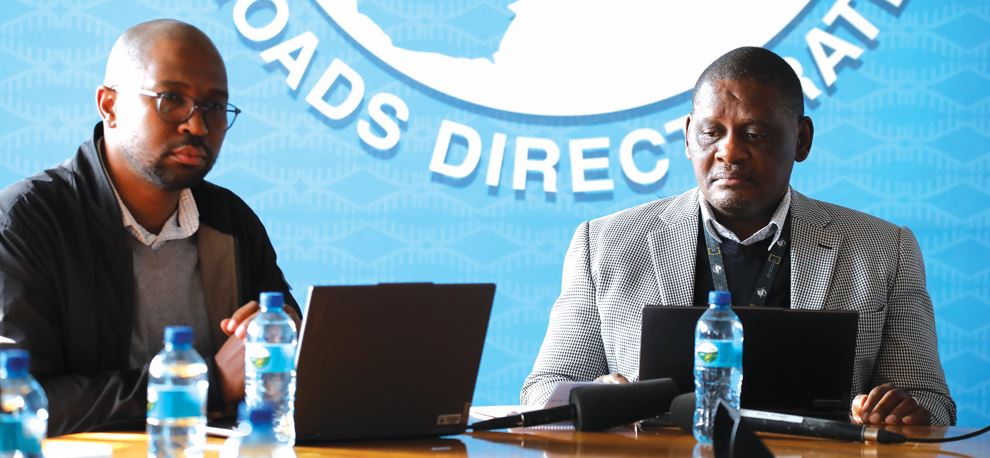
The challenge was highlighted by Roads Directorate Director General Teboho Mokhoane during the Directorate’s Annual Works Programme presentation, where he identified road reserve encroachment as one of the biggest obstacles to road development and maintenance.
Mokhoane said the Roads Reserve Programme would be prioritised this year to facilitate the rollout of several infrastructure projects under the government’s transport development agenda.
The initiative will involve the removal of illegal structures built within road reserves and surveys covering 640 kilometres of urban roads to determine the extent of encroachment. Initial operations will focus on the TY Central Business District, Semonkong town and Seretse Khama Road in Maputsoe.
“The protection of road reserves is essential for road maintenance, public safety and future expansion projects,” Mokhoane said.
He noted that illegal occupation of road corridors has persisted for years, complicating maintenance, rehabilitation and traffic management works.
“When people build shops, houses or fences on road reserves, engineers cannot do their work properly,” he said.
The Director General described encroachment as one of the Directorate’s most difficult operational challenges, often requiring police support.
“We normally seek assistance from the police during such operations. At times we are threatened with guns,” he revealed.
Roads still awaiting surveys include Kingsway, Thabong Circle–Lakeside, Ha-Motšoeneng–Ha Makhoathi, Mookoli-Tšosane, Sekamaneng–Ha Foso and Seputana–Maqalika via Temong.
Beyond encroachment, Mokhoane identified climate change as a growing threat to Lesotho’s road network, warning that increasingly intense rainfall is causing flooding, damaged bridges and overwhelmed drainage systems.
“The rains we are experiencing today are not the same as those experienced in the past,” he said.
In response, engineers are incorporating larger culverts and stronger drainage systems into road designs to improve resilience against extreme weather.
Despite these challenges, Mokhoane said the Roads Directorate has significantly improved its emergency response capacity.
“Unlike in the past, we are now able to restore movement within 24 hours in most cases,” he said.
The Directorate is also battling vandalism of road infrastructure, including theft and destruction of road signs, traffic equipment and street lights.
“This increases repair costs and puts drivers and pedestrians at risk,” Mokhoane said.
To address the problem, street lighting will be rehabilitated along key routes, including Kolonyama–Maputsoe–Hlotse, Butha-Buthe–Caledon’s Poort, Matala–Masianokeng, Van Rooyen’s Gate–Matholeng and Masianokeng–Airport Junction.
The Roads Directorate has been allocated M1,861,492,888.40 for the 2026/27 financial year. Funding will come from the Government of Lesotho, the Road Fund, the World Bank and the Ministry of Finance and Development Planning.
According to Mokhoane, the programme aims to improve connectivity, enhance road safety and stimulate economic growth.
Major projects include upgrading the Thaba-Tseka–Katse, Matlali–Lebakeng and Ha Paramente–Ha Mpharoane roads to bitumen standard, as well as constructing the long-awaited Tebellong Bridge and approach roads in Qacha’s Nek.
The Directorate will also design 13 future projects, including the Butha-Buthe–Oxbow, Mafeteng–Quthing and Moshoeshoe I International Airport Road and Runway projects. In Maseru, 13 major intersections will be redesigned to ease traffic congestion.
Other planned works include rehabilitation of 171 kilometres of paved roads and 281 kilometres of gravel roads, reconstruction of footbridges, Bailey bridges and culverts, upgrading of the Maqhena–Motsemocha Road, and rehabilitation of railway infrastructure.
However, Mokhoane warned that limited funding could affect implementation. He noted that nearly 99 percent of Lesotho’s road network requires routine maintenance, placing significant pressure on available resources.
“We may run out of funds considering the amount of work that needs to be completed and the budget that has been allocated to us,” he said.
Reflecting on the previous financial year, Mokhoane said operational challenges limited budget utilisation to between 60 and 70 percent.
“It was not an easy year. It was a tough year for us,” he said.
He added that several procurement and planning processes have since been completed, paving the way for implementation of projects such as the Maseru Border Post–Maqhaka Road upgrade. Construction at the Monontša Border Facility is also largely complete, with only staff housing remaining outstanding.
Mokhoane stressed that protecting road corridors, adapting infrastructure to climate change and curbing vandalism are essential to achieving the country’s long-term transport objectives.
“The job is no longer just building roads. It is now building roads that can survive heavy rains and floods, while also protecting the roads we already have,” he said.
Summary
- The challenge was highlighted by Roads Directorate Director General Teboho Mokhoane during the Directorate’s Annual Works Programme presentation, where he identified road reserve encroachment as one of the biggest obstacles to road development and maintenance.
- Major projects include upgrading the Thaba-Tseka–Katse, Matlali–Lebakeng and Ha Paramente–Ha Mpharoane roads to bitumen standard, as well as constructing the long-awaited Tebellong Bridge and approach roads in Qacha’s Nek.
- “We may run out of funds considering the amount of work that needs to be completed and the budget that has been allocated to us,” he said.

Senior journalist and communications professional with extensive experience in general news reporting, specializing in business and sports journalism. Skilled in public speaking, media relations, and strategic communication, with a proven ability to deliver accurate, engaging, and impactful stories.
A strong team player who thrives in collaborative environments and adapts effectively to diverse working conditions. Passionate about continuous learning, professional growth, and enhancing communication practices to meet evolving industry demands.