
Lesotho’s water sector has pledged to fast-track a review of the 1986 Lesotho Highlands Water Project (LHWP) Treaty, a commitment underscored by a damning Ombudsman investigation that found the 40-year-old agreement has failed to protect communities displaced by the multi-billion-maloti Polihali Dam.
The fast-tracking pledge is one of eleven resolutions adopted at a three-day retreat of the country’s top water institutions in Mohale’s Hoek, attended throughout by the Minister of Natural Resources. But it lands months after Ombudsman Advocate Tlotliso Polaki tabled a 50-page report calling for a comprehensive review of the Treaty, after site visits and testimony from Mokhotlong district residents affected by Phase II construction.
Polaki’s investigation, published in May, documented collapsed and cracked homes in villages including Masakong and Ha Tlhakola, some linked to tunnel blasting. One resident told investigators her house began cracking in 2023 during construction and collapsed entirely in November 2024. The LHDA told the Ombudsman 48 damaged houses had since been repaired.
The report also recorded respiratory complaints from dust in Tsekong village and described blasting noise as consistently unbearable for nearby residents, prompting a recommendation for sound barriers around affected villages.
Most damning were the compensation figures. As of December 2025, Phase I compensation arrears stood at roughly M142.2 million, with a further M473 million in future compensation costs still owed. Phase II arrears totalled about M6.8 million, with M25 million more projected.
The Ombudsman found that complaints dating as far back as 2012, including 69 community thickets and fuel-tree areas cleared for dam construction, remain unresolved, with the LHDA saying the money is being held in its custody.
The investigation concluded that while the LHDA generally meets procedural requirements such as holding meetings and making some payments, it struggles to ensure that affected communities’ living standards genuinely hold up over time. It singled out the Treaty’s core protection, that displaced people be left “not inferior to that obtaining at the time of first disturbance,” as too low a bar for a multi-billion-dollar project, arguing affected communities should instead share directly in its wealth. Residents interviewed also argued the 50-year compensation window should run for life, to protect future generations.
The Ombudsman’s recommendations, filed under the report’s section on legislative and regulatory reform, call for the Treaty to be reviewed “in all aspects” and for the government to issue overdue secondary regulations under the LHDA Order of 1986 within twelve months.
The Treaty was signed in 1986 to transfer water from the Senqu/Orange River to South Africa’s Gauteng province in exchange for royalties and hydropower for Lesotho. It was supposed to be re-examined roughly 15 years in, around 2001, but that review never happened. Government only confirmed plans to undertake it last year, with Finance Minister Dr Retšelisitsoe Matlanyane telling Parliament that renegotiating parts of the deal was necessary to secure better terms for Lesotho. Talks between the two countries were reported to be getting under way around April this year.
The Mohale’s Hoek retreat, held at the Mount Maluti Hotel, brought together the Lesotho Highlands Development Authority, the Lesotho Highlands Water Commission, the Water and Sewerage Company, the Lesotho Electricity and Water Authority, the Department of Water Affairs, the Department of Rural Water Supply, the Office of the Commissioner of Water, the Lesotho Lowlands Water Development Project, the Lesotho Lowlands Rural Water Supply and Sanitation Project, the Lesotho Lowlands Water Supply Scheme Unit, and ReNOKA.
It produced eleven resolutions:
- Cut non-revenue water losses to the internationally acceptable level of 25 percent by 2029, through digitisation of services.
- Improve institutional collaboration and orderly infrastructure handovers, effective immediately.
- Reactivate dormant water assets and dredge dams that have fallen out of use.
- Mobilise sustainable financing and more private-sector investment.
- Strengthen procurement planning, execution and budget utilisation.
- Accelerate the enactment of long-delayed water sector legislation.
- Expand water access to communities that still lack it.
- Ensure communities affected by water projects are fairly compensated.
- Fast-track the review of the LHWP Treaty.
- Protect water catchments and build climate resilience.
- Improve how the sector reports, communicates and builds its own skills.
Presenting the outcomes, Mohlomi Moleko said the retreat had “set a proper platform to inform the development and implementation of the Water Compact,” which the sector must finalise by the end of September to benefit from government’s reallocation process.
The Ministry says the resolutions will be built into the sector’s 2026/27 priority interventions and 2027/28 strategic plan, with an implementation roadmap and accountability mechanisms to track follow-through.
The two developments now sit side by side: an independent Ombudsman investigation documenting a decade of unresolved compensation claims, damaged homes and disrupted livelihoods in the highlands, and a sector-wide commitment from the very institutions responsible for the project to fast-track the Treaty that governs it.
Whether resolution nine translates into the kind of overhaul Polaki’s report demands, rather than another round of procedural compliance without substantive change for affected communities, will be the measure of whether this review succeeds where the one due in 2001 never materialised.
LHWP is a bi-national scheme between Lesotho and South Africa, established under a 1986 Treaty. It transfers water from the Senqu/Orange River system in Lesotho’s highlands to South Africa’s Gauteng province, the country’s economic and mining heartland, while generating hydroelectric power.
In exchange for the water, South Africa pays Lesotho royalties that form a significant share of state revenue outside of taxation. It is Africa’s largest water transfer scheme.
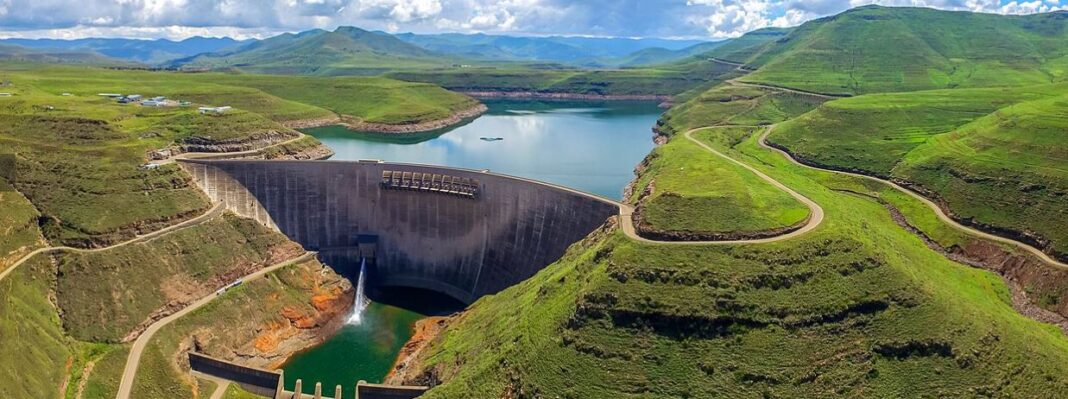
The project is being built in phases. Phase I, completed in 2003 and inaugurated in 2004, delivered the Katse Dam and the Mohale Dam along with their transfer tunnels and the ‘Muela hydropower station, the infrastructure that established the scheme’s basic water-transfer and power-generation capacity.
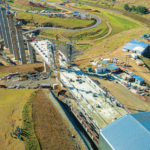
Phase II is currently under construction and centres on the Polihali Dam in Mokhotlong district, downstream of the confluence of the Senqu and Khubelu rivers, along with a roughly 38-kilometre transfer tunnel linking the new Polihali reservoir to the existing Katse reservoir. As of recent progress updates, the Polihali Dam was over 40 percent complete and the transfer tunnel over 50 percent complete, alongside advanced infrastructure such as bridges and access roads. Water delivery and hydropower generation under Phase II are expected to come online in the near term, with project close-out targeted for the 2028/29 financial year.
Both phases have been accompanied by recurring disputes over compensation, resettlement and environmental impacts in the highlands communities living closest to the dams, friction that has fed directly into recent calls, including from the Ombudsman, for the governing 1986 Treaty to be reviewed.
Summary
- Lesotho’s water sector has pledged to fast-track a review of the 1986 Lesotho Highlands Water Project (LHWP) Treaty, a commitment underscored by a damning Ombudsman investigation that found the 40-year-old agreement has failed to protect communities displaced by the multi-billion-maloti Polihali Dam.
- It singled out the Treaty’s core protection, that displaced people be left “not inferior to that obtaining at the time of first disturbance,” as too low a bar for a multi-billion-dollar project, arguing affected communities should instead share directly in its wealth.
- The Mohale’s Hoek retreat, held at the Mount Maluti Hotel, brought together the Lesotho Highlands Development Authority, the Lesotho Highlands Water Commission, the Water and Sewerage Company, the Lesotho Electricity and Water Authority, the Department of Water Affairs, the Department of Rural Water Supply, the Office of the Commissioner of Water, the Lesotho Lowlands Water Development Project, the Lesotho Lowlands Rural Water Supply and Sanitation Project, the Lesotho Lowlands Water Supply Scheme Unit, and ReNOKA.

Authored by our expert team of writers and editors, with thorough research.