
The Ministry of Trade, Industry and Business Development has urged Micro, Small and Medium Enterprises (MSMEs) to strengthen their export readiness and competitiveness so they can take advantage of the opportunities created by regional trade agreements and the African Continental Free Trade Area (AfCFTA).
Speaking in Maseru at a workshop on enhancing the capacities of Lesotho’s MSMEs to leverage regional trade agreements and the AfCFTA, Permanent Secretary Palesa Matobako said access to markets alone would not guarantee success for local businesses.
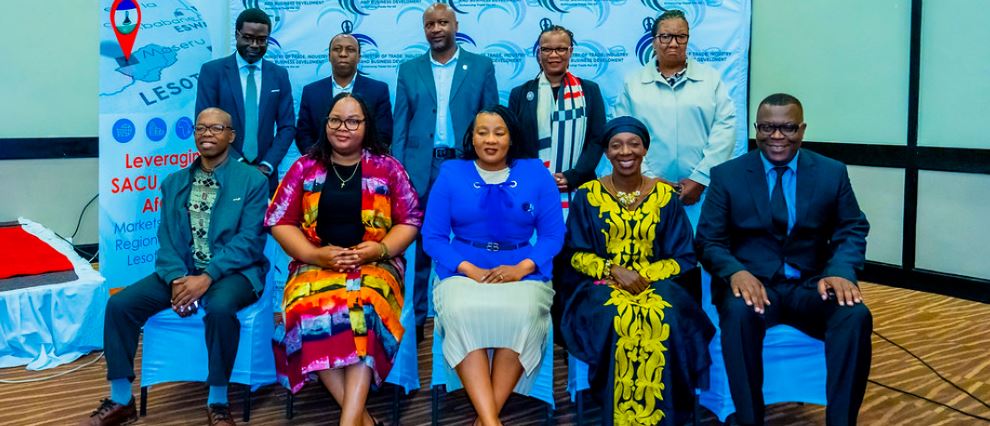
Matobako officially opened the capacity-building workshop, which seeks to equip MSMEs with the practical knowledge and tools to participate more effectively in regional and continental markets.
She said businesses must be able to identify viable markets, understand consumer demand, comply with tariffs and rules of origin, meet quality and certification requirements, and build relationships with potential buyers.
“The African market is opening up, but opportunity rewards those who are prepared,” Matobako said.
The workshop focuses on helping MSMEs to understand rules of origin and access preferential markets, use digital tools to find new African markets, connect with buyers and regional value chains, adopt digital trade and e-commerce solutions, and comply with quality and certification standards.
Dr Jacqueline Olweya told the workshop that preferential market access would have an economic impact only if it translated into real business opportunities for enterprises.
“Market access alone is, however, not enough. Preferential market access only becomes meaningful when it translates into actual business opportunities,” she said.
Olweya said MSMEs were central to Lesotho’s economic transformation because of their contribution to productive capacity, export diversification, employment and sustainable livelihoods.
She noted that international trade remained an important driver of economic development but warned that geopolitical tensions, changing trade policies, tariffs and supply-chain disruptions were creating new uncertainties for businesses.
“These developments reinforce the importance of strengthening Africa’s own markets and productive capacities,” she said.
Olweya described the AfCFTA as a historic opportunity, providing a framework for a single African market of more than 1.4 billion people with a combined gross domestic product (GDP) of more than US$3.4 trillion.
She said the agreement offered a chance for Lesotho to look beyond the limits of the country’s relatively small domestic market and to position Basotho enterprises to participate more actively in regional and continental value chains.
However, she said enterprises would need to understand where demand exists, what buyers require, which standards and regulations apply, and how rules of origin, pricing and packaging work, as well as how to establish and maintain reliable commercial relationships.
“This is precisely why this workshop is important. It addresses the entire pathway from market intelligence and opportunity identification, to export readiness, compliance and, ultimately, market linkages and sustainable business relationships,” Olweya said.
She cited the 2023 FinScope MSME Survey, which estimates that 107,753 MSME owners in Lesotho operate 138,723 enterprises and employ about 255,420 people.
According to figures presented at the workshop, MSMEs account for around 40 percent of manufacturing output, nearly 35 percent of aggregate exports, close to three percent of GDP and approximately 30 percent of total employment.
“These figures demonstrate that strengthening MSMEs is not simply a private-sector development objective. It is central to Lesotho’s broader economic transformation agenda: expanding productive capacity, diversifying exports, generating employment and creating sustainable livelihoods,” she said.
Olweya said the ambition was to see more Basotho businesses move from identifying markets to reaching buyers, and from producing mainly for the domestic market to supplying regional value chains, ultimately turning trade opportunities into sustainable enterprise growth and decent employment.
Providing the technical context, Zodwa Mabuza, Regional Adviser on Trade and Regional Integration, said Lesotho’s export model had delivered results but remained vulnerable because of the concentration of its exports. Greater market and export diversification was therefore necessary, she said.
Mabuza outlined the workshop’s objectives as strengthening MSMEs’ ability to leverage the AfCFTA through improved export readiness, trade compliance and integration into regional and continental value chains.
Her presentation focused on helping businesses use International Trade Centre (ITC) tools, identify priority markets, interpret market access conditions and turn trade data into practical business decisions.
The first day of the programme was aimed at helping businesses convert market information into informed export choices.
The official speeches were followed by a training session delivered by consultant Lira Khalala of the United Nations Economic Commission for Africa (ECA), who introduced participants to ITC trade tools, including the analysis of tariffs, non-tariff measures and market intelligence. Participants also received a presentation on the SADC SME Strategy and Competitiveness.
The workshop has brought together government, MSMEs, private-sector stakeholders, development partners and regional institutions, reflecting the collaborative approach needed to expand Lesotho’s participation in regional trade. The Southern African Development Community (SADC) Secretariat is represented by Dr Johansein Rutaihwa and Motheba Malibeng, while the Southern African Customs Union (SACU) Secretariat is represented by Terence Mabaso.
The three-day initiative is being organised with the support of the United Nations Economic Commission for Africa (UNECA), UNDP Lesotho, the United Nations Resident Coordinator’s Office and other partners. It also advances the mandate of the ECA Subregional Office for Southern Africa (ECASROSA) to accelerate intra-African trade, deepen regional integration and promote inclusive industrialisation in the region.
The ministry expects the programme to produce practical, actionable outcomes, provide tools that MSMEs can apply immediately, and strengthen networks for integration into regional value chains.
Ultimately, the initiative seeks to turn market intelligence into informed export decisions, market access into active market participation, and trade opportunities into sustainable enterprise growth, while raising the visibility and competitiveness of Made in Lesotho products across African markets.
Summary
- Speaking in Maseru at a workshop on enhancing the capacities of Lesotho’s MSMEs to leverage regional trade agreements and the AfCFTA, Permanent Secretary Palesa Matobako said access to markets alone would not guarantee success for local businesses.
- The workshop focuses on helping MSMEs to understand rules of origin and access preferential markets, use digital tools to find new African markets, connect with buyers and regional value chains, adopt digital trade and e-commerce solutions, and comply with quality and certification standards.
- She said the agreement offered a chance for Lesotho to look beyond the limits of the country’s relatively small domestic market and to position Basotho enterprises to participate more actively in regional and continental value chains.

Senior journalist and communications professional with extensive experience in general news reporting, specializing in business and sports journalism. Skilled in public speaking, media relations, and strategic communication, with a proven ability to deliver accurate, engaging, and impactful stories.
A strong team player who thrives in collaborative environments and adapts effectively to diverse working conditions. Passionate about continuous learning, professional growth, and enhancing communication practices to meet evolving industry demands.