
- as inclusive traffic lights signal new era for Kingsway
Maseru has taken its first step toward becoming a smart city, with the Roads Directorate unveiling innovative, technology-driven traffic lights along Kingsway designed to make road crossings safer and more accessible for pedestrians with disabilities.
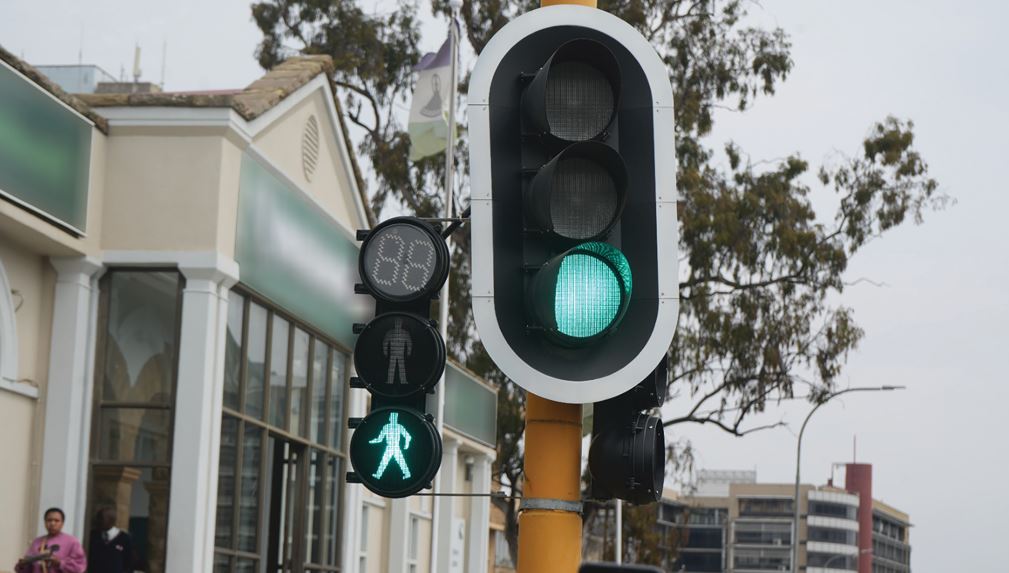
The new inclusive pedestrian signals, fitted with countdown timers and audible buzzers, were activated at the State Library intersection this week, marking the first installation of its kind in Lesotho and a milestone in the country’s move toward smarter, more responsive urban infrastructure. The initiative is expected to be extended to four intersections along Kingsway.
Speaking at the activation ceremony, Roads Directorate Director General Teboho Mokhoane said the upgraded signals were designed to provide clearer guidance to pedestrians, particularly those with visual and hearing impairments.
“The new pedestrian signals will be integrated with the existing system and will feature green walking and red standing symbols, a two-digit countdown timer and an audible buzzer for pedestrians with visual and hearing impairments,” Mokhoane said.
He said the features would help pedestrians determine when it was safe to cross, contributing to safer and more accessible movement along one of Maseru’s busy roads. Mokhoane described the launch as a historic development for the country, saying it formed part of broader efforts to build a transport network, and, more broadly, a city, that enabled people of all abilities to move safely and independently.
Minister of Public Works and Transport Matjato Moteane said busy roads could present particular challenges to people living with visual or hearing impairments. He said the pilot project demonstrated the government’s commitment to incorporating people with disabilities into infrastructure planning, and to ensuring that as Lesotho’s roads modernise, they do so in a way that responds to the needs of all Basotho without discrimination.
“Roads and public service areas must be accessible and serve everyone. Inclusiveness will be seen when all people with disabilities know how to get to work, schools and health facilities without any hindrance,” Moteane said.
He said freedom of movement was a fundamental human right and that the government’s efforts were aligned with the principles of the United Nations Convention on the Rights of Persons with Disabilities. Moteane stressed that accessibility should not be regarded as an optional feature of public infrastructure, but rather as an essential component of smart, forward-looking planning, engineering and governance.
“Accessibility is not an optional extra to be added when convenient. It is an essential part of good planning, sound engineering and responsible government,” he said.
He added that inclusion would only become meaningful when people could access workplaces, schools, health facilities and business areas without unnecessary barriers.
The Minister, however, noted that accessibility challenges extended beyond traffic signals, particularly where pedestrian walkways had been occupied by informal commercial activities. He acknowledged that such activities provided livelihoods for some Basotho, but said this should not compromise the ability of other members of society, particularly people with disabilities, to move safely.
“The right of some to make a living should not be trampled upon by others to travel safely,” he said.
Moteane also raised concern over motorists who disregard traffic signals, saying the behaviour undermined efforts to improve road safety. He called for stronger enforcement against drivers who cross intersections when traffic lights are red, warning that such conduct endangered both motorists and pedestrians.
The Minister appealed to motorists to drive responsibly, reduce speed, remain alert and allow pedestrians sufficient time and space to cross. He also urged police to intensify enforcement of traffic laws, particularly against motorists who ignore traffic lights.
“Similarly, pedestrians should cross the road at safe, designated crossing points and follow the signs. Road safety is a responsibility that we all must take, and respect for each other on the road is a habit that we must build,” Moteane said.
Road Fund Chief Executive Officer ‘Matšepang Sekhokoana said the organisation was proud to finance the project, reaffirming its commitment to supporting the Roads Directorate in improving road infrastructure and promoting the safety of road users.
The rollout of these smart, inclusive signals marks a deliberate shift in how Lesotho approaches urban infrastructure, embedding accessibility and technology into road design from the outset rather than retrofitting it later.
With the pilot expected to expand to four Kingsway intersections, the Roads Directorate will further assess the role these innovations can play in building a safer, more accessible and more connected Maseru.
Summary
- The new inclusive pedestrian signals, fitted with countdown timers and audible buzzers, were activated at the State Library intersection this week, marking the first installation of its kind in Lesotho and a milestone in the country’s move toward smarter, more responsive urban infrastructure.
- Mokhoane described the launch as a historic development for the country, saying it formed part of broader efforts to build a transport network, and, more broadly, a city, that enabled people of all abilities to move safely and independently.
- He said the pilot project demonstrated the government’s commitment to incorporating people with disabilities into infrastructure planning, and to ensuring that as Lesotho’s roads modernise, they do so in a way that responds to the needs of all Basotho without discrimination.

Senior journalist and communications professional with extensive experience in general news reporting, specializing in business and sports journalism. Skilled in public speaking, media relations, and strategic communication, with a proven ability to deliver accurate, engaging, and impactful stories.
A strong team player who thrives in collaborative environments and adapts effectively to diverse working conditions. Passionate about continuous learning, professional growth, and enhancing communication practices to meet evolving industry demands.