
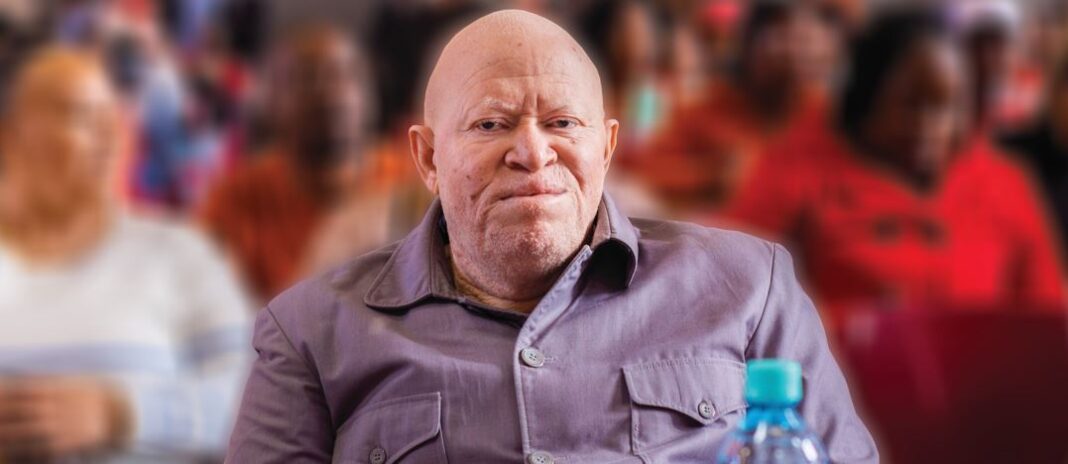
Embattled Professor Kananelo Mosito has secured a victory against the National University of Lesotho (NUL) following a legal challenge with the institution.
The Court of Appeal this week ordered the university to reinstate Prof Mosito to his former office and facilitate his appointment as Acting Vice-Chancellor, in accordance with the university’s regulations.
The ruling marks a victory for Mosito, who has consistently maintained that NUL erred by not appointing him to act as Vice-Chancellor after 31 July 2026, when the then-incumbent’s contract came to an end.
In this case, Prof Mosito had approached the country’s highest court seeking a contempt order against the first, second, third, fourth, fifth and ninth respondents.
Prof Mosito, who also serves as President of the Court of Appeal, was the applicant. The respondents were the Council of NUL, Prof Motlatsi Molati, Dr Khabele Matlosa, Advocate Mamello Makau, Dr Lipalesa Mathe, Dick J. Makoetlane, the Commissioner of Police, the Attorney-General, and NUL itself cited as the first to ninth respondents, respectively.
The case was heard by Judge Petrus Damaseb (Namibia), Judge Van Der Westhuizen (South Africa), and Judge Moneuoa Kopo.
The apex court also found that the university had misdirected itself by removing Prof Mosito from the position of Pro-Vice-Chancellor and relegating him to the status of an ordinary staff member in the Faculty of Law.
Mosito was appointed Pro-Vice-Chancellor on 1 November 2023, and his term in that office is set to conclude on 31 October 2027, in line with his contract.
“It is declared that the first and ninth respondents failed to comply with paragraph (e) of this Court’s order dated 1 June 2026 by preventing the applicant from exercising the functions of Acting Vice-Chancellor after the vacancy arose on 31 July 2026, by appointing the second respondent to that office and by terminating the applicant’s substantive appointment as Pro-Vice-Chancellor,” reads the judgment.
On 3 August 2026, the NUL Council, the university’s supreme governing body, announced its decision to terminate Prof Mosito’s Pro-Vice-Chancellorship, arguing that his conduct had “fundamentally impaired the trust and confidence essential to the senior management.” By that point, Mosito had already been suspended.
The court also ordered Prof Molati, who had been holding the fort in the Vice-Chancellor’s office, to step aside for Prof Mosito.
“The second respondent must, upon service of this order, cease holding himself out as or exercising the functions of Acting Vice-Chancellor and deliver the records and access rights of that office to the applicant.”
On 31 July, when the contract of then-Vice-Chancellor Prof Isaac Fajana came to an end, Prof Mosito presented himself that morning but was stopped by the Council from assuming the office. On 2 August, Prof Molati was appointed Acting Vice-Chancellor, and Prof Regina Thetsane was endorsed as Acting Pro-Vice-Chancellor.
Curiously, in his farewell statement, Prof Fajana made no mention of Prof Mosito, despite Mosito having served as his deputy and having ushered him into office in 2021, when Fajana joined NUL as Vice-Chancellor.
Mosito’s dispute with the university centres on the legality of the process the Council initiated to recruit a new Vice-Chancellor.
The matter dates back to October last year, when Prof Fajana informed the Council that he would not seek an extension or renewal of his contract upon its expiry.
Prof Mosito subsequently engaged the Council on the matter, but the parties failed to reach an agreement. He then approached the High Court, seeking to bar the university from proceeding with the recruitment process, arguing that it had violated his right to act in the position.
Prof Mosito contended that Section 16(2) of the NUL Order of 1992 could only be invoked once a vacancy had actually arisen in the office of the Vice-Chancellor. In his view, the recruitment process was premature, as the incumbent should first vacate the office before the university advertises the position.
The case saw several interlocutory applications while pending before the High Court. The university first challenged that court’s jurisdiction, but the court ruled that it did have jurisdiction.
NUL also challenged the panel of High Court judges hearing the matter, arguing that Prof Mosito, by virtue of being President of the Court of Appeal, was their superior, but lost on that point as well.
In June, NUL petitioned the Court of Appeal on an urgent basis, seeking a stay of the High Court proceedings, but was unsuccessful. Judge Philip Musonda (Zambia), presiding at the time, stated that “the fact that unfolding events may justify urgent Interlocutory consideration does not, without more, entitle a litigant to appellate priority over others awaiting hearing.”
In his ruling, Judge Musonda said NUL and the Council, as petitioners, had failed to meet the threshold requiring compelling and exceptional circumstances for the case to be treated as urgent. The court ordered that NUL’s appeal instead be heard during the next ordinary session of the Court of Appeal, in October.
In his application, Prof Mosito had cited the respondents in both their professional and personal capacities. However, the ruling directed only the first and ninth respondents to bear the applicant’s costs, including the costs of two counsel.
The court did not find against the other respondents in their personal capacities “As no finding of wilfulness, mala fides or personal contempt is made, neither punitive or personal costs are justified against an individual respondent.”
Summary
- The Court of Appeal this week ordered the university to reinstate Prof Mosito to his former office and facilitate his appointment as Acting Vice-Chancellor, in accordance with the university’s regulations.
- The apex court also found that the university had misdirected itself by removing Prof Mosito from the position of Pro-Vice-Chancellor and relegating him to the status of an ordinary staff member in the Faculty of Law.
- “It is declared that the first and ninth respondents failed to comply with paragraph (e) of this Court’s order dated 1 June 2026 by preventing the applicant from exercising the functions of Acting Vice-Chancellor after the vacancy arose on 31 July 2026, by appointing the second respondent to that office and by terminating the applicant’s substantive appointment as Pro-Vice-Chancellor,” reads the judgment.
Thoboloko Ntšonyane is a dedicated journalist who has contributed to various publications. He reports on accountability, human rights, exposes corruption and wrong doing by those in power. He reports have exposed corruption, abuse of power, fraud, misconduct and negligence. He subscribes to evidence-based reporting. He reports on governance, parliament, courts, climate change, human rights, sexual and reproductive health rights (SRHR), health, business and agriculture. He gives a voice to the marginalised while also demanding accountability. His work inspires change, triggers dialogue and also promote transparency in a society.