
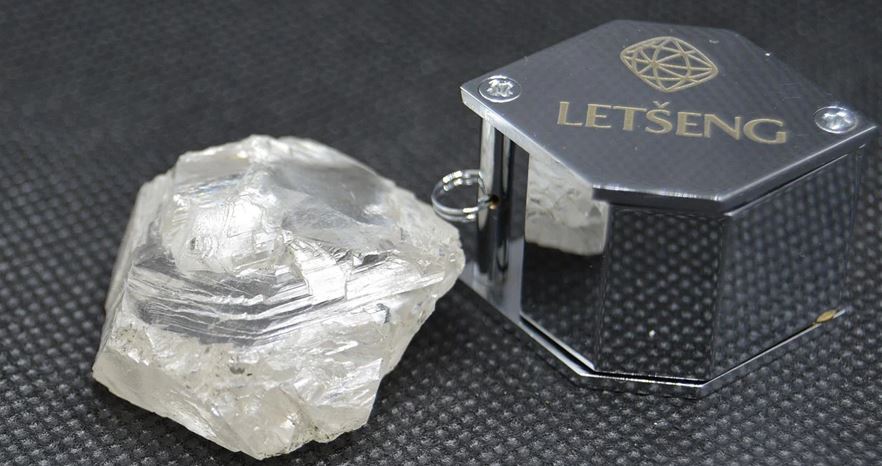
Gem Diamonds has recovered a massive 346.99 carat white diamond at its Letšeng mine in Lesotho, and has named the stone the “Lesotho Jubilee” in honour of the country’s 60th independence anniversary.
The London-listed miner disclosed the discovery in its Trading Update covering 1 January to 30 June 2026 (H1 2026), released this week.
The diamond, recovered in June, was one of three exceptional +100 carat stones unearthed during the Period, two of which have already been sold. The Lesotho Jubilee itself will go under the hammer after the close of the reporting period.
Beyond the headline gem, the company reported that its highest price achieved in the half was US$32,908 per carat, fetched for a 52.24 carat white diamond.
In total, eight diamonds each sold for more than US$1.0 million, together generating aggregate revenue of US$16.1 million, underlining Letšeng’s reputation as one of the world’s premier sources of large, high-value stones.
Gem Diamonds said “all operational and financial metrics are trending within issued guidance for 2026,” a reassuring signal for investors despite a mixed production picture.
At Letšeng, waste tonnes stripped fell sharply to 308,118 in H1 2026, down 82% from 1,698,817 in H1 2025, while ore tonnes treated edged up 4% to 2,604,145 from 2,504,001.
However, the Satellite Pipe, the mine’s higher-grade, higher-value ore source, contributed only 417,734 tonnes, a 48% drop from 802,135 tonnes a year earlier.
That shift in mix, drove the headline production figures down. Carats recovered fell 12% to 41,695 from 47,125, while the grade recovered slipped 15% to 1.60 carats per hundred tonnes (cpht) from 1.88 cpht.
The company explained that “the lower proportion of Satellite Pipe material in the production mix resulted in the overall lower grade, and therefore lower carats recovered during the Period when compared to H1 2025,” adding that “production for the remainder of the year will be sourced only from the Main Pipe, while preparations are made for the next cutback in the Satellite Pipe.”
Despite fewer carats, revenue told a far more encouraging story. Carats sold dipped only 4% to 42,624, yet total sales value surged 33% to US$59.5 million from US$44.7 million, as the average price achieved climbed 38% to US$1,395 per carat from US$1,008.
The improved pricing comes against a difficult backdrop for the broader rough diamond industry, which continues to grapple with the disruptive rise of lab-grown alternatives.
Gem Diamonds’ CEO, Clifford Elphick, said: “Market prices for lower quality, small, rough diamonds remain severely impacted by synthetic diamonds. This has resulted in a number of mines, with this particular size and quality diamond footprint, suspending operations.”
Letšeng, he noted, “has been less impacted, with encouragingly strong demand leading to an improvement in prices during H1 2026,” owing to its exceptional quality and large diamond recoveries.
“Gem remains focused on continuing to operate the Letšeng mine safely and responsibly, maintain financial discipline, and preserve the long-term value of the business,” Elphick added.
Apart from the Lesotho Jubilee, Letšeng is renowned for the production of other historic diamonds. In January 2018, a 910-carat white diamond, the Lesotho Legend was recovered, becoming the fifth-largest diamond in the world.
In August 2011, a 550-carat white diamond, the Letšeng Star became the fourth major recovery at Letšeng since Gem Diamonds’ 2006 takeover. It was preceded by the 478-carat Leseli la Letšeng (‘Light of Letšeng’) in 2008, the 493-carat Letšeng Legacy in 2007 and the 603-carat Lesotho Promise in 2006.
Letšeng has thus produced five of the largest rough white gem diamonds on record. In addition, the 601-carat Lesotho Brown was recovered from the mine in 1967.
Summary
- 99 carat white diamond at its Letšeng mine in Lesotho, and has named the stone the “Lesotho Jubilee” in honour of the country’s 60th independence anniversary.
- The company explained that “the lower proportion of Satellite Pipe material in the production mix resulted in the overall lower grade, and therefore lower carats recovered during the Period when compared to H1 2025,” adding that “production for the remainder of the year will be sourced only from the Main Pipe, while preparations are made for the next cutback in the Satellite Pipe.
- It was preceded by the 478-carat Leseli la Letšeng (‘Light of Letšeng’) in 2008, the 493-carat Letšeng Legacy in 2007 and the 603-carat Lesotho Promise in 2006.