A Professional Communications practitioner with a wealth of expertise in marketing, public speaking, communication and media relations. I believe in learning everyday and improving one's personal and professional capabilities.
* A former journalist and radio host who is passionate about media and it's impact on society.
The applause is loud, the images are polished, and success appears effortless.
Yet behind the scenes of Lesotho’s creative industry lies a quieter reality, one shaped by instability, pressure, and, increasingly, substance abuse.
Recent conversations within the sector have drawn growing attention to the impact of substance use on artists’ careers and well-being. While such cases are often discussed informally in public spaces and on social media, they are rarely documented in ways that allow for deeper understanding or accountability.
This silence makes it difficult to quantify the scale of the problem. It also reflects a broader culture in which creatives are expected to endure pressure without support.
In the absence of open dialogue and accessible mental health services, substance use continues to thrive as an unspoken coping mechanism rather than being addressed as a public health and industry concern.
For many creatives, addiction does not begin with recklessness. It begins with proximity, expectation, and survival.
Popular hip hop artist, who rose to stardom in the early 2010s Moji Mokotso, popularly known as Jiji F, shared that his substance use began in spaces where power and opportunity intersect.
“Peer pressure was my downfall, but these people were not my peers,” Jiji F recalled.
“They were people I once looked up to, saw on TV. I was in a room with them, and they were doing coke, so I just wanted to blend in.”
Those moments carried unspoken promises.
“They were big people in the industry. I believed they would put me on, that being close to them would open opportunities.”
What followed was not an isolated incident, but a gradual shift.
Initially, substances served a purpose. “After that first time, we’d do it at clubs and networking,” Jiji said.
“Then I started using at shows because coke gave me energy I didn’t have before.”
Over time, reliance replaced choice.
“I started using more frequently, feeling like the night isn’t complete without having a line.”
This progression is common in high-pressure creative environments where stamina, confidence, and constant output are rewarded. Available data suggest that illicit drug use among young people in Lesotho is a growing concern, although comprehensive national statistics remain limited.
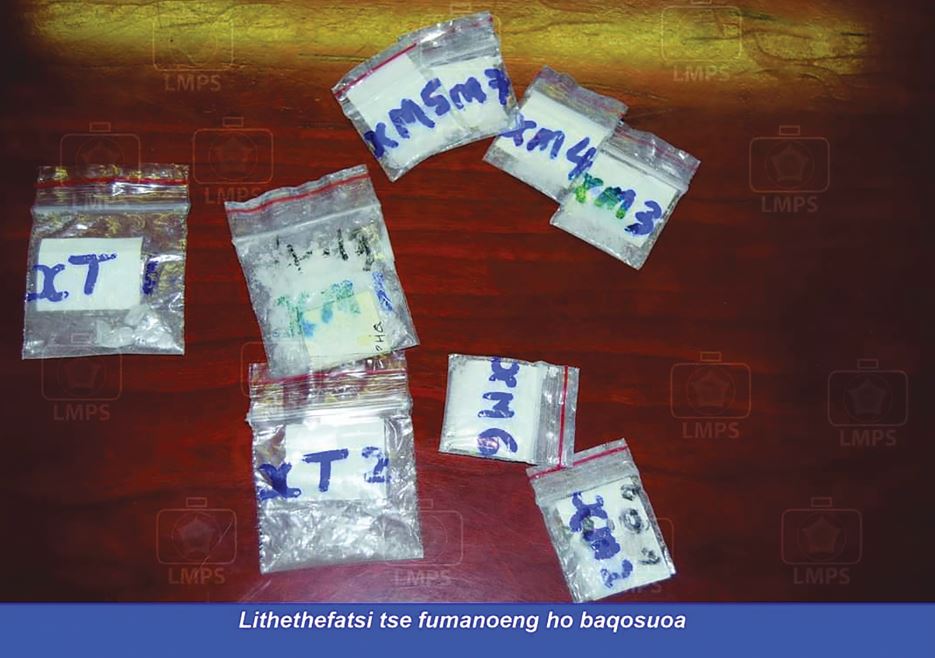
School-based surveys and community screening programmes show that cannabis (dagga) is the most commonly used illicit substance among adolescents.
In urban areas such as Maseru, studies have reported lifetime cannabis use among learners at approximately 15–17%. Inhalant use has also been recorded among school-going youth, with prevalence estimates of about 10–12% in some surveys.
While alcohol and tobacco remain the most widely used substances overall, emerging reports from law-enforcement agencies, civil society organisations, and health ministry point to increasing exposure of young people to synthetic drugs, including methamphetamine (Crystal Meth), particularly in urban settings.
The World Health Organisation (WHO) and local researchers caution that early initiation, limited access to treatment, and low awareness of substance-use disorders contribute to underreporting, suggesting the true scale may be higher than current figures indicate.
These gaps mirror the silence that often surrounds addiction in creative spaces.
National University of Lesotho (NUL) lecturer and mental health practitioner Steny Mohapi explained that the creative environment itself creates vulnerability.
“Creatives work in unstable conditions,” she said. “There’s public scrutiny and an expectation to always perform at a high level.”
Substances often enter as tools.
“At first, drugs are used as an enhancement, especially for people working long hours who want to stay productive. Over time, they become susceptible.”
Creative work, she noted, is inseparable from identity.
“Their work is their lifestyle. When their work is rejected, they feel personally rejected, which pushes them to seek belonging in substances.”
Irregular income intensifies this pressure, forcing creatives to overextend themselves during peak seasons.
Clinically, many creatives use their work to process pain.
“Creativity becomes a way of repairing what is broken, transforming trauma into art,” Mohapi explained.
When trauma remains unresolved, anxiety and perfectionism follow. “There’s a performance fear: ‘If I don’t release a hit, I’m not good enough.’ That anxiety drives emotional numbness.”
Substances then become coping mechanisms.
“Drugs like crystal meth are used to reduce anxiety and convince the person they are good enough.”
Early indicators are frequently misread. “Most people assume the artist is just tired,” Mohapi said. “It starts with energy drinks, then moves to substances like weed.”
Other warning signs include reduced sleep, increased irritability, and unusually intense productivity, often mistaken for passion or dedication.
One of the OGs and an active creative, an artist mentor and hip hop artist, Mokebe Mohasoa, known as Skebza D, said that for most creatives, expectations escalate once success arrives.
“Once people love what you create, it becomes a benchmark. You’re expected to outdo yourself every time.”
For Jiji, image maintenance became exhausting.
“People see flashy videos and expect perfection,” he said. “But you’re still a regular person.”
Meeting those expectations often means spending more, financially and emotionally, than creatives can afford.
Substance use is widely accepted in entertainment spaces.
“It’s normalised,” Jiji said. “Weed, cocaine, especially among big artists.”
Silence reinforces the culture, while fear of judgment keeps many from seeking help.
“I was afraid people would know me and label me a junkie,” he admitted.
Industry stakeholders, including Moeketsi Kebise, have increasingly acknowledged that the sector prioritises visibility and output while neglecting mental-health support. Burnout is rewarded; wellness is treated as a personal issue.
Mohapi stressed that many creatives need therapy, not substances.
“Some artists express pain beyond art. That’s a sign they need trauma-informed support,” she said.
Rest, she added, is not the enemy of creativity.
“Being a creative does not mean working all the time.”
Summary
In the absence of open dialogue and accessible mental health services, substance use continues to thrive as an unspoken coping mechanism rather than being addressed as a public health and industry concern.
Popular hip hop artist, who rose to stardom in the early 2010s Moji Mokotso, popularly known as Jiji F, shared that his substance use began in spaces where power and opportunity intersect.
I was in a room with them, and they were doing coke, so I just wanted to blend in.
A Professional Communications practitioner with a wealth of expertise in marketing, public speaking, communication and media relations. I believe in learning everyday and improving one’s personal and professional capabilities.
* A former journalist and radio host who is passionate about media and it’s impact on society.
To ensure optimal experiences, we utilize technologies such as cookies to store and/or access information from your device. Granting consent to these technologies enables us to process data, including browsing habits or unique identifiers on this website. Conversely, not consenting or revoking consent may negatively impact specific features and functionalities.
Functional
Always active
The technical storage or access is strictly necessary for the legitimate purpose of enabling the use of a specific service explicitly requested by the subscriber or user, or for the sole purpose of carrying out the transmission of a communication over an electronic communications network.
Preferences
The technical storage or access is necessary for the legitimate purpose of storing preferences that are not requested by the subscriber or user.
Statistics
The technical storage or access that is used exclusively for statistical purposes.The technical storage or access that is used exclusively for anonymous statistical purposes. Without a subpoena, voluntary compliance on the part of your Internet Service Provider, or additional records from a third party, information stored or retrieved for this purpose alone cannot usually be used to identify you.
Marketing
The technical storage or access is required to create user profiles to send advertising, or to track the user on a website or across several websites for similar marketing purposes.