Beyond the cash transfer: Dissecting the legacy of Ntlafatsa Bana
The NtlafatsaBana Project, a partnership between UNICEF, the Ministry of Gender, Youth and Social Development and the European Union, will close in December 2026 after bringing new services and opportunities to thousands of children and families in five districts: Quthing, Thaba-Tseka, Leribe, Mohale’s Hoek and Qacha’s Nek
Ntsoaki Motaung is an award-winning health journalist from Lesotho, specializing in community health stories with a focus on sexual and reproductive health and rights, as well as HIV. She has contributed to platforms like "Be in the KNOW," highlighting issues such as the exclusion of people with disabilities from HIV prevention efforts in Lesotho.
In addition to her journalism, Ntsoaki serves as the Country Coordinator for the Regional Media Action Plan Support Network (REMAPSEN). She is also a 2023 CPHIA Journalism Fellow.
The NtlafatsaBana Project, a partnership between UNICEF, the Ministry of Gender, Youth and Social Development and the European Union, will close in December 2026 after bringing new services and opportunities to thousands of children and families in five districts: Quthing, Thaba-Tseka, Leribe, Mohale’s Hoek and Qacha’s Nek.
Launched in April 2023, the project is part of a long-running effort to reduce child vulnerability, end malnutrition and fight rural poverty in Lesotho.
A new model
At a recent multi-stakeholder reflection meeting, UNICEF Lesotho Social Policy Specialist Sophia Shawa stressed the importance of working together to improve children’s lives.
She thanked all partners for their hard work and praised the leadership of the Ministry of Gender, Youth and Social Development.
“Since 2005, UNICEF, the European Union, and the Ministry have worked together, but this latest phase uses a new “Cash Plus” model.
Instead of only giving cash support to families, the project now also connects them with vital public services, including birth registration, nutrition support, clean water, and renewable energy,” she said.
Shawa said the project has a budget of more than US$7 million, funded mainly by the European Union and UNICEF. One of its main goals is to raise the share of children under five with birth certificates in the target areas from 45 percent to 75 percent.
“Birth registration is a crucial step, as it gives children legal identity and access to essential services, such as health care and protection,” she added.
Birth registration
Monitoring and Evaluation Officer Phaello Mosala outlined the project’s progress, starting with birth registration. The aim was to expand services in rural areas and develop a policy to support them. Teams held planning meetings with the Department of Home Affairs, learned from visits to Tanzania, Rwanda and Mauritius, and invested in IT equipment, training and pilot testing.
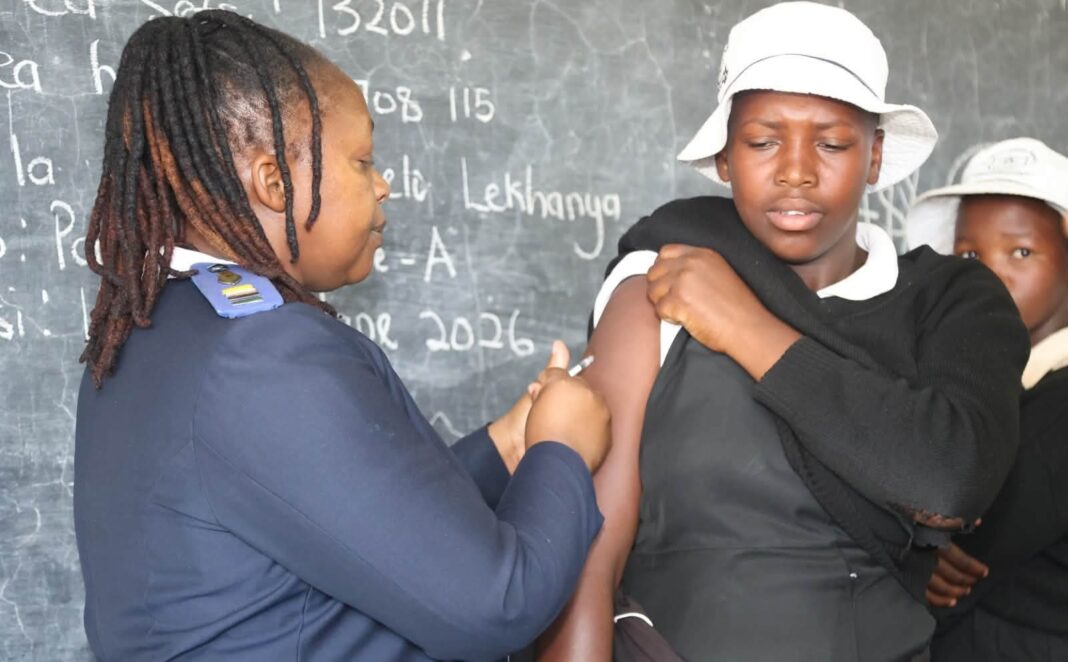
Service providers were trained in civil registration and vital statistics (CRVS) business processes. Joint campaigns, including direct outreach and special events, targeted areas with low registration. Digital health registration systems were also launched to make it easier for families to register births.
Nutrition
Mosala said nutrition was another major area of progress. The project worked with World Vision and other organisations to promote healthy eating and set up nutrition clubs in rural communities.
The clubs teach parents about infant and young child feeding and support home gardens and poultry farming, helping to improve diets and food security. Nearly 4,500 people have joined so far, and the clubs provide seeds, tools and equipment. Children’s growth is monitored, and families learn about child protection and immunisation. About 600 vulnerable children have been referred to community kitchens for meals.
The target was to reach 8,000 women, girls and young children with nutrition support. Mosala said the project has reached over half that number, with more data still to be validated.
Clean water
The water, sanitation and hygiene (WASH) component also made strong gains, according to Mosala. After technical and social assessments in the selected community councils, contractors were hired to rehabilitate rural water systems, creating new or improved water sources in many villages.
More than 9,000 people now have access to clean water, beating the original target. The number of children under five with clean water has risen too, with 737 benefiting so far, above the revised goal.
Solar power
“Bringing clean, renewable energy to households was another focus. The project studied what families needed most, and a consultant devised a fair way to distribute 1,000 solar home systems and clean cookstoves across the nine community councils. Suppliers were contracted, products were tested and assembled, and training was given to make sure families could use and maintain their new equipment.
Awareness campaigns helped families understand the benefits and select the right solutions for their homes,” he said.
Digital payments
Mosala added that a key innovation has been the shift to digital payments for social protection benefits. By using mobile money and bank transfers, the project aims to increase transparency, cut waiting times and get help to more families faster. The share of households receiving digital payments has already risen, and the goal is to reach 40 percent, or more than 20,000 households, by the end of the project.
Looking ahead
The workshop brought together people from national and district levels to reflect on the project, celebrate successes and discuss challenges. It was also a chance to share lessons and plan how to sustain the gains after the project ends.
Mohale’s Hoek District Administrator Moleboheleng Lebele spoke warmly about the changes she has seen.
“Not only did the project benefit children, it also benefited their families as well as the communities they live in. Projects like this one need to be supported. If they are, Lesotho will go far,” she said.
A family in Mount Moorosi
The project’s impact is clearest at household level. In an earlier story, “The Sun Comes to Mount Moorosi: How Solar is Giving Lesotho’s Children Back Their Evenings,” this publication showed how it changed life for one family.
Before solar power arrived, children struggled to do homework after dark, and the family relied on candles or paraffin lamps, which were costly and unsafe. Through the NtlafatsaBana Project, the family received a solar home system that lit their evenings and let the children study safely and comfortably after sunset. The mother said the solar kit saved the family money and improved their children’s education, health and security.
Summary
The NtlafatsaBana Project, a partnership between UNICEF, the Ministry of Gender, Youth and Social Development and the European Union, will close in December 2026 after bringing new services and opportunities to thousands of children and families in five districts.
Launched in April 2023, the project is part of a long-running effort to reduce child vulnerability, end malnutrition and fight rural poverty in Lesotho.
The project studied what families needed most, and a consultant devised a fair way to distribute 1,000 solar home systems and clean cookstoves across the nine community councils.
Ntsoaki Motaung is an award-winning health journalist from Lesotho, specializing in community health stories with a focus on sexual and reproductive health and rights, as well as HIV. She has contributed to platforms like “Be in the KNOW,” highlighting issues such as the exclusion of people with disabilities from HIV prevention efforts in Lesotho.
In addition to her journalism, Ntsoaki serves as the Country Coordinator for the Regional Media Action Plan Support Network (REMAPSEN). She is also a 2023 CPHIA Journalism Fellow.
To ensure optimal experiences, we utilize technologies such as cookies to store and/or access information from your device. Granting consent to these technologies enables us to process data, including browsing habits or unique identifiers on this website. Conversely, not consenting or revoking consent may negatively impact specific features and functionalities.
Functional
Always active
The technical storage or access is strictly necessary for the legitimate purpose of enabling the use of a specific service explicitly requested by the subscriber or user, or for the sole purpose of carrying out the transmission of a communication over an electronic communications network.
Preferences
The technical storage or access is necessary for the legitimate purpose of storing preferences that are not requested by the subscriber or user.
Statistics
The technical storage or access that is used exclusively for statistical purposes.The technical storage or access that is used exclusively for anonymous statistical purposes. Without a subpoena, voluntary compliance on the part of your Internet Service Provider, or additional records from a third party, information stored or retrieved for this purpose alone cannot usually be used to identify you.
Marketing
The technical storage or access is required to create user profiles to send advertising, or to track the user on a website or across several websites for similar marketing purposes.