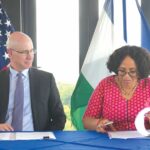

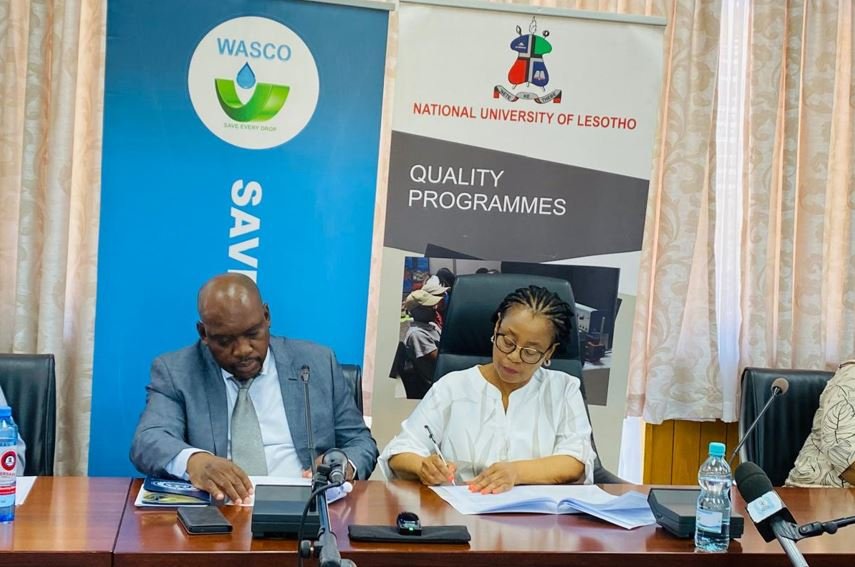
The National University of Lesotho (NUL) and the Water and Sewerage Company (WASCO) have signed a five-year partnership to apply academic research, innovation and technical expertise to Lesotho’s water and sanitation challenges.
The Memorandum of Understanding (MOU), signed at the NUL Roma campus on Wednesday, 18 November 2026, sets a framework for collaboration in water resources management, infrastructure development, research and human capital development. It pairs NUL’s research capacity with WASCO’s operational experience to tackle climate variability, catchment degradation, reservoir sedimentation, water losses and infrastructure sustainability.
NUL Acting Vice-Chancellor Regina Thetsane said the deal links academic knowledge to the practical needs of the water sector, and that research must serve the country beyond campus.
“In an era defined by rapid urbanisation, infrastructure demands and the escalating realities of climate change, a modern university cannot afford to remain in an ivory tower. Our research must leave the shelves of our libraries and enter the pipelines, treatment plants and catchments of our country,” she said.
Warning against agreements that are signed but deliver little, she added: “Let us have the MOU that is practical.”
NUL Water Institute Director Mamohau Thamae outlined six areas of cooperation: water resources management and climate resilience; water supply and sanitation infrastructure; digital technologies and renewable energy; human capital development; student training and postgraduate research; and research consultancy and evidence-based decision-making.
She said the partnership was needed because abundant water does not guarantee water security.
“However, the fact that we are well-endowed with the water resources doesn’t automatically mean that we are water secure. It doesn’t automatically mean that we are sustainable when it comes to water resources management,” she said.
Students will gain internships, industrial attachments and postgraduate research opportunities based on real WASCO challenges. “Our research is going to be solving WASCO’s problems,” Thamae said. One NUL graduate has already used WASCO consumption data and machine learning to predict future water demand in growing urban communities in a master’s dissertation.
WASCO Chief Executive Officer Lebohang Mpeke Makara said the partnership comes as the company faces financial pressure and needs practical solutions.
“We are hoping that we can actually start developing systems and processes, equipment that is practical, that are everyday uses for WASCO,” he said.
He added that upcoming water infrastructure projects will need skilled personnel, and that the university can help the company prepare.
A joint steering committee of three representatives from each institution will guide implementation, set priorities, develop annual work plans and monitor progress. The agreement may be renewed by mutual consent, while specific projects and financial commitments will be set out in separate work plans.
NUL Pro-Vice-Chancellor Motlatsi Molati said the signing is a formal commitment, but its value will depend on results.
“The real measure of our success will not be found in the signatures of these pages, but in the joint research projects launched, the technical skills sharpened, and the tangible improvements delivered to our students, households, and communities across the country,” he said.
He said joint projects and student placements must follow.
Summary
- The National University of Lesotho (NUL) and the Water and Sewerage Company (WASCO) have signed a five-year partnership to apply academic research, innovation and technical expertise to Lesotho’s water and sanitation challenges.
- The Memorandum of Understanding (MOU), signed at the NUL Roma campus on Wednesday, 18 November 2026, sets a framework for collaboration in water resources management, infrastructure development, research and human capital development.
- “The real measure of our success will not be found in the signatures of these pages, but in the joint research projects launched, the technical skills sharpened, and the tangible improvements delivered to our students, households, and communities across the country,” he said.

A passionate and dedicated journalism practitioner with an interest in telling stories that inform, educate and give people a voice.
Committed to producing credible and meaningful journalism while continuously improving research, writing and communication skills. Eager to learn from experienced media professionals, take on new challenges and grow into a well-rounded journalist who makes a positive contribution to society through responsible reporting.