
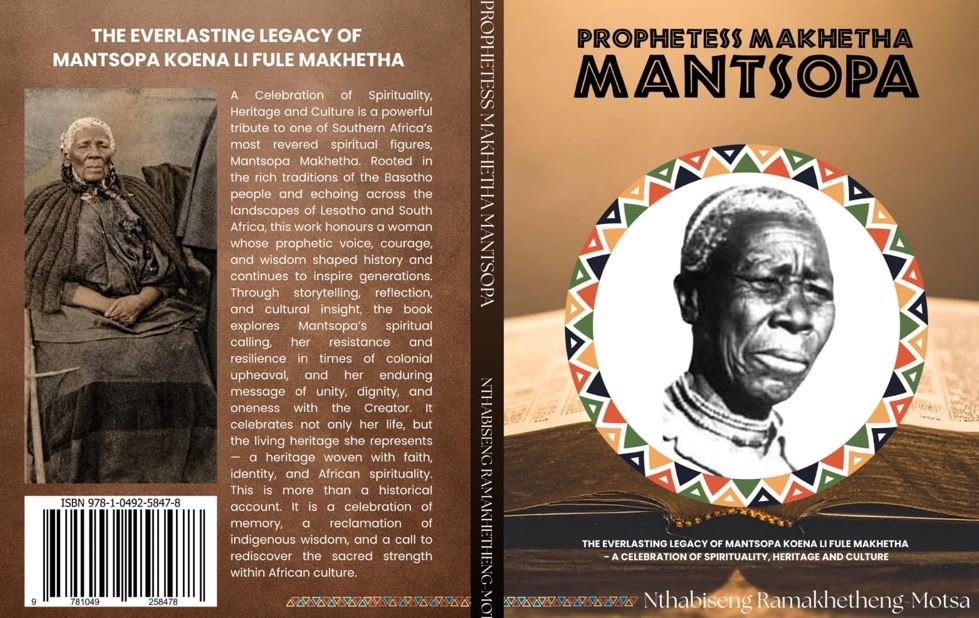
As Lesotho prepares to celebrate the legacy of Prophetess Mantsopa Koena li Fule Makhetha, author Nthabiseng Ramakhetheng-Motsa believes documenting her story is an important step towards restoring recognition to a historical figure whose influence deserves greater appreciation in her homeland.
For Nthabiseng Ramakhetheng-Motsa, writing about Prophetess Mantsopa Koena li Fule Makhetha was more than an academic exercise; it was a personal responsibility to ensure that a remarkable chapter of Basotho history is not forgotten.
Her book, The Everlasting Legacy of Mantsopa Koena li Fule Makhetha: A Celebration of Spirituality, Heritage and Culture, seeks to preserve the story of one of Southern Africa’s prominent spiritual figures, whose legacy continues to attract people seeking spiritual guidance, healing and hope.
Published by Epiphany Publishers, the book will be officially celebrated at a launch scheduled for November 28, 2026, at Café What in Maseru.
The inspiration behind the publication came from the author’s realisation that despite Mantsopa’s recognition beyond Lesotho’s borders, there was limited accessible literature documenting her life and contribution.
Ramakhetheng-Motsa says she struggled to find a comprehensive book about Mantsopa, despite discovering that the historical figure was closely connected to her own family.
“Nkhono Mantsopa didn’t have even one book. I looked everywhere, wanting to read about her,” she explains.
She says discovering that the world recognised Mantsopa, including through a municipality named after her in South Africa, while many Basotho remained unfamiliar with her story, strengthened her determination to document the legacy.
“I wished I knew her earlier in my life. I could have grown more confidence in all I do, through positive identification,” she says.
The author subsequently embarked on a research journey, drawing from existing academic writings, archival material, historical publications and oral accounts from family elders.
She explains that the limited literature available motivated her to produce a more comprehensive account while creating room for further editions as additional information emerges.
For Ramakhetheng-Motsa, the book also forms part of the 120-year commemoration of Mantsopa’s legacy since her passing in 1906.
Beyond her identity as a prophetess, the author describes Mantsopa as an influential leader who played a role in the history of the Basotho nation during the reign of King Moshoeshoe I.
According to Ramakhetheng-Motsa, Mantsopa communicated visions concerning impending conflicts, including the Battle of Viervoet in 1851, and offered guidance that contributed to Basotho resistance during the period.
She also recounts Mantsopa’s warning about the potential consequences of allowing missionaries into the kingdom, which she believes reflects the prophetess’s understanding of the political and cultural challenges facing the Basotho.
Mantsopa’s influence, however, extended beyond prophecy and leadership. The author highlights her work as a healer, her family life as a wife and mother of four, and her continued spiritual influence across communities in Lesotho and South Africa.
Her research also uncovered historical details that further deepened her appreciation of Mantsopa’s life.
Among the discoveries was information concerning a baptism ceremony at Thaba Bosiu, which Mantsopa was expected to attend alongside King Moshoeshoe I. According to the author, the King died a day before the ceremony, which nevertheless proceeded.
Ramakhetheng-Motsa says the baptism records contain names connected to significant figures in Lesotho’s history, making the archival material an important historical resource.
Her research also explored Mantsopa’s family background, marriage and relationship with the wider Makhetha and Ramakhetheng families.
The author acknowledges that documenting the story was not without challenges, particularly given the limited availability of written material and the need to engage people with knowledge of the family’s history.
However, she believes the publication has already opened doors for further research, with members of the Makhetha family beginning to come forward with additional information that could inform a second edition.
Beyond preserving an individual’s story, Ramakhetheng-Motsa believes the publication raises a broader question about how African societies document and value their own histories.
Having an academic background in Psychology and Cultural Heritage Tourism, as well as postgraduate qualifications in Leadership and Management and Commerce, she argues that written documentation is essential in ensuring indigenous knowledge receives the recognition it deserves.
She is particularly concerned about the tendency to regard written historical accounts as more authoritative than oral traditions.
“We need to write our experiences as Africans,” she says, adding that women writers have an important role to play in documenting the contributions of female historical figures.
She believes Mantsopa’s contribution to nation-building has not received sufficient recognition, with her work sometimes reduced to the activities of traditional healers rather than acknowledged within the broader context of Basotho leadership and history.
The author also challenges certain interpretations of Mantsopa’s spiritual identity, particularly suggestions that her baptism meant abandoning African spirituality.
According to Ramakhetheng-Motsa, Mantsopa continued practising her traditional healing after being baptised, using water and plants to treat those who sought her assistance.
She argues that understanding Mantsopa requires appreciating the relationship she maintained between Christianity and African spirituality.
“Being African is not sinful. We are people of God and Nkhono Mantsopa understood this when she said there are many paths to go to God, not just one,” she says.
For younger generations, the author believes Mantsopa’s story offers lessons about identity, resilience, unity and the importance of remaining connected to one’s cultural roots.
She draws particular attention to the traditional practice of Thakaneng, which brought young people together with elders to learn about respect, responsibility, love and navigating life’s challenges.
Ramakhetheng-Motsa recalls organising a four-night Thakaneng camp in 2005, when she was 19, bringing together young girls and respected community leaders to share knowledge and life lessons.
She believes such initiatives demonstrate the value of indigenous approaches to mentorship and community development.
Her message is that Basotho must take greater responsibility for celebrating their historical figures and protecting the spaces associated with their heritage.
“Nkhono Mantsopa Makhetha is from Lesotho. She should be remembered in Lesotho, not just in the Free State,” she emphasises.
She also calls for greater responsibility in protecting Mantsopa’s heritage sites, particularly against practices that damage the natural environment around these historically significant spaces.
The publication marks another milestone in Ramakhetheng-Motsa’s writing journey. She previously published The Untangled Heart in 2020, a workbook aimed at helping people process trauma, followed by Toward Acceptance in 2023, which explores grief and loss.
She describes the Mantsopa publication as a different experience, requiring extensive historical research and engagement with oral accounts rather than relying primarily on personal and psychological experiences.
Looking ahead, she hopes the book will inspire further documentation of influential but underrepresented figures in Basotho history.
She also supports the proposed development of what has been described as Mantsopa-ism, an initiative associated with the work of Leoma Monaheng and proposed for consideration at the National University of Lesotho’s Moshoeshoe Institute of Peace and Leadership.
For Ramakhetheng-Motsa, preserving Mantsopa’s legacy should not be an isolated literary exercise but part of a wider effort to strengthen Basotho identity and historical consciousness.
As the book prepares to meet its readers, her ultimate wish is that future generations will know not only Mantsopa’s name, but also understand the contribution she made to the history, spirituality and cultural identity of the Basotho people.
Summary
- As Lesotho prepares to celebrate the legacy of Prophetess Mantsopa Koena li Fule Makhetha, author Nthabiseng Ramakhetheng-Motsa believes documenting her story is an important step towards restoring recognition to a historical figure whose influence deserves greater appreciation in her homeland.
- Beyond her identity as a prophetess, the author describes Mantsopa as an influential leader who played a role in the history of the Basotho nation during the reign of King Moshoeshoe I.
- The author highlights her work as a healer, her family life as a wife and mother of four, and her continued spiritual influence across communities in Lesotho and South Africa.

A Professional Communications practitioner with a wealth of expertise in marketing, public speaking, communication and media relations. I believe in learning everyday and improving one’s personal and professional capabilities.
* A former journalist and radio host who is passionate about media and it’s impact on society.