
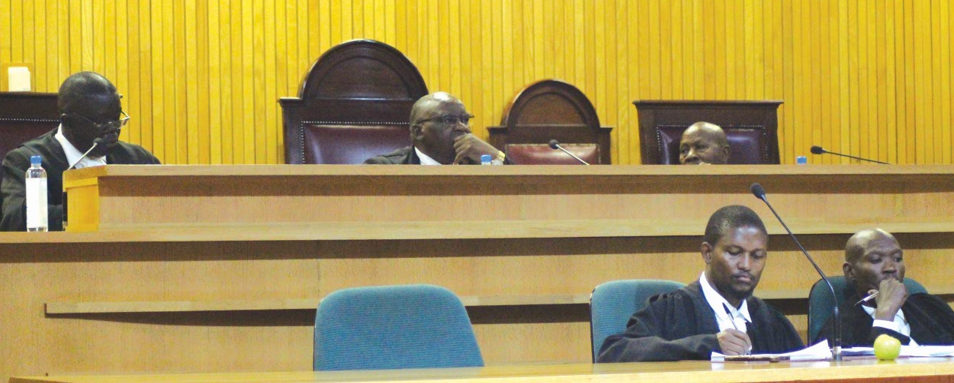
The High Court, sitting as the Constitutional Court, has reserved judgment in a case involving retired High Court judge Tšeliso Monapathi, who is challenging the decision to withhold his terminal benefits.
Justice Monapathi retired in August 2024 after reaching the statutory retirement age of 75. However, Chief Justice Sakoane Sakoane has withheld his terminal benefits on the basis that Monapathi has a substantial backlog of outstanding work, including about 128 part-heard cases.
Monapathi has approached the Constitutional Court seeking an order declaring the Chief Justice’s decision null and void, and directing the release of his withheld terminal benefits.
He is the applicant in the matter, while the respondents are the Chief Justice, the Prime Minister, the Judicial Service Commission (JSC), the Attorney-General, and the Defined Contribution Pension Fund, cited as the first to fifth respondents respectively.
Chief Justice Sakoane has maintained that Monapathi’s benefits can only be released once he completes his outstanding judgments. It was revealed in court that some of the cases presided over by Monapathi date back as far as 1994 and remain unresolved.
Monapathi, on the other hand, has argued that he can only complete the outstanding work if he is reinstated with the full support afforded to serving judges, including a salary, office space, a vehicle, a driver, and other benefits.
The matter is being heard by a panel of judges from the Southern African Development Community (SADC), comprising Justice Mankhambira Mkandawire of Malawi, Justice Sylvester Salufu Maingu of Namibia, and Justice David Mangota of Zimbabwe.
Arguing on behalf of Monapathi, Advocate Mocheta Makara submitted that judges in Lesotho operate under severe resource constraints and heavy workloads. He told the court that no judge leaves the bench having completed all matters allocated to them.
Makara further argued that upon reaching retirement age, a judge has the option to either retire fully or request an extension to finalise outstanding work. He added that where judges die, resign, or retire, cases are routinely reallocated and reheard.
He criticised the Chief Justice for failing to pursue disciplinary processes against Monapathi if his performance was in question. Makara said his client is willing to complete the outstanding work, provided he is properly resourced and remunerated as a sitting judge. However, he noted that the Chief Justice considers granting such benefits to be tantamount to rewarding “incompetence.”
Makara also pointed out that the law is silent on how outstanding judicial work should be handled at the point of retirement.
In support of his argument, Makara referred the court to the case of Dr Likoti, in which the court declared it unconstitutional for the government to withhold pension benefits to recover debts. The court held that pensions are a right, not a discretionary benefit, and ordered the release of the withheld pension, emphasising equal treatment of public officers in financial matters.
Advocate Rudie Cronje, appearing for the Chief Justice and the Attorney-General, argued that the case is not about resources or workload but centres on the constitutional oath taken by judges to dispense justice and uphold the Constitution.
“A judge is constitutionally obliged to complete their work,” Cronje submitted.
He told the court that Monapathi has access to the court library to write judgments and that the Chief Justice had undertaken to provide a clerk to assist with typing. Cronje accused Monapathi of shifting his position, stating that the retired judge had previously agreed to complete the outstanding work under the conditions set by the Chief Justice but later imposed additional demands.
Cronje further informed the court that the Chief Justice had introduced rules requiring judgments to be delivered within three months after the close of submissions. He said the rules were adopted in response to criticism from the Court of Appeal regarding delays in judgment delivery by some High Court judges.
He added that the Chief Justice had reminded Monapathi, three months prior to his retirement, to complete the work under his responsibility, but this was not done.
The court has reserved judgment, which will be delivered on a date to be announced.
Summary
- He is the applicant in the matter, while the respondents are the Chief Justice, the Prime Minister, the Judicial Service Commission (JSC), the Attorney-General, and the Defined Contribution Pension Fund, cited as the first to fifth respondents respectively.
- Monapathi, on the other hand, has argued that he can only complete the outstanding work if he is reinstated with the full support afforded to serving judges, including a salary, office space, a vehicle, a driver, and other benefits.
- Advocate Rudie Cronje, appearing for the Chief Justice and the Attorney-General, argued that the case is not about resources or workload but centres on the constitutional oath taken by judges to dispense justice and uphold the Constitution.
Thoboloko Ntšonyane is a dedicated journalist who has contributed to various publications. He focuses on parliament, climate change, human rights, sexual and reproductive health rights (SRHR), health, business and court reports. His work inspires change, triggers dialogue and also promote transparency in a society.