
- Says governance reforms are restoring trust and stabilising the sports sector
The Lesotho Sports and Recreation Commission (LSRC) has achieved what many insiders describe as one of the most significant financial turnarounds in its recent history after reducing its debts from M1.4 million to under M150,000 in just over four months.
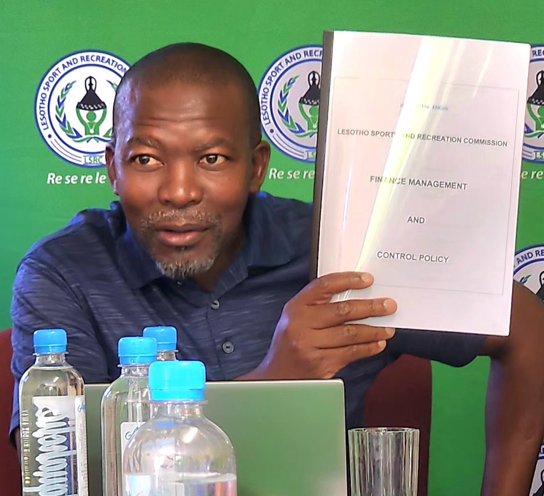
The Commission’s president, Baba Malephane, revealed this notable progress during a consultative meeting with sports journalists and media practitioners in Maseru this week.
The session, hosted by LSRC’s Public Relations Officer Advocate Jobo Raswoko, was designed to strengthen the relationship between the Commission and the media while providing a transparent update on the state of sports and recreation administration in Lesotho.
But the headline-grabbing revelation was the Commission’s dramatic financial recovery, which Malephane described as “a turning point in restoring trust, credibility, and stability within the LSRC.”
When the current leadership assumed responsibility, the LSRC was facing mounting pressure from creditors, a backlog of unresolved audit queries, strained supplier relationships, and internal governance gaps.
The M1.4 million debt had reached a level that threatened operations, partnerships, and even the Commission’s credibility with government stakeholders.
“Where we were a few months ago was deeply concerning,” Malephane admitted.
“We inherited a financial situation that could have crippled our ability to deliver on our mandate. Suppliers had lost confidence, audit processes were lagging behind, and the general perception was that the Commission was not functioning effectively.”
In response, the LSRC developed a recovery strategy that included; Direct negotiations with creditors; Restoration of supplier relationships; Introduction of stricter financial controls; Strengthening internal audit systems; Enhancing the separation between Commissioner oversight and operational management; Implementing new remuneration and HR structures; and Developing a revised Financial Management and Control Policy.
The Commission’s leadership traveled to several suppliers in person, held difficult negotiations, and established new repayment agreements. The approach, Malephane said, was necessary to repair broken trust.
“It required uncomfortable conversations, transparency, and humility,” he said. “But we came out with renewed relationships and a shared understanding that the LSRC is rebuilding. That has made all the difference.”
By November, just four and a half months after the recovery plan was implemented, the LSRC had brought the outstanding creditor debt down from M1.4 million to M147,000, a reduction that many observers did not believe would be possible in such a short timeframe.
Malephane attributed the success to “honesty, discipline, and putting systems before personalities.”
“We needed to prove that the Commission could be trusted again. It wasn’t just about settling amounts owed. It was about demonstrating that the LSRC is capable of responsible stewardship.”
This restoration of financial stability has opened new doors for the Commission to engage sponsors, government departments, and international partners with renewed legitimacy. Another major area highlighted in the engagement was the clearing of long-standing audit queries.
According to Malephane, previous audit cycles revealed issues related to documentation, procurement processes, unclear expenditure patterns, and weak financial oversight. The Commission has now resolved these issues and implemented corrective measures intended to prevent recurrence.
“We have strengthened internal controls and updated policies to align with expected corporate governance standards.Audit concerns that were repeatedly flagged in the past have now been addressed,” he explained.
A new Organizational Realignment Plan was recently approved, designed to modernise how the Commission operates and to ensure clear separation between policy, oversight, and operational execution.
Despite the financial recovery, the LSRC continues to grapple with underfunding.The Commission disclosed that its annual activities require a budget of over M20 million, yet it often receives only a quarter of that amount.
Last year’s allocation was approximately M12 million, with quarterly disbursements of about M2.2 million, far below what is needed for athlete development, facility upkeep, or national team preparations.
Upcoming international commitments, including the Africa Games, Commonwealth Games, and World Championships, require more financial stability.
“In January, we will appear before the Ministry of Sports to present a motivated budget,” Malephane said. “We can no longer plan major national programs on insufficient allocations. We must be honest with the government about what it takes to build a competitive and functioning sports sector.”
He added that part of the strategy is to prioritise development and capacity-building over excessive travel or cosmetic activities.
“Our approach is to prioritise knowledge-building and long-term growth. Financial prudence must guide every decision we make as we rebuild.”
The Commission’s leadership emphasised that the reforms are about more than fixing numbers; they are about rebuilding public trust, stabilising administration, and ensuring that future generations of athletes and recreation groups inherit a functional system.
“With this turnaround, we want people to know that the LSRC is no longer in crisis mode. We are becoming a transparent, accountable, people-centered institution,” said Malephane.
He concluded by calling for continued collaboration with the media, noting that the pen truly remains “mightier than the sword,” especially in shaping public confidence and national pride.
“As we rebuild, we need storytelling. We need the truth. We need accountability. And we need you, the media, to walk this journey with us.”
Summary
- The session, hosted by LSRC’s Public Relations Officer Advocate Jobo Raswoko, was designed to strengthen the relationship between the Commission and the media while providing a transparent update on the state of sports and recreation administration in Lesotho.
- But the headline-grabbing revelation was the Commission’s dramatic financial recovery, which Malephane described as “a turning point in restoring trust, credibility, and stability within the LSRC.
- The Commission disclosed that its annual activities require a budget of over M20 million, yet it often receives only a quarter of that amount.

A Professional Communications practitioner with a wealth of expertise in marketing, public speaking, communication and media relations. I believe in learning everyday and improving one’s personal and professional capabilities.
* A former journalist and radio host who is passionate about media and it’s impact on society.