

… Highlands’ icon ready in days
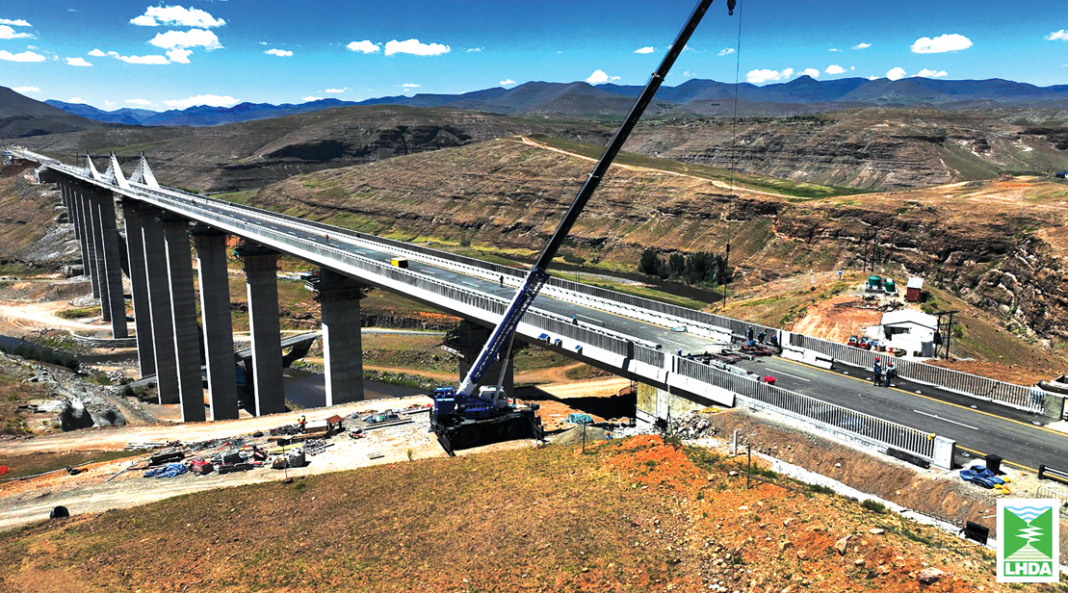
The Senqu Bridge, a towering engineering marvel in Lesotho’s highlands, is on the verge of full practical completion in the coming days of early February 2026, the Lesotho Highlands Development Authority (LHDA) announced this week.
This milestone arrives as the Lesotho Highlands Water Project (LHWP), a landmark binational partnership between Lesotho and South Africa, enters its 40th anniversary year, commemorating the 1986 treaty that launched one of Africa’s most ambitious water transfer and infrastructure initiatives.
Final touches are now underway on the extradosed bridge, which spans approximately 825 meters across the Senqu River at a height of about 90 meters above the valley floor.
“Final works include completed expansion joints and balustrades scheduled for completion this week. The bridge marks the end of Phase II advance infrastructure works. Planning for the official opening is underway,” LHDA said.
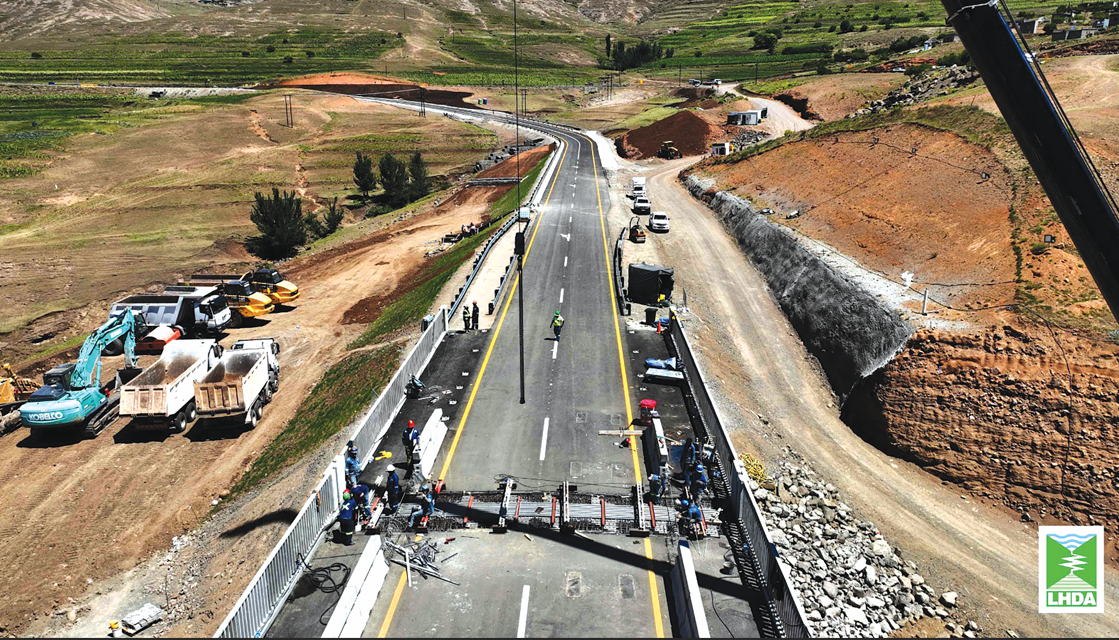
The bridge, Lesotho’s first of its extradosed design, a hybrid incorporating cable-stayed elements with a prestressed concrete box girder, was constructed by the WRES Senqu Bridge Joint Venture under a contract awarded in 2022.
Designed to endure the region’s extreme high-altitude conditions, including fierce winds, heavy snowfall, and sub-zero winters, the structure features 15 piers of varying heights and is built to last over a century.
As the largest of three major bridges being built under Phase II of the LHWP, alongside the Mabunyaneng and Khubelu bridges, the Senqu Bridge will play a vital role in maintaining connectivity along the A1 national road from Maseru to Mokhotlong.
Once the Polihali Dam, a key component of Phase II, begins impounding water, the rising reservoir would otherwise submerge or disrupt existing crossings, potentially isolating communities, schools, markets, and emergency access routes.
By ensuring uninterrupted road links across the future reservoir, the bridge will safeguard livelihoods, trade, and daily life for highland residents while supporting the broader goals of the LHWP which are to transfer billions of cubic meters of water annually to South Africa’s Vaal River system to bolster water security in Gauteng and surrounding areas, while providing Lesotho with royalties, hydropower, and transformative infrastructure.
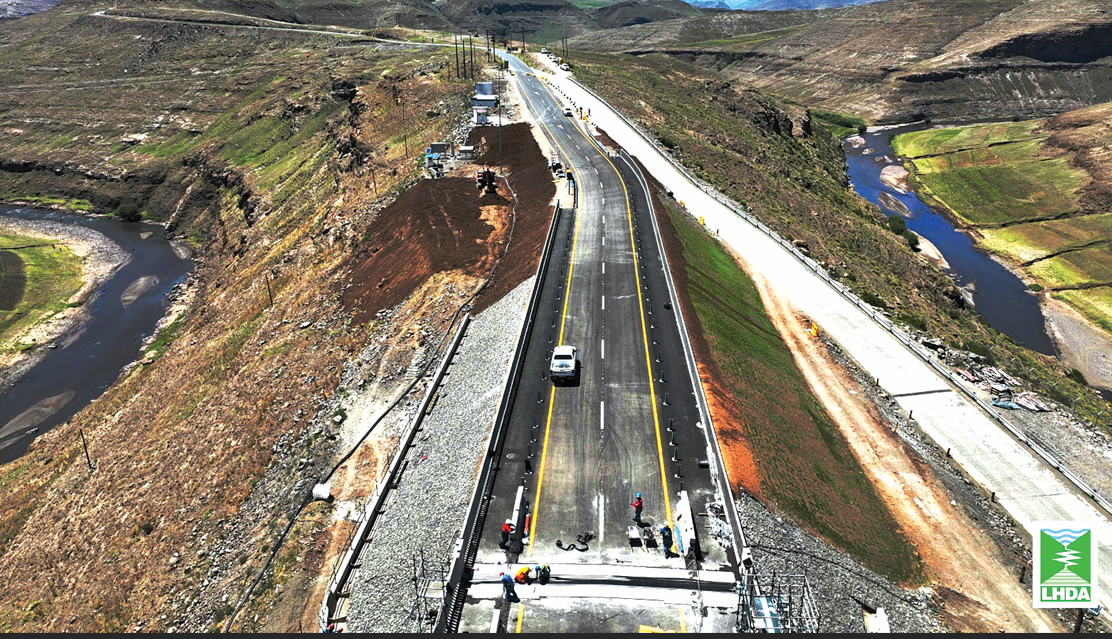
Earlier construction faced challenges, including design adjustments, severe weather, labour issues, and occasional community-related delays, pushing the timeline from an initial November 2025 target to early 2026.
Progress accelerated significantly in recent months, with the deck largely completed and the overall project reaching advanced stages by late 2025. The Senqu Bridge’s completion formally concludes the advance infrastructure phase of Phase II.
This achievement underscores four decades of bilateral cooperation under the LHWP, which has delivered iconic structures like the Katse Dam and Muela Hydropower Station in Phase I, while continuing to drive socioeconomic benefits and regional development.
As one LHDA official noted in prior updates, the bridge is “not just about engineering; it is about ensuring that communities remain connected, that children can still get to school and that trade and livelihoods can continue, despite the changes the dam will bring.”
The LHDA’s announcement aligns with strong parallel progress at the Polihali Dam, the centerpiece of Phase II.
As reported by Newsday in December 2025, the dam achieved a key construction milestone by reaching a rockfill placement elevation of 1,977 meters, 65 meters above the riverbed, following an intensive 2025 push that placed over six million cubic meters of rock by the end of November.
The main dam wall continues at a remarkable pace, exceeding 22,000 cubic meters of rockfill per day, equivalent to filling nine Olympic-sized swimming pools daily. The saddle dam has seen more than 154,000 cubic meters placed.
In total, around 14 million cubic meters of rock will be required to complete the dam, a concrete-faced rockfill structure rising to 166 meters, surpassing the 145-meter-high Mohale Dam from Phase I as one of Africa’s largest of its kind.
Rock for the embankment, sourced from a precision-blasted quarry within the future reservoir basin, which will be submerged upon impoundment, is loaded directly onto dump trucks and compacted in layers up to 0.8 meters thick.
Operating on a two-shift system, the site sees roughly 2,700 truckloads transported daily.
When finished, the Polihali Dam’s embankment will crest at 921 meters long and nine meters wide, with a base span of about 490 meters. Associated infrastructure includes a spillway, intake tower, bottom outlet, compensation outlet structure, and a small hydropower station.
The resulting reservoir on the Senqu and Khubelu rivers will cover 5,053 hectares and store up to 2,325 million cubic meters of water at full supply level.
Summary
- By ensuring uninterrupted road links across the future reservoir, the bridge will safeguard livelihoods, trade, and daily life for highland residents while supporting the broader goals of the LHWP which are to transfer billions of cubic meters of water annually to South Africa’s Vaal River system to bolster water security in Gauteng and surrounding areas, while providing Lesotho with royalties, hydropower, and transformative infrastructure.
- As reported by Newsday in December 2025, the dam achieved a key construction milestone by reaching a rockfill placement elevation of 1,977 meters, 65 meters above the riverbed, following an intensive 2025 push that placed over six million cubic meters of rock by the end of November.
- In total, around 14 million cubic meters of rock will be required to complete the dam, a concrete-faced rockfill structure rising to 166 meters, surpassing the 145-meter-high Mohale Dam from Phase I as one of Africa’s largest of its kind.

Authored by our expert team of writers and editors, with thorough research.



 a href="https://etickets.co.ls/events/29" target="_blank">