
Nkopane Mathibeli
The most immediate risk from genetic technologies does not come from the production of scary new weapons; they instead come from nefarious actors, including governments, obtaining information and abusing genetic data”The three names to which the above quotation is attributed are of an Assistant Professor of Intelligence Analysis (Lund University), a Professor of Molecular Pathology (Lund University) and an Associate Professor in Science and International Security (King’s College London), respectively. How is what they say related to the Bilateral Health Cooperation MOU between Lesotho and the USA? To answer this question in a complete and simplest way possible, it is most logical to begin by explaining how the core component of this MOU (sharing genomic data) could become a security risk if abused by nefarious actors, as highlighted by these three experts (Ingesson, Nord, Lentzos). This is a potentially difficult conversation because we must essentially ask whether the very same US government that funds important projects/programmes in our country can possibly fall among nefarious actors. Won’t probing in that direction represent the highest form of ungratefulness and, at worst, raising a false alarm on conspiratorial grounds? It probably might elicit such sentiments in various quarters, but it is definitely not based on conspiratorial grounds.
Origins of the concern
This is because this concern raised by Ingesson, Nord, Lentzos seven months ago is purely scientific as it is based on scientifically proven facts. Equally important to note is that this concern was first raised 26 years ago by a British scientist working for the British Medical Association (Dr Vivienne Nathanson) in response to work then being done under the USA initiated Human Genome Project (HGP). This project ran from 1990 to 2003 to map the genetic make up of the entire human race with the noble goal of undertaking effective genetic based medical diagnoses to facilitate efficient medical treatment for various groups of the human race.
This is precisely what the America First Global Health Aid Strategy says in Goal 2 titled outbreak response: “We will engage counterparts in the local government to understand the risks for additional spread and obtain basic genetic sequencing information or physical samples of the pathogen to inform the response and development or deployment of medical countermeasures”.
Four years before the HGP completed its work, Dr Vivienne Nathanson warned that such information as was being pursued could be used to target biological weapons at particular ethnic groups. This is precisely what Ingesson, Nord, and Lentzos mean by the abuse of genetic data by nefarious actors. But can the government of the USA be a nefarious actor? But before we answer that question, what does being nefarious mean? For a start, the Oxford English Dictionary gives, among others, the following words: criminal, immoral, wicked and sinister.
Evidence of nefarious conduct
In last week’s opinion piece titled “Venezuela’s fate and South Africa’s correct but vulnerable global posture”, I referred to a concept formulated in 1936 by an American think tank (Council on Foreign Relations) called The Grand Area. This area is described as the geographical area across the globe necessary for the productive functioning of the economy of the USA. Given what documented history teaches about the actions of consecutive USA governments to control this area, it is not worthwhile to ask whether the USA has the capacity to act nefariously because that history itself is a colourful display of criminal, immoral, wicked and sinister behaviour that disregards every aspect of International Law.
To drive this point across, I proceed to substantiate it with several documented examples. In 1936-37, the USA criminally and immorally interfered in the internal affairs of Nicaragua by supporting Somoza Garcia’s coup against Baustista in 1936 and rigged the election outcome. Somoza went on to oversee a 40-year military dictatorship that served the USA’s interests.
In 1950, the people of Puerto Rico rose against the government of a pro-USA Luis Muñoz Marín because of a repressive law that prohibited singing Patriotic songs, displaying the national flag and talking about freedom. The USA intervened by bombing towns and conducting mass arrests. In 1953, the USA, through the CIA, executed a coup to remove Prime Minister Mohamad Mossadegh for having nationalised the Anglo-Iranian oil company.
In 1959, the USA came to the rescue of Francois Duvalier’s government when Haitian exiles attempted to forcefully take over. Duvalier, popularly known as Papa Doc, had not only militarily taken over in 1957, but he was an extremely violent voodoo practitioner whose evil acts traumatised the populace while he kept them in extreme poverty. When he died in 1971, his son, nicknamed Baby Doc, took over until 1986. It is impossible to outline all the evidence demonstrating the criminal and immoral capacity of the government of the USA. As a result, I sum this by simply listing some of the most prominent examples of its mischief.
Vietnam (1965 – 1973); Guatemala (1966); Laos (1971 – 1973); Nicaragua (1972); Grenada (1983); Libya (1986 & 2011); Honduras (1988); Iraq (1991 & 2003); Somalia (1992 – 1994); Sudan (1998); Afghanistan (2001); Syria (2011 & 2018) and Venezuela (2026).
African responses to the USA health strategy
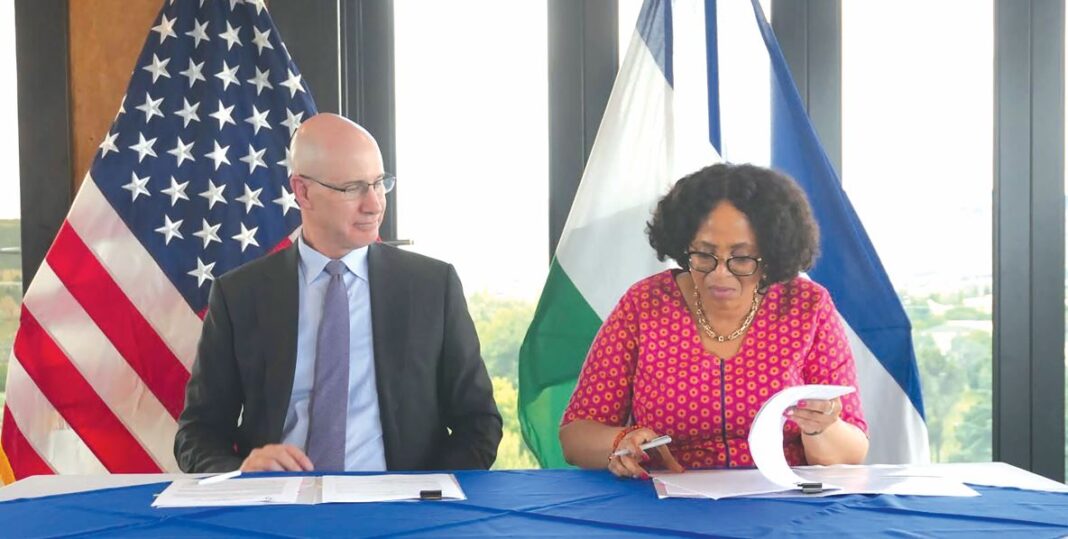
To date, fourteen African countries have signed the MoU pertaining to the America First global health strategy. In the order of their signing, they are: Kenya; Rwanda; Liberia; Uganda; Lesotho; Eswatini; Mozambique; Cameroon; Nigeria; Madagascar; Sierra Leone; Botswana; Ivory Coast; and Ethiopia. Kenya was the first to sign on the 4th of December 2025. On the 10th and 11th of the same month, the Consumer Federation of Kenya (Cofek) and Senator Okiya Omtatah, respectively, filed petitions to the Kenyan High Court and the Constitutional Court challenging the MoU.
The four issues of concern for the petitioners were data privacy, constitutional and procedural gaps, data sovereignty and control and lastly, financial risks. A day after Cofek’s petition, a conservatory order suspending the deal on grounds of data privacy was granted. Six days later (19 December), a second order stopping the whole deal was issued by the constitutional court in response to Senator Omtatah’s application.
The grounds on which this second order was granted were a lack of public participation and fiscal responsibility. All this was primarily the outcome of Cofek being vigilant and proactive as mobilised by Resilience Action Network Africa (RANA). RANA is a Pan-Africanist civil society advocacy network established in November 2023 and is dedicated to strengthening Africa’s resilience to threats such as pandemics and climate change.
Out of the 14 African countries that have signed the MoU, it was only in Kenya that legal challenges were launched against it from both the civil society and political spheres. Of course, in other countries such as Nigeria, South Africa, Madagascar and Ethiopia, concerns were raised, but they were only verbal and therefore of no consequence. This in itself is very important as it tells a rather sad story about acutely low levels of both civic and political virtue across our continent.
The Lesotho dynamics
Just like the rest of the thirteen countries which signed the MoU, both the civic movement and political circles have thus far remained as silent as a cemetery. This silence also extended to the media, if not only this publication as per its December 19th 2025 and January 9th 2026 coverages of the issue. What could be the cause? Might it be the deeply internalised and seemingly subtle and irredeemable beggar mentality that leads many of us to reason that our sorry state of finances does not give us the right to reject assistance if it includes money? Purely based on many years of observing how it operates, what I am certain of, regarding our political class on this issue, is that it welcomes it without question. This is because time has proven that the majority in this class is both inherently incapable of determining an innately Lesotho-specific development trajectory and secondly, that its parasitic nature makes it susceptible to being co-opted into accepting externally formulated and funded development initiatives in return for kickbacks. Those who give these kickbacks do so knowing that in the long run, the return on those kick-backs will be more than double to their mother countries. What I am saying here has been an open secret since 2007, when a man named John Perkins published a highly acclaimed book called The Confessions of an Economic Hitman.
In summary, we must determine our own development agenda, particularly now when the weak are being devoured for believing that the strong care about them. The concerns raised by Cofek in Kenya about data privacy regarding this health deal are legitimate, and so are the constitutional shortfalls raised by Senator Omtatah.
Must we in Lesotho ignore its similar constitutional shortfalls raised by this publication earlier? Over and above these stated constitutional transgressions, there are also serious loopholes in our Data Protection Act, 2011. Its most critical weakness is that of a non-operational commission responsible for enforcement. These issues are not light.
Summary
- To answer this question in a complete and simplest way possible, it is most logical to begin by explaining how the core component of this MOU (sharing genomic data) could become a security risk if abused by nefarious actors, as highlighted by these three experts (Ingesson, Nord, Lentzos).
- “We will engage counterparts in the local government to understand the risks for additional spread and obtain basic genetic sequencing information or physical samples of the pathogen to inform the response and development or deployment of medical countermeasures”.
- Given what documented history teaches about the actions of consecutive USA governments to control this area, it is not worthwhile to ask whether the USA has the capacity to act nefariously because that history itself is a colourful display of criminal, immoral, wicked and sinister behaviour that disregards every aspect of International Law.
Your Trusted Source for News and Insights in Lesotho!
At Newsday Media, we are passionate about delivering accurate, timely, and engaging news and multimedia content to our diverse audience. Founded with the vision of revolutionizing the media landscape in Lesotho, we have grown into a leading hybrid media company that blends traditional journalism with innovative digital platforms.