
Lesotho’s long-distance runners have repeatedly demonstrated that the country possesses the talent to compete with some of the continent’s finest athletes. What remains in question is whether the government and private sector are prepared to invest in that talent with the seriousness and consistency it deserves.
From Tebello Ramakongoana and ‘Neheng Khatala to Mokulubete Makatisi, Lebenya Nkoka, and Mabothile Lebopo, Lesotho has produced runners who have carried the national flag with distinction on the international stage.
They have achieved remarkable results despite the challenges of limited resources, inadequate facilities and insufficient institutional support. Their performances should force the country to confront an uncomfortable question: how much more could Lesotho achieve if athletics received the investment it needs to thrive?
The latest results from South Africa offer another compelling reason to act. Last Sunday, ‘Neheng Khatala won the women’s Hollywoodbets Johannesburg 10km race in 33 minutes and 40 seconds, beating South African runners Emma Brown and Irvette van Zyl.
On the same weekend, Tšepo Ramashamole finished second in the inaugural Nelson Mandela Marathon in Cape Town, clocking an impressive 2:15:24, just 10 seconds behind South African winner Arthur Jantjies. His compatriot Lebenya Nkoka also finished sixth in 2:18:31.
These were not isolated achievements. They were further evidence of the competitive quality of Lesotho’s distance runners. Khatala’s victory and Ramashamole’s marathon performance showed that Basotho athletes can challenge established competitors on South African soil, where road running attracts strong fields and substantial corporate backing.
At home, Tšepo Mathibelle won the 42.2km AvaniFit Marathon in a time of 2:29:45, while his wife, ‘Mathabo, finished second in the women’s marathon. Mathibelle received M15,000 for his victory. These results underline the depth of distance-running talent available to Lesotho, but they also raise questions about the value the country places on sporting excellence.
A M15,000 first prize is welcome recognition, but the wider ambition should be to build a sporting environment in which athletes can earn sustainable livelihoods, prepare professionally and compete internationally without constantly worrying about how they will finance their next race.
The problem with Lesotho’s approach to sporting achievement is that it too often begins at the finish line. An athlete wins a major race, breaks a record or represents the country at a global competition, and the authorities respond with financial rewards, public congratulations or promises of support.
While these gestures are appreciated, they cannot substitute for a functioning system that prepares athletes for success in the first place.
A cash reward comes after the hard work has been done. It does not pay for months of specialised training, quality running shoes, nutritious food, physiotherapy, medical assessments, coaching or travel to competitions. Nor does it guarantee that an athlete will have the resources to prepare adequately for the next challenge.
In May 2025, Ramakongoana was reportedly considering withdrawing from the Mountain Marathon after waiting months for promised prize money. He had won the inaugural race in October 2024 and was reportedly still owed M150,000.
Such an episode illustrates the danger of making promises without reliable systems for fulfilling them. A country cannot expect professional commitment from its athletes while treating its own commitments as optional.
Investment must begin with infrastructure and expertise
Lesotho needs to move beyond celebrating individual achievements and establish the foundations of a sustainable athletics industry.
The first priority should be proper training infrastructure. Athletes need accessible, safe and well-maintained tracks, gyms, recovery facilities and training centres. Such facilities should not be concentrated exclusively in Maseru. Districts and communities that have produced promising runners must also have opportunities to develop their talent.
Lesotho’s mountainous terrain offers a natural advantage for endurance training, but geography alone cannot produce champions. Athletes still need structured programmes, professional supervision, medical support and opportunities to train under conditions that prepare them for elite competition.
The government, through the relevant sports authorities and the Federation of Athletics Lesotho (FAL), should develop a long-term national athletics strategy with measurable targets, a dedicated budget and transparent accountability mechanisms.
Such a strategy should identify emerging talent early, support promising junior athletes and create clear pathways from school competitions to national teams and professional racing.
Coaches and trainers are equally important. Natural ability may help a runner win a local race, but competing consistently at international level requires technical knowledge, disciplined preparation and careful management of an athlete’s development.
Lesotho must therefore invest in coach education, sports science and specialist training. Qualified strength and conditioning coaches, physiotherapists, sports physicians and nutritionists should form part of a properly supported athletics ecosystem.
Nutrition, in particular, should not be treated as an afterthought. Distance running places enormous demands on the body. Athletes require appropriate diets, hydration, recovery and medical monitoring to sustain training loads and reduce the risk of injury.
Expecting runners to compete against well-supported international rivals while leaving them to figure out these essentials on their own is hardly a winning strategy.
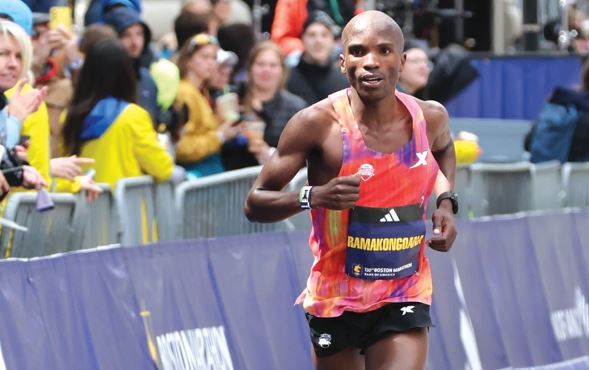
The international standing of Ramakongoana offers a glimpse of what is possible. World Athletics records his marathon personal best at 2:04:18, achieved at the Boston Marathon in April 2026. That performance places a Mosotho athlete among the world’s serious marathon competitors and should be regarded as an asset worth nurturing.
There is also a compelling economic argument for investing in athletics.
A properly developed sporting industry can create jobs for coaches, trainers, event organisers, medical professionals, nutritionists, sports journalists, photographers, equipment suppliers and hospitality businesses. It can generate demand for accommodation, transport, food services and tourism.
Road races can become important economic events, drawing participants and spectators from neighbouring countries and beyond. With professional organisation, reliable sponsorship and effective marketing, Lesotho could position selected races as attractive regional fixtures.
The country has already witnessed a proliferation of long-distance races in the years following the Covid-19 pandemic. Corporate participation in events such as the AvaniFit Marathon and other road races is encouraging. These events create platforms for healthy living, community engagement and brand visibility.
However, the next stage requires a shift from isolated sponsorship arrangements to coordinated investment. Corporates should consider pooling resources to strengthen the entire athletics calendar rather than competing to support individual events without a broader development framework.
A collective sponsorship model could improve prize money, event logistics, athlete welfare, marketing and the consistency of race organisation.
Better prizes would make a difference. The M15,000 earned by Mathibelle is a meaningful reward in the local context, but Lesotho should aspire to create a more competitive prize structure as the market develops.
Major South African road races demonstrate the potential of substantial sponsorship to raise the financial stakes for elite athletes. Lesotho’s smaller economy means it may not immediately match the biggest events across the border, but that should inspire collaboration rather than resignation.
Government could support this effort through incentives for sports sponsorship, transparent grants, partnerships with local authorities and investment in facilities that can serve schools, clubs and communities.
Private companies, meanwhile, should look beyond the immediate publicity generated by presenting a cheque to a victorious athlete. Long-term sponsorship contracts, training bursaries, equipment provision and athlete welfare programmes can produce far greater value for both the athlete and the sponsor.
Why not make athletics a national priority?
Lesotho cannot realistically invest equally in every sporting code at every stage of its development. Resources are limited, and difficult choices must be made about where investment can produce the greatest returns.
Athletics deserves serious consideration because the country already possesses a proven competitive foundation, particularly in distance running. The achievements of Basotho runners in South Africa suggest that the country does not need to start from scratch. It needs to strengthen what is already working.
This is not an argument for abandoning football, basketball, netball or other sports. Rather, it is a call to recognise where focused investment could deliver particularly strong results. Athletics offers opportunities for individual athletes to progress through measurable performance standards and compete across a wide range of regional and international events.
Lesotho has already shown that its athletes can compete with runners from countries with strong distance-running traditions, including Kenya and Ethiopia. The challenge is to build a pipeline that produces more than a handful of exceptional individuals.
That means supporting school athletics, identifying talent in rural communities, improving coaching, funding international exposure and ensuring that promising athletes do not abandon the sport because they cannot afford to pursue it.
The government must provide leadership, but it cannot do everything alone. The private sector, sports federations, schools, local authorities and communities must become partners in a common national project.
Lesotho’s runners have done their part. They have trained, travelled and competed, often with limited support, and returned with victories that have brought pride to the country.
The next generation should not have to overcome avoidable financial and structural obstacles merely to fulfil its potential. If Lesotho can produce champions under difficult circumstances, imagine what its runners could achieve with modern facilities, professional coaching, proper nutrition, reliable sponsorship and meaningful prize money.
The opportunity is before us. The talent is already here. What is missing is the collective determination to invest in it.
Lesotho must put its money where its applause is. The rewards could extend far beyond medals and finish-line photographs to a stronger sporting culture, new employment opportunities, healthier communities and a country increasingly recognised for excellence on the international stage.
Summary
- A M15,000 first prize is welcome recognition, but the wider ambition should be to build a sporting environment in which athletes can earn sustainable livelihoods, prepare professionally and compete internationally without constantly worrying about how they will finance their next race.
- An athlete wins a major race, breaks a record or represents the country at a global competition, and the authorities respond with financial rewards, public congratulations or promises of support.
- The government, through the relevant sports authorities and the Federation of Athletics Lesotho (FAL), should develop a long-term national athletics strategy with measurable targets, a dedicated budget and transparent accountability mechanisms.

Senior journalist and communications professional with extensive experience in general news reporting, specializing in business and sports journalism. Skilled in public speaking, media relations, and strategic communication, with a proven ability to deliver accurate, engaging, and impactful stories.
A strong team player who thrives in collaborative environments and adapts effectively to diverse working conditions. Passionate about continuous learning, professional growth, and enhancing communication practices to meet evolving industry demands.