
Chris Mokolatsie
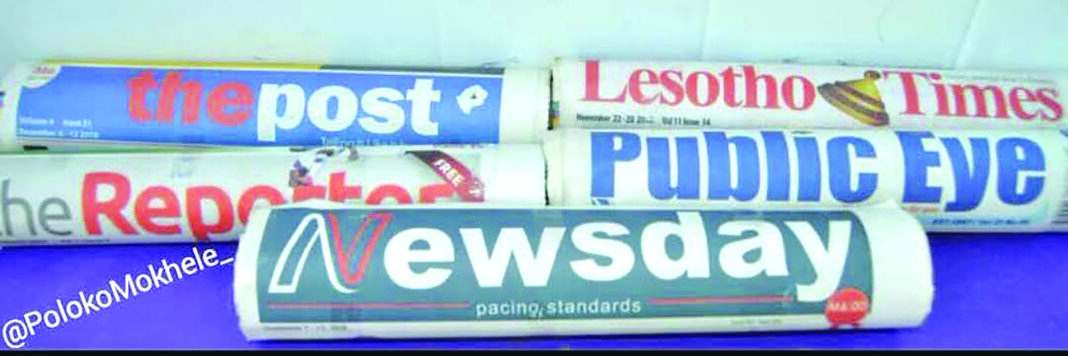
Lesotho’s print media landscape, dominated by publications such as the Lesotho Times, Newsday, The Post, and Public Eye, among others, appears to be little more than an advertising revenue scheme masquerading as journalism. These so-called newspapers seem to prioritise profit over purpose. A quick glance at any edition reveals a glaring omission: the absence of genuine news on the front page. Instead, it is invariably reserved for advertisements. Where is the breaking news?
A brief perusal of their content exposes a troubling pattern: an overwhelming reliance on advertising, predominantly from public sector entities and a select few private companies, with little emphasis on quality journalism. Articles are unnecessarily long, poorly structured, and padded with irrelevant details. Accompanying photographs are often blurry and unprofessional, evoking outdated cell phone snapshots rather than the polished visuals expected in contemporary journalism.
The digital editions are no better. These papers merely upload their print layouts as cumbersome PDFs, which are difficult to navigate – particularly on mobile devices, the primary platform for digital content consumption today.
Style Over Substance
The editorial style of these newspapers exacerbates the problem. Stories are often bloated, lacking conciseness, engagement, or substance. Readers are left overwhelmed by sprawling text and underwhelmed by the lack of meaningful information. What passes for “news” frequently consists of minimally edited press releases or verbatim political statements, offering little analysis or depth to educate or engage the public.
Take, for example, a recent article in Public Eye titled “Mahao Schools Prime Minister.” The paper failed to report the actual news, that the Prime Minister had dismissed Professor Mahao as Minister of Energy. Instead, readers were subjected to a meandering 1,000-word narrative spread across three pages. Similarly, The Post devoted two full pages to a mundane legislative amendment on banning the initiation of minors under 18, a story devoid of urgency or widespread interest.
Such long-winded, poorly executed reporting highlights a fundamental lack of professionalism in Lesotho’s print media. Consider Newsday, which last week published an opinion piece titled “Water for South Africa – Despair for Villagers” under the wrong byline. While mistakes happen, this basic error reflects a troubling lack of editorial oversight.
Are These Really Newspapers or Advertorials?
This raises a critical question: Are these publications genuine news organisations, or are they merely advertising platforms disguised as newspapers? A closer look suggests the latter.
In Lesotho, advertising revenue—particularly from government departments and state-owned enterprises—is a lucrative and steady income stream. Consequently, these publications prioritise securing advertisements over producing quality content. This dynamic is exacerbated by advertisers’ lack of objective criteria for selecting publications. A newspaper’s existence alone appears to suffice.
This approach rewards mediocrity, encouraging newspapers to rely on connections rather than content quality to secure advertising revenue. In a market with limited competition, these publishers have settled into a low-effort, high-reward model: producing the bare minimum to attract advertising while charging readers between M6 and M7 per copy. What value do readers get for their money?
Quality Journalism Requires Investment
True journalism requires integrity, curiosity, and a relentless commitment to serving the public interest. It also demands investment: in skilled reporters, professional photography, and diverse, engaging content. Globally, leading newspapers attract loyal readerships through investigative reporting, sharp editorials, and dynamic coverage of sports, entertainment, and human-interest stories.
Lesotho’s print media, however, consistently falls short. The current crop of publications appears content with minimal effort as long as advertising revenue continues to flow. Few seem interested in expanding coverage to rural areas or diversifying their reporting to reflect the complexities of the nation.
A Call for Change
Lesotho desperately needs serious investment in its print media landscape from publishers who view journalism as a public good rather than a quick-profit enterprise. These investors must prioritise quality reporting that informs, critiques, and fosters public debate, and off course well paid and well-trained reporters.
From the outside looking in, the current state of Lesotho’s print media is disheartening. Most publications: Newsday, Public Eye, The Post, Lesotho Times etc etc all of them without exception prioritise advertising revenue over their journalistic responsibilities, leaving readers shortchanged. Until this changes, the print media in Lesotho will remain a scam, selling adverts not news.
It is not enough to print content on newsprint, roll it off a press, and call it a newspaper. The nation deserves better. The time for change is now.
Summary
- Lesotho’s print media landscape, dominated by publications such as the Lesotho Times, Newsday, The Post, and Public Eye, among others, appears to be little more than an advertising revenue scheme masquerading as journalism.
- Similarly, The Post devoted two full pages to a mundane legislative amendment on banning the initiation of minors under 18, a story devoid of urgency or widespread interest.
- Few seem interested in expanding coverage to rural areas or diversifying their reporting to reflect the complexities of the nation.

Welcome to Newsday Media – Your Trusted Source for News and Insights in Lesotho!
At Newsday Media, we are passionate about delivering accurate, timely, and engaging news and multimedia content to our diverse audience. Founded with the vision of revolutionizing the media landscape in Lesotho, we have grown into a leading hybrid media company that blends traditional journalism with innovative digital platforms.
Our mission is simple: to inform, inspire, and empower our readers by providing comprehensive coverage of local and global events, current affairs, and cultural happenings. Whether you’re looking for breaking news, in-depth analysis, or captivating storytelling, Newsday Media is your go-to destination for all things news-related.
With a dedicated team of journalists, editors, and multimedia experts, we are committed to upholding the highest standards of journalistic integrity and professionalism. We pride ourselves on delivering content that not only informs but also sparks conversation, fosters understanding, and drives positive change in our society.
From our flagship newspaper to our dynamic digital platforms, we offer a wide range of multimedia content to cater to the diverse interests and preferences of our audience. Whether you prefer to stay informed through print, online articles, videos, or podcasts, Newsday Media has something for everyone.
We believe in the power of storytelling to connect people, bridge divides, and inspire action. That’s why we’re dedicated to providing a platform for voices from all walks of life, championing diversity, inclusion, and authenticity in everything we do.
Thank you for visiting Newsday Media. We invite you to explore our website, engage with our content, and join us on our journey to inform, inspire, and empower our community. Together, let’s shape the future of media in Lesotho.