
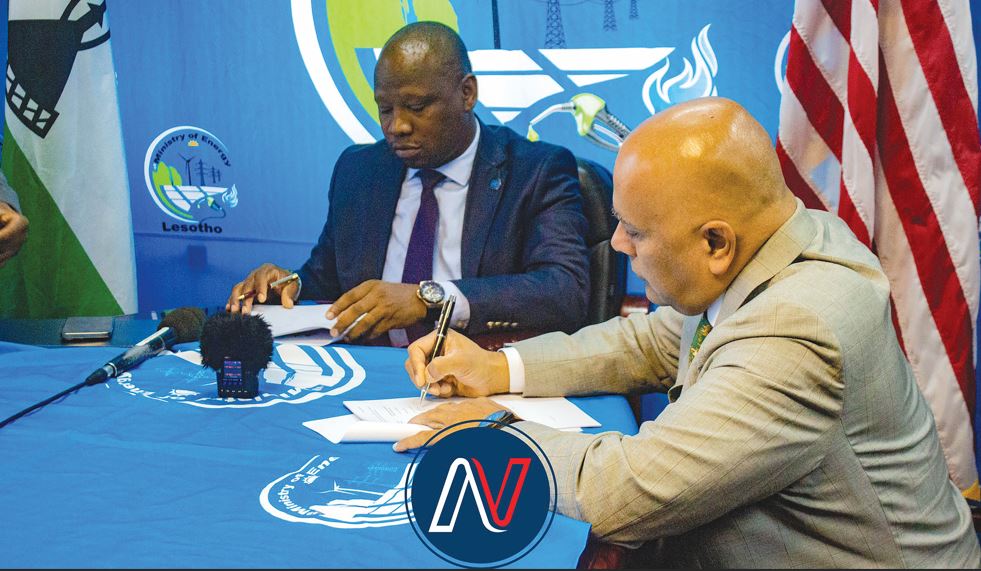
Minister of Energy Lejone Mpotjoane has signed a Memorandum of Agreement (MoA) with Convalt Energy Inc founder and CEO Hari Achuthan to undertake a feasibility study at Kobong in Leribe for a renewable energy project.
It is expected that this United States solar manufacturing and renewable energy developer will generate 1,200 megawatts of electricity for the country once the project is completed.
The deal is also envisaged to transform the energy sector in Lesotho, as it is expected to bring about US$6 billion (about M110 billion at the 4 June 2026 exchange rate) in investment, according to Mpotjoane. It further includes a proposed US$20 billion (about M366 billion) investment for a 900-megawatt data centre.
The Principal Secretary (PS) of the Ministry of Energy, Tankiso Phapano, said the company met with Lesotho in Morocco in August 2025 and was then sold on investing in the country. From that point, Phapano said, the government has been in discussions with the company. It submitted its proposal and, following scrutiny, a letter of intent was issued for it to undertake the feasibility study at Kobong (the Kobong Project).
The study will take 12 months, and may be renewed.
Convalt CEO Hari Achuthan said the project is a stepping stone for further investment in Lesotho. He said Lesotho distinguished itself as the most viable destination for investment when compared with other African countries.
Convalt Energy Inc’s footprint spans different parts of the world, including the United States, India and Chad, among other countries, where it has invested in green energy, data centre construction and recycling, among other sectors.
Senior Energy Adviser to Lesotho, Dr Albert Butare, who is also Rwanda’s former Minister of State for Infrastructure, said the project will not only revolutionise Lesotho’s digital economy but will also transform it into an energy hub.
He said the company will be able to pump water for hydropower generation and that it plans to install a transmission line from Polihali to Durban, relying on optical fibre infrastructure. He added that this will also be connected to the data centre, which is expected to be one of the largest in the region. The plan also includes linking undersea optical fibre cables through Durban, South Africa.
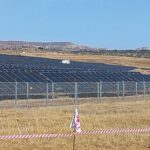
Solar panels will be used to generate power, with installations both on land and floating on the Senqu River.
Lesotho reportedly enjoys 300 days of direct sunlight annually. Mpotjoane said this would be the country’s advantage in attracting the investment, and pointed out that Lesotho is well positioned to generate clean energy.
Mpotjoane said that as the world moves rapidly with digitisation, Lesotho cannot be left behind, and that if the project is well executed, it could attract investment from major tech firms such as Google and Facebook to build data centres in the country. He said that before exporting energy to other countries, Lesotho must first meet its own demand and should not rush to export in a way that leaves the country short of power.
He highlighted that once the project kicks off, the country is likely to see significant capital inflows, many job opportunities and investment across multiple sectors. “We need to support this project as Basotho,” he said.
While the Ministry could not disclose the full contractual terms, Phapano said it would assist the company by removing any hurdles that could impede smooth operations, granting rights to undertake the feasibility study, and sharing information in the Ministry’s possession where required. Upon completion of the feasibility study, Convalt Energy Inc will submit its report, which will be subjected to governance and legal processes; once requirements have been met, the government will proceed to sign an implementation agreement.
The power purchase agreement for the project has also not yet been finalised.
Meanwhile, Lesotho has previously signed problematic energy deals with other foreign firms, including a Chinese company and Fraser Solar GmbH. Those agreements have been criticised for unfavourable terms, limited local benefit and delayed delivery; observers warn the new US deal must avoid similar pitfalls if it is to deliver genuine long-term value for the country.
The government is embroiled in a protracted legal battle with Fraser Solar over a deal allegedly signed by the then Minister in the Prime Minister’s Office, Temeki Tšolo. The German company is suing the government for failure to honour contractual obligations, and the government has spent millions fighting the lawsuit.
Recently, the Supreme Court of Appeal (SCA) in Bloemfontein reversed a prior ruling by the Gauteng Division of the High Court on a €50 million (approximately M970 million) arbitration award under which the country’s assets had been attached.
Last year, before the Public Accounts Committee (PAC), it was disclosed that the government had saddled itself with a US$53 million (about M970 million) debt in relation to a contested deal involving China-based Beijing Jinyuntong Technology Co. Ltd (JYT), which would finance, build and operate a 40MW solar plant with a 20MW energy storage system under a Build Operate Transfer (BOT) model, before handing the project to the government after 15 years.
Although Lesotho urgently needs more generation, it currently produces just 72MW against peak demand of 240MW. The country imports power from South Africa’s Eskom at a cost of over M600 million annually.
Summary
- Minister of Energy Lejone Mpotjoane has signed a Memorandum of Agreement (MoA) with Convalt Energy Inc founder and CEO Hari Achuthan to undertake a feasibility study at Kobong in Leribe for a renewable energy project.
- The deal is also envisaged to transform the energy sector in Lesotho, as it is expected to bring about US$6 billion (about M110 billion at the 4 June 2026 exchange rate) in investment, according to Mpotjoane.
- Mpotjoane said that as the world moves rapidly with digitisation, Lesotho cannot be left behind, and that if the project is well executed, it could attract investment from major tech firms such as Google and Facebook to build data centres in the country.
Thoboloko Ntšonyane is a dedicated journalist who has contributed to various publications. He reports on accountability, human rights, exposes corruption and wrong doing by those in power. He reports have exposed corruption, abuse of power, fraud, misconduct and negligence. He subscribes to evidence-based reporting. He reports on governance, parliament, courts, climate change, human rights, sexual and reproductive health rights (SRHR), health, business and agriculture. He gives a voice to the marginalised while also demanding accountability. His work inspires change, triggers dialogue and also promote transparency in a society.