
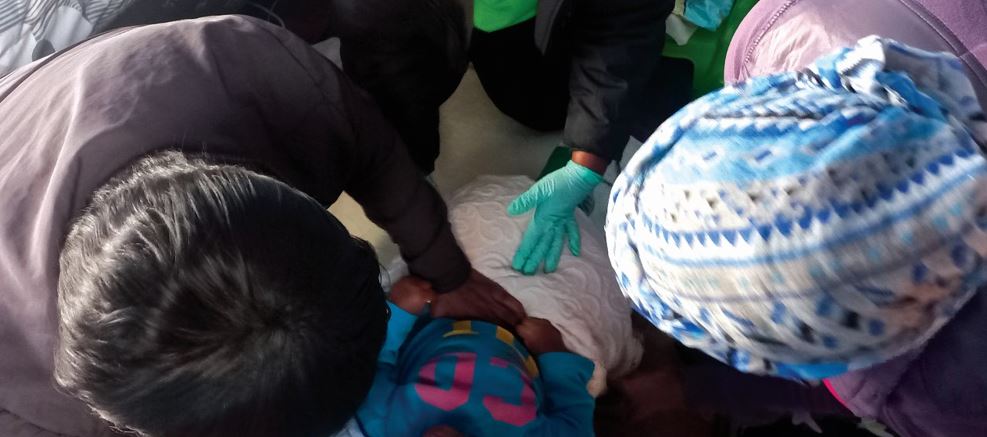
On a cold winter morning in Maseru, the Malamulele Onward team set out on an outreach exercise, crunching along frost-hardened tracks and navigating pothole-filled roads through the city and surrounding villages.
Their destination is the homes of families raising children with cerebral palsy (CP). At each stop, they stepped into small worlds where mothers balance daily chores while guiding children with stiff, uncertain limbs. Together, they spoke and sang quietly, attended to each child gently, and unpacked their tools, gloves, and sanitisers.
For Malamulele Onward, outreach is never just a physiotherapy visit. It is caring, helping families, and giving hope, all wrapped in dignity.
Bringing therapy to the doorstep
The organisation’s parent facilitators trained parents in stretches and positioning, fitted adapted chairs and walkers, and discussed ways to keep children moving despite scarce resources. Malamulele Onward recently came to Lesotho from South Africa to visit families with children living with cerebral palsy.
Some children have hemiplegia affecting the whole left side. In these cases, the left arms cannot fully straighten or lock. In other children, the arms may be uneven, with one appearing shorter than the other. Some legs are weaker; ankles have limited movement, and toes move very little. The degree of each child’s condition varies, but they are generally vulnerable to tiredness and stiffness.
Executive Director of Malamulele Onward, Pulane Baloyi, said they use whatever the family has instead of expensive equipment, because some cannot afford it.
“We actually train them to use whatever they have for therapy,” she said. “The work we do is meant to benefit the child.”
A gentle approach to care
Lydia Ngwana, the lead Master Trainer and Parent Facilitator Mentor for Malamulele Onward, explained that when children are happy, their bodies relax; but when they are not happy, they become stiff and unable to function well.
“What he wants is for you to talk to him. This is his body. Will you be happy if someone just undresses you without saying a word to you?” she told a parent while demonstrating how to help her son relax his body.
One family’s journey
Moleboheng told the Malamulele Onward team that her child had difficulty eating solid food and would vomit, only delighting in eating cereal. She was advised to refer him to a dietitian.
“Explain everything to a dietitian so that he can be able to assist him to maintain a healthy body so that it is easier to pick him up,” Ngwana emphasised.
Moleboheng said her son was injured on the head during birth. Doctors told her that he has a small brain and suffers from fits. She was also informed that his abilities would come slowly.
“How I met Malamulele Onward’s Lesotho-based parent facilitator, ‘Maseretse Makhothi, was at Queen II Hospital,” said the parent. “She explained to me the condition and how I should help my child.”
Makhothi conducts house visits and shows parents how to position their children’s bodies and how to lay them in ways that keep them relaxed. She also teaches them how to pick the children up safely.
“During the time I met ‘Maseretse, I had learned and understood how to position him and relax him so that he is at ease,” the parent said.
She added that even how the child sat was not right, and ‘Maseretse taught her how to place a towel so the feet could relax and not be floppy. Sometimes his feet can reach behind his head.
“We have to make him stand from time to time. This is a sandwich standing. Every time he stands, his weight should support his body, and his legs should get used to the weight of his body,” said Ngwana, demonstrating how the child should stand.
Ngwana continued: “I am not happy at how he cries. When you check, explain everything to them about his condition and challenges so that they are able to assist him.”
The team also uses home-visit follow-up forms that contain information about each child.
A mother’s struggle for support
In the second family, they met a six-year-old child with CP. Mpho said she was taught how to stand him up and how to always ensure he has his shoes on.
She said at physio they do not show them how to properly take care of their child. She commented that Malamulele Onward is checking on them and teaching them how to care for a child with CP.
However, she said that because she is not working due to ill health, she cannot provide for her child. She complained that Social Development last helped her four years ago with diapers and milk for her son.
“They don’t care about us; they don’t help us. I think they have assisted me once. Every time I go, I am dismissed and told this is not there, this is finished. And that is tiresome,” she complained, saying she has given up.
In the third family, they found the child asleep. The child also had CP and was assisted by ‘Maseretse. The parent said the assistance had been helpful.
Ngwana said the children have different types of cerebral palsy. She also shared a message of encouragement with the parents: “Know that what you have is not a burden; there is a life despite.”
The organisation’s origins and reach
Malamulele Onward is a non-profit organisation that helps improve the quality of life of African children with cerebral palsy, especially those from underprivileged families. While it is based in South Africa, its services extend to Lesotho.
It was established by Dr Gillian Saloojee in 2006, who was a physiotherapist at Baragwanath Hospital in Soweto. Baloyi said there was a request from Malamulele in Limpopo to be helped, because there were no physiotherapists to assist children with CP in that area. She gathered other therapists, and that is when the idea was born.
In Lesotho, Baloyi said they work in Maseru, Leribe, Botha-Bothe, Mohale’s Hoek, and Mokhotlong. They have also trained parent facilitators in Lesotho who help children with CP.
She said they work closely with hospitals under programme careers to careers, and a manual has been developed with modules for parents of children with CP. The modules include how to understand CP, the types of CP, CP as a way of life, the levels of CP, different ways of communication using sounds and gestures, and Cerebral Visual Impairment (CVI).
Ngwana explained that even after bathing, there should be massage, and the children should be positioned in a healthy way and left sitting comfortably.
“Everything we do with them we prepare the body,” said Ngwana. “Just like a soccer player.”
From 2012, they expanded to Lesotho. Baloyi said they had visited 16 families in Lesotho, whereas initially they were supposed to be 18, but on arriving they received reports that the children had passed on. Their services are free.
She said they work with the Ministry of Health (MoH) through hospitals but pointed out that they are planning to formalise a relationship through a Memorandum of Understanding (MoU) with the Ministry.
In South Africa, Baloyi said there is a grant that people with disabilities receive. It covers children with CP, who qualify for it and receive it monthly.
Challenges and the way forward
“We see the value of our work through the support that they have received through ‘Maseretse. I think the one problem which is universal, not just in Lesotho, is access. It could be resources,” said Baloyi.
“The work that we do focuses on rural places and families that are resource constrained. Because of those challenges, there is limited access to healthcare services.”
She added that the distance is sometimes far for parents to take their children to health facilities. As the child grows, she said it becomes difficult for a parent to carry the child, and they end up not taking them to the hospital or the clinic. Because of that, their home visit programme fills the gap, and through ‘Maseretse, the children receive continuous therapy.
They work with the child from birth until they are 18, when they can release them from the programme.
Asked what challenges they face when conducting home visits, Baloyi said that sometimes some parents do not show interest in helping the child. She added that they would sometimes ask what she has brought to the child. She said sometimes she would find the parent not there despite making an appointment.
Baloyi said that as much as they want to expand their reach, they are limited by resources.
“We hope the Ministries [Social Development and Health] will see more value in our work and allocate some funding for the work that we do. There is so much that we want to do but we are struggling to do because we have limited funding. We can only work with what we have. But if we can get more funding, the impact will be bigger,” she said.
Understanding Cerebral Palsy
Cerebral palsy (CP) is a group of disorders that affect a person’s ability to move and maintain balance and posture. “Cerebral” means having to do with the brain, and “palsy” means weakness in or problems with using the muscles.
CP is caused by abnormal brain development or damage to the developing brain, affecting a person’s ability to control their muscles. It is the most common motor disability in childhood.
Symptoms of CP vary from person to person. A person with severe CP might need special equipment to walk or might not be able to walk at all and might require lifelong care. A person with mild CP, on the other hand, might walk awkwardly but might not need any special help. CP does not get worse over time, though the exact symptoms can change over a person’s lifetime.
Government support for families
The Disability Equity Act, 2021 calls for the Minister to take necessary steps to achieve the full realisation of the rights of persons with disability.
Mpho Makhetha, the Public Relations Officer at the Ministry of Gender, Youth, and Social Development, explained the support available for families with children living with cerebral palsy, especially those from less privileged backgrounds.
Makhetha said the Ministry supports children living with cerebral palsy through a range of care services, including disability grants, disposable nappies, and assistive devices such as specialised wheelchairs designed to meet their specific needs.
She further stated that the Ministry provides food support for children who struggle with swallowing solid foods. “The Ministry also provides soft food packages, including Nespray, soup, and Ensure milk,” Makhetha said.
She explained that the Ministry also coordinates with nutrition experts, stating that it facilitates referrals and coordination with nutritionists, who guide parents and guardians on how to prepare nutritious soft meals suitable for children living with cerebral palsy.
On emotional support, Makhetha highlighted that caregiving is not only medical but also psychological and social. “For emotional support and the well-being of both children and their caregivers, the Ministry offers counselling sessions/services for parents and guardians,” she said.
Makhetha added that counselling helps families understand and accept their child’s condition, learn appropriate caregiving practices, and encourage the inclusion of their children in family and community life. She emphasised that counselling also supports children’s opportunities to interact and play with other children. Makhetha said counselling is also provided to some children living with cerebral palsy, depending on their individual condition and needs.
How to access support
Makhetha said families can access assistance through local structures. “Services can be accessed by parents or guardians of a child with Cerebral Palsy by approaching the Ministry through Auxiliary Social Workers at the Community Council level or through the district offices,” she stated.
She also outlined the documentation required, saying parents must submit: a letter from the local chief confirming the family’s residence and the child’s condition; the child’s birth certificate; and the parent or guardian’s identification document.
On eligibility, Makhetha explained that assistance is tied to household vulnerability and income categories. “Families that qualify for assistance are those assessed as being in the poor, ultra-poor, or middle-income categories, depending on the needs and circumstances of the household,” she said.
Earlier this year, Minister of Gender, Youth, and Social Development Pitso Lesaoana said the disability grants will no longer be paid quarterly at M1,800.00; instead, they will be paid monthly at M650.00.
Financial and educational support
Makhetha justified the rationale for support by describing the financial pressure cerebral palsy can place on households. “The Ministry provides this support because caring for a child with CP often places a significant financial burden on families, with the child’s needs sometimes exceeding the household income,” she stated.
She added that this can affect other children as well: “As a result, the needs of other children in the family may also be affected, including their education and overall well-being.”
Makhetha explained that the Ministry’s school support differs between primary and high school learners.
She said, “The Ministry covers boarding and lodging costs for children with Cerebral Palsy attending inclusive primary schools, such as the Resource Centre,” while also encouraging parents to enrol learners in inclusive schools registered with MOET.
“Parents are encouraged to enrol their children in inclusive schools registered with MOET,” she added.
Makhetha clarified that at primary level, the Ministry covers living costs but not school fees or transport. “At the primary level, the Ministry covers only the boarding and lodging expenses; school fees are not paid at the primary level, and transport costs are also not covered since the children reside on the school campus during the school term.”
She then contrasted this with high school level, where more direct fee support applies. “At the high school level, the Ministry provides support by covering school fees as well as boarding and lodging expenses for learners with CP,” Makhetha stated.
Names of parents have been changed to protect their identities.
Summary
- “Explain everything to a dietitian so that he can be able to assist him to maintain a healthy body so that it is easier to pick him up,” Ngwana emphasised.
- “During the time I met ‘Maseretse, I had learned and understood how to position him and relax him so that he is at ease,” the parent said.
- She added that even how the child sat was not right, and ‘Maseretse taught her how to place a towel so the feet could relax and not be floppy.
Thoboloko Ntšonyane is a dedicated journalist who has contributed to various publications. He reports on accountability, human rights, exposes corruption and wrong doing by those in power. He reports have exposed corruption, abuse of power, fraud, misconduct and negligence. He subscribes to evidence-based reporting. He reports on governance, parliament, courts, climate change, human rights, sexual and reproductive health rights (SRHR), health, business and agriculture. He gives a voice to the marginalised while also demanding accountability. His work inspires change, triggers dialogue and also promote transparency in a society.