
A national Training of Trainers workshop in Berea prepared Master Trainers to carry Teaching at the Right Level, known locally as Ntataise, into 300 primary schools, helping learners in Grades 3 to 5 build the foundational literacy and numeracy skills they need to succeed.
BEREA — Inside a bright training room in Berea, a circle of District Resource Teachers and Inspectors lean forward as a facilitator holds up simple letter cards and number charts.
One by one, participants take turns role-playing a learner struggling to sound out words or solve a basic sum.
Others practise the quick one-on-one assessment, carefully noting what the “learner” can already do before gently guiding them into a flexible group.
“It is known that learners cannot grasp information at the same time when a teacher is teaching. Some lag behind while the teacher moves forward with those who understand,” said Lehlaka Mohapi, a Schools Inspector from Quthing, reflecting on the morning’s practical exercise.
For years, this has been the reality in many of Lesotho’s classrooms. Now, a new government-led programme is working to change that story.
Through the Ministry of Education and Training (MoET), with support from the Global Partnership for Education (GPE) and UNICEF, and technical assistance from TaRL Africa, Lesotho is rolling out Teaching at the Right Level (TaRL) – known here as “Ntataise,” Sesotho for “lead me by the hand.” The goal is to make sure no child is left behind.
Ntataise is a national commitment to meet every learner where they are, and guide them towards their full potential. According to Mohapi, the programme focuses on children in Grades 3, 4 and 5, to strengthen their foundational literacy and numeracy skills.
The need is urgent. A World Bank learning poverty estimate cited in the programme’s documentation puts the scale of the challenge in stark terms. An estimated 97 percent of children in Lesotho are unable to read and understand a simple, age-appropriate text by the age of ten.
Under the traditional approach of moving through the curriculum at the same pace for an entire class, many learners are left behind. Mohapi said Ntataise is changing that by making sure each child gets help at the right time and in the right way.
| NTATAISE AT A GLANCE | |
| What it is | Teaching at the Right Level (TaRL), known in Lesotho as “Ntataise” — Sesotho for “lead me by the hand” |
| Led by | Ministry of Education and Training, with support from the Global Partnership for Education and UNICEF, and technical assistance from TaRL Africa |
| Who it’s for | Learners in Grades 3, 4 and 5, to strengthen foundational literacy and numeracy |
| Reach | 300 primary schools across all ten districts |
| Teacher training | 600 teachers — two from every participating school — to be trained by newly qualified Master Trainers |
| Timeline | Two implementation cycles, running from May 2026 to December 2027 |
| The challenge | An estimated 97% of 10-year-olds in Lesotho cannot read and understand a simple, age-appropriate text (World Bank learning poverty estimate) |
At the heart of TaRL is a simple but powerful idea that teaching should meet the learner at their current level, not their grade. Teachers use quick assessment tools to find out what each child can do, group learners according to their current skills, and support them with activities matched to their needs. Progress is checked regularly, and learners move between groups as they improve.
“We are taught about grouping them according to their challenges. Those who cannot read letters, those struggling with words, and those who struggle with reading a paragraph, so that a teacher can assist them separately from those who already understand,” Mohapi explained.
The goal is for learners to move up from one group to the next, step by step, until they catch up with their peers and can keep pace with the curriculum.
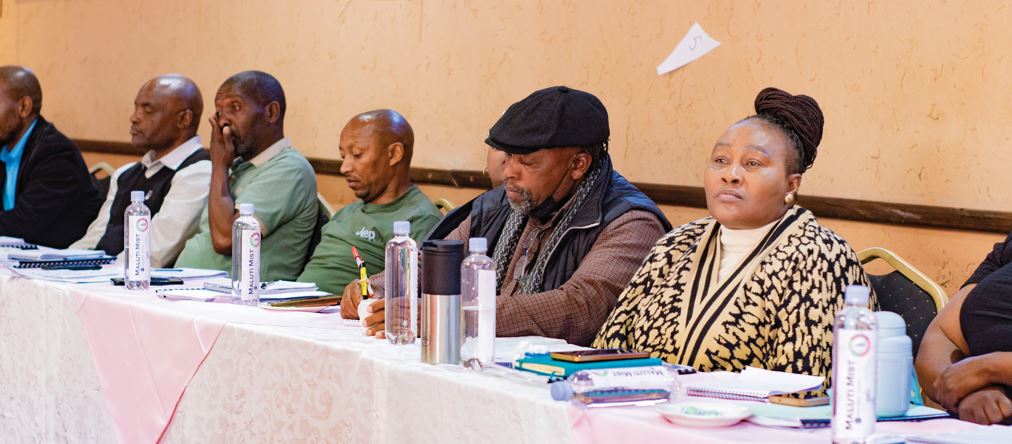
The Ministry of Education and Training, together with GPE, UNICEF and TaRL Africa, recently held a national Training of Trainers workshop in Berea to launch this approach.
District Resource Teachers and Inspectors from across the country gathered to become Master Trainers and mentors, joined by representatives of the National Curriculum Development Centre (NCDC) and the Lesotho College of Education (LCE), to strengthen the link between TaRL, the national curriculum and teacher development.
These Master Trainers will now train 600 teachers — two from each of the 300 participating primary schools — who will carry Ntataise into classrooms across all ten districts. Implementation is expected to roll out in two cycles between May 2026 and December 2027, woven into Lesotho’s existing education structures under government leadership.
According to UNICEF, TaRL does not replace Lesotho’s national curriculum, permanently label learners, or separate them by ability. Grouping is flexible, and groups change as children progress.
‘Maliteboho Lehloba, a District Resource Teacher from Leribe, explained how the approach will work on the ground. “When we get to the schools, we assess Grade 3, 4 and 5 learners using the tools provided. We are also expected to use locally and readily available materials while passing the knowledge on to other teachers,” she said.
She said TaRL sessions will run for 80 minutes, four days a week, focusing on one subject each day. After two weeks, learners are reassessed to track their progress, and teachers adjust their support accordingly.
Parents and communities also have a role to play, Lehloba said. “TaRL is also going to help parents easily monitor their children’s progress. We appeal to parents to encourage their children by always checking on their progress at school.” She also urged schools and teachers to welcome the programme: “It is when they have welcomed us that even the learners will accept us, and we will get the results we want.”
Bhekilizwe Maphosa, Programme Management and Partnerships Coordinator for TaRL Africa, explained that TaRL is an evidence-based approach that began in India and is now used in more than 18 African countries. “The methodology aims to reach learners at their right level, to equip them with good foundational literacy and numeracy skills, and to ensure that they do not fall behind in their learning,” he said.
Unlike traditional teaching, which groups children mainly by age or grade, Maphosa said TaRL groups learners according to their current skills. Classrooms become more interactive, with teachers using hands-on activities and locally made learning materials.
The design of the Ntataise programme, Maphosa said, was shaped by experts from Lesotho’s own education sector, including language specialists and curriculum developers to ensure the materials and methods fit the local context and languages, especially Sesotho, and support the national curriculum. Teachers are encouraged to use resources easily found in their communities, such as cards, flip charts and number cards, to make lessons lively and practical.
“Quality is key. Teachers are trained to assess each learner one-on-one and to use data to track every child’s progress. This means children move from one group to the next only when they are truly ready, not just because of their age or grade,” Maphosa explained. Regular reviews and data collection, he added, allow teachers and trainers to learn what works, improve their methods and share successes and challenges as the programme develops.
TaRL, he said, is more than a set of lessons or a new teaching method. It is a promise from government and partners like UNICEF that every child in Lesotho deserves the chance to succeed in school.
“We have been trained on how to do assessments to see who is left behind, find their problem and help them from there.”
— Lehlaka Mohapi, Schools Inspector, Quthing
For Mohapi and many others at the workshop, the programme is personal. “We have been trained on how to do assessments to see who is left behind, find their problem and help them from there. This will be a continuous exercise, because as trainers we are expected to go back to our districts and train teachers, to make sure no learner is left behind,” he said.
He hopes that, with Ntataise, children across Lesotho will build strong reading, writing and mathematics skills in the early grades. “This will not only help them succeed in school but will give them the foundation they need for life. As more teachers are trained and more schools join the programme, Lesotho is taking big steps towards a future where every child is supported, no matter where they start,” he said.
Principal Secretary (PS) in the Ministry of Education and Training, Ratšiu Majara, said tackling learning poverty in Lesotho means looking beyond the grade a child is in. “If we are to tackle learning poverty in Lesotho, we must ensure that every child develops the foundational skills needed to progress through school and reach their full potential. This requires us to look beyond the grade a child is in and understand what they can do,” Majara said.
Teaching at the Right Level, he said, will make it possible to meet children at their current level of learning, provide targeted support, and help those who have fallen behind to catch up. “By strengthening foundational literacy and numeracy, we will give every learner a fair opportunity to succeed in school and beyond,” he said.
“By strengthening foundational literacy and numeracy, we will give every learner a fair opportunity to succeed in school and beyond.”
— Ratšiu Majara, Principal Secretary, Ministry of Education and Training
Deputy Representative for UNICEF Lesotho, Sara Skovgaard, said she is excited to see Teaching at the Right Level being introduced in Lesotho, adding that evidence from other countries shows the approach can deliver meaningful improvements in learning outcomes.
“Its success in Lesotho will depend on teachers and school leaders embracing the methodology and applying it consistently in the classroom. This presents an important opportunity to learn what works in the Lesotho context, and to build an approach that can benefit many more children across the country,” she said.
Summary
- A national Training of Trainers workshop in Berea prepared Master Trainers to carry Teaching at the Right Level, known locally as Ntataise, into 300 primary schools, helping learners in Grades 3 to 5 build the foundational literacy and numeracy skills they need to succeed.
- Through the Ministry of Education and Training (MoET), with support from the Global Partnership for Education (GPE) and UNICEF, and technical assistance from TaRL Africa, Lesotho is rolling out Teaching at the Right Level (TaRL) – known here as “Ntataise,” Sesotho for “lead me by the hand.
- NTATAISE AT A GLANCEWhat it isTeaching at the Right Level (TaRL), known in Lesotho as “Ntataise” — Sesotho for “lead me by the hand”Led byMinistry of Education and Training, with support from the Global Partnership for Education and UNICEF, and technical assistance from TaRL AfricaWho it’s forLearners in Grades 3, 4 and 5, to strengthen foundational literacy and numeracyReach300 primary schools across all ten districtsTeacher training600 teachers — two from every participating school — to be trained by newly qualified Master TrainersTimelineTwo implementation cycles, running from May 2026 to December 2027The challengeAn estimated 97% of 10-year-olds in Lesotho cannot read and understand a simple, age-appropriate text (World Bank learning poverty estimate).

Ntsoaki Motaung is an award-winning health journalist from Lesotho, specializing in community health stories with a focus on sexual and reproductive health and rights, as well as HIV. She has contributed to platforms like “Be in the KNOW,” highlighting issues such as the exclusion of people with disabilities from HIV prevention efforts in Lesotho.
In addition to her journalism, Ntsoaki serves as the Country Coordinator for the Regional Media Action Plan Support Network (REMAPSEN). She is also a 2023 CPHIA Journalism Fellow.