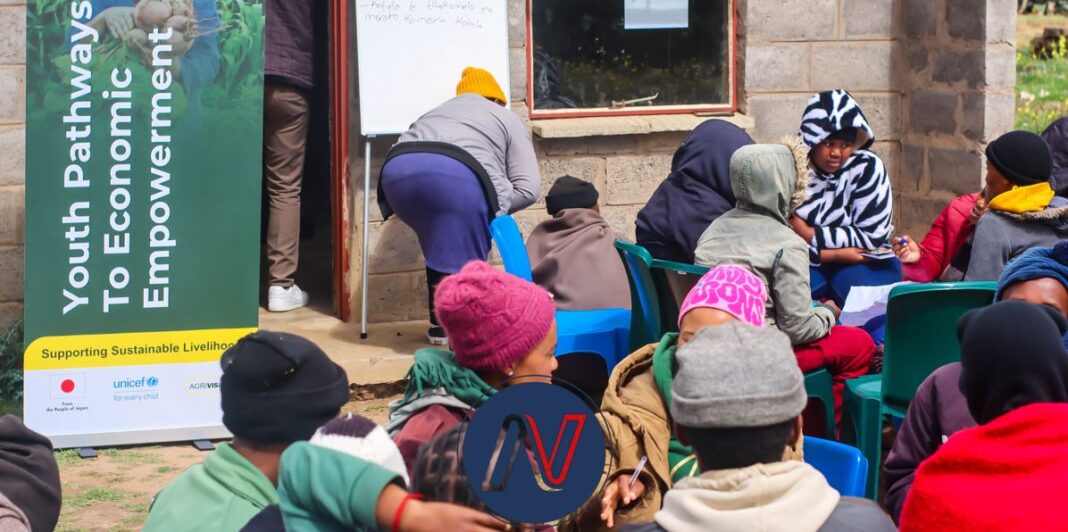
Japan, UNICEF join hands to give hope to young people in Lesotho
Lesotho's young people are facing tough times. Many are jobless, and life in rural areas is especially hard. Climate change is making it harder still to grow food and earn a living. Now a new programme is offering some hope.
Ntsoaki Motaung is an award-winning health journalist from Lesotho, specializing in community health stories with a focus on sexual and reproductive health and rights, as well as HIV. She has contributed to platforms like "Be in the KNOW," highlighting issues such as the exclusion of people with disabilities from HIV prevention efforts in Lesotho.
In addition to her journalism, Ntsoaki serves as the Country Coordinator for the Regional Media Action Plan Support Network (REMAPSEN). She is also a 2023 CPHIA Journalism Fellow.
Lesotho’s young people are facing tough times. Many are jobless, and life in rural areas is especially hard. Climate change is making it harder still to grow food and earn a living. Now a new programme is offering some hope.
Supported by the Government of Japan and UNICEF, the programme is giving young people the chance to learn new skills and start businesses in climate-smart agriculture.
It began in February 2026 and will run until February 2027. It is expected to directly help 450 young people aged 15 to 35, at least 60 percent of them young women and girls. About 1,000 family and community members are also expected to benefit indirectly as these young people earn more and produce more food.
There are not enough jobs, and many young people lack the skills or resources to start their own businesses. This is especially true for girls, young women and young mothers, who find it harder to get land, money or training. Many rural households depend on farming, but frequent droughts, soil erosion and unpredictable rain make it difficult to grow enough food.
In some areas the situation is even more serious. According to Manko Manko, Executive Director of the local NGO Agrivision Lesotho, the community of Ha ‘Mamathe has a high number of early and unintended pregnancies. He explained that young women and girls often have few choices, and some end up relying on men for money, which can put them at risk.
“Young people in Lesotho face limited access to market-relevant skills, productive resources and enterprise opportunities,” says UNICEF. “These barriers are made worse by climate shocks, declining agricultural productivity, poverty, gender inequality and the effects of HIV on households.”
The programme aims to break these cycles by giving young people practical skills and support. Its main focus is climate-smart agriculture, which means using new methods and technology to farm in a way that is good for the environment and can withstand climate change.
Participants will be trained in climate-smart farming, agribusiness, agro-processing, food manufacturing and business planning. Training in financial literacy, savings, investment and cooperative development will give them the tools not only to grow food, but to build and manage successful businesses.
There will also be peer learning, coaching and mentorship to help participants turn their new skills into real economic opportunities. Selected youth groups and enterprises will receive start-up grants, along with continuing technical support.
Manko said, “The main aim of the project is to respond to the major problem of high youth unemployment. It is an emergency project. At the end of the programme, participants should be able to produce food and provide for their families.”
He added that the project includes a focus on nutrition, an area young people often do not take part in.
“Mostly youth do not take part in nutrition-related initiatives, so this is a major step in ensuring they take part,” he said.
Sixteen nutrition clubs have been set up and will receive support through the project.
The programme will also try to reach youth who have dropped out of school. Many of them, according to Manko, end up involved in crime or alcohol abuse because they have no work. By giving them new skills and a chance to earn money, the project hopes to keep them busy and away from risky activities.
UNICEF is running the programme with three national NGOs: Agrivision Lesotho, Rutanang Community Foundation and Barali Foundation. They will work closely with government ministries, local authorities, community leaders, community-based organisations and existing youth groups to find and support the young people who need help most.
Participants are selected in a participatory and inclusive way, with the whole community involved in choosing who will join, so that the programme reaches those most in need.
Some young people are already seeing benefits. ‘Mamphu Lenyatsa, 34, from Ha Boose, said poverty and unemployment push some youth into crime and alcohol abuse. After joining the sessions, she learned how to build secure, improved plots for farming.
She said, “After the programme, I expect to have skills to produce for commercial agriculture. I know my life may change for the better.”
Moitheri Mothibeli, 27, also from Ha Boose, said many young people in his community turn to crime or alcohol because they have nothing else to do. Already interested in agriculture, he has learned new skills through the programme, such as building a compost plot to grow more nutritious vegetables.
“I would be happy if after the programme, I see a lot of youth get into farming and come together to produce on a larger scale,” he said.
The hope is that the programme will serve as a model for how social protection and livelihoods support can work together to lift communities out of poverty. According to UNICEF, the initiative complements Lesotho’s social protection system by helping vulnerable households build income and resilience.
It also supports national priorities on youth employment and climate adaptation, while contributing to food security, gender equality and better outcomes for children. Support from Japan is seen as vital, showing how international partnerships can help countries like Lesotho respond to urgent needs and long-term challenges.
By working with local organisations and government bodies, the programme aims to create lasting change, not just for the current group of young people but for future generations.
UNICEF’s work in Lesotho is part of its global mission to help disadvantaged children and their families. It operates in more than 190 countries and territories to make sure every child has a fair chance in life.
Summary
Supported by the Government of Japan and UNICEF, the programme is giving young people the chance to learn new skills and start businesses in climate-smart agriculture.
Its main focus is climate-smart agriculture, which means using new methods and technology to farm in a way that is good for the environment and can withstand climate change.
Participants are selected in a participatory and inclusive way, with the whole community involved in choosing who will join, so that the programme reaches those most in need.
Ntsoaki Motaung is an award-winning health journalist from Lesotho, specializing in community health stories with a focus on sexual and reproductive health and rights, as well as HIV. She has contributed to platforms like “Be in the KNOW,” highlighting issues such as the exclusion of people with disabilities from HIV prevention efforts in Lesotho.
In addition to her journalism, Ntsoaki serves as the Country Coordinator for the Regional Media Action Plan Support Network (REMAPSEN). She is also a 2023 CPHIA Journalism Fellow.
To ensure optimal experiences, we utilize technologies such as cookies to store and/or access information from your device. Granting consent to these technologies enables us to process data, including browsing habits or unique identifiers on this website. Conversely, not consenting or revoking consent may negatively impact specific features and functionalities.
Functional
Always active
The technical storage or access is strictly necessary for the legitimate purpose of enabling the use of a specific service explicitly requested by the subscriber or user, or for the sole purpose of carrying out the transmission of a communication over an electronic communications network.
Preferences
The technical storage or access is necessary for the legitimate purpose of storing preferences that are not requested by the subscriber or user.
Statistics
The technical storage or access that is used exclusively for statistical purposes.The technical storage or access that is used exclusively for anonymous statistical purposes. Without a subpoena, voluntary compliance on the part of your Internet Service Provider, or additional records from a third party, information stored or retrieved for this purpose alone cannot usually be used to identify you.
Marketing
The technical storage or access is required to create user profiles to send advertising, or to track the user on a website or across several websites for similar marketing purposes.