

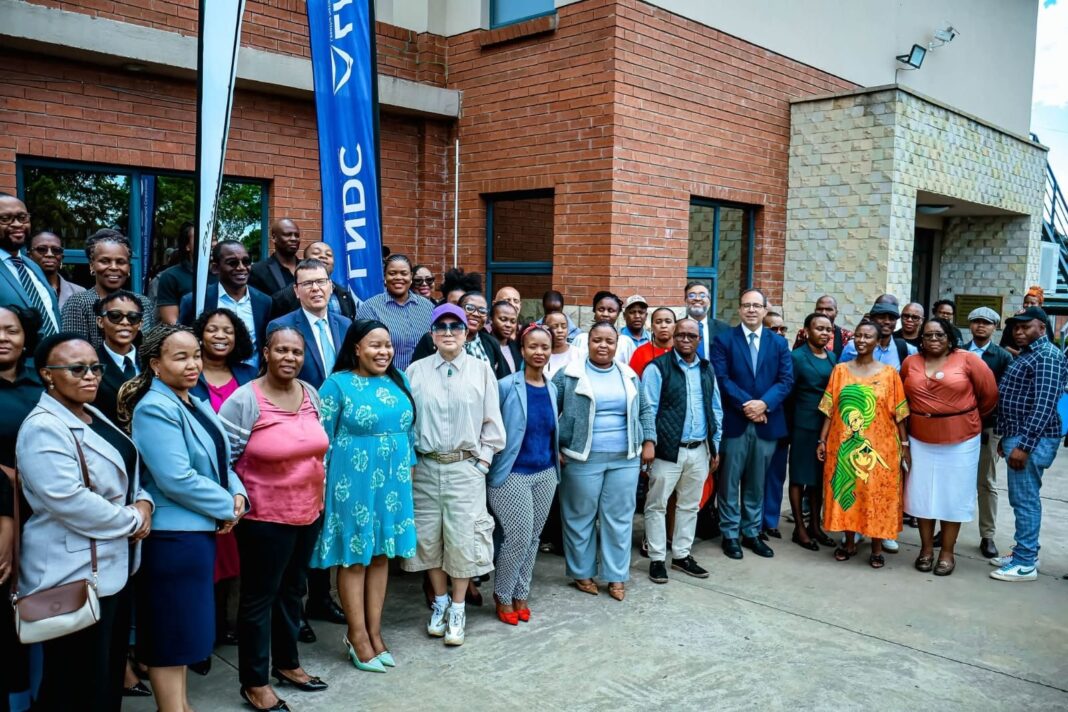
Lesotho has launched a new Textiles and Apparel Sector Strategy that aims to create more than 70,000 jobs and lift annual exports above US$1 billion by 2033, with the goal of moving the industry away from its dependence on the United States market.
The strategy was launched on Wednesday, October 7, 2026, by the Ministry of Trade, Industry and Business Development (MTIBD) in partnership with the World Bank Group, the Competitiveness and Financial Inclusion (CAFI) project and the Lesotho National Development Corporation (LNDC). It seeks to reposition the sector as more diversified, higher-value and resilient.
By 2033, the Government wants to:
- Create more than 70,000 jobs and reach annual exports above US$1 billion.
- Have markets outside the US account for 55 percent of textile and apparel exports.
- Attract more than US$400 million in new investment.
- Move more than a third of production from cut-make-and-trim operations to full-package manufacturing.
- Raise the share of Basotho in management positions to 40 percent.
- Process at least 20 percent of the country’s wool and mohair domestically.
The strategy contains 28 actions in three phases: Diversification to 2028, Expansion to 2031 and Consolidation from Year Seven. The Government says each action will have defined timelines, budgets and performance indicators. Progress is to be reviewed quarterly and the action plan updated annually.
The strategy calls for Lesotho to retain and upgrade its position in the US market while expanding sales to South Africa and the wider African market. It also seeks new opportunities in the European Union and other high-end markets, and identifies the African Continental Free Trade Area (AfCFTA) as an opening for regional growth.
It comes after the recent extension of the African Growth and Opportunity Act (AGOA) to December 31, 2028. Delivering remarks on behalf of the Ministry’s Principal Secretary, Palesa Matobako, Director of the One Stop Business Facilitation Centre (OBFC) Monaheng Monaheng warned that the extension should not be treated as a permanent solution. He said the two years should instead give the country time to implement reforms and reduce its reliance on a single market.
The strategy aims to position Lesotho as a global supplier of high-end and complex garments and services, supported by modern technology, skilled labour, stronger middle management and the country’s indigenous wool and mohair.
LNDC Chief Executive Officer Thabo Khasipe said the turnaround requires Lesotho to move beyond assembling imported fabrics and add value to its own natural resources. Lesotho is the world’s second-largest mohair producer, and Lesotho and South Africa together account for approximately two-thirds of global mohair production.
Wool and mohair make up about 60 percent of the country’s agricultural exports and support approximately 40,000 growers and more than 350,000 Basotho directly through farmers and their families. Khasipe said most of the fibre is still exported raw, leaving significant value and jobs outside the country.
The strategy proposes investment in scouring, combing, spinning, knitting, weaving, garment production, craft, design and branding. Initial opportunities could include locally produced knitwear, blankets and home textiles, linking producers more closely to domestic manufacturers. Khasipe said domestic testing, biosecurity and traceability could also help position Lesotho’s fibre as a premium product internationally.
On infrastructure, Monaheng said new factory shells at Ha Belo in Butha-Buthe are nearing completion and are expected to provide plug-and-play capacity for new investors. Feasibility work is also expected to begin on dedicated textiles and wool and mohair industrial parks.
On skills, the Government plans to:
- Conduct a national skills-needs assessment.
- Establish vocational training centres for machine operators and line supervisors.
- Offer scholarships and set up a fashion incubator to develop Basotho designers, engineers and managers.
The textiles and apparel industry has for decades been the backbone of Lesotho’s manufacturing sector and remains the country’s largest formal private-sector employer, with 42 firms currently operating. Monaheng said apparel manufacturing accounts for more than 80 percent of manufacturing value added. At its peak, the sector employed more than 50,000 Basotho, the majority of them women, and contributed close to a third of national output.
The industry has since been hit by the COVID-19 pandemic and uncertainty over AGOA. Monaheng said employment, which stood at between 38,000 and 40,000 workers in 2023, has fallen to between 30,000 and 35,000. Factories have closed, and exports to the US declined by more than a third between 2022 and 2023.
He said the strategy builds on Lesotho’s established manufacturing base, skilled workforce, preferential market access and abundant wool and mohair.
“What we have lost is orders and confidence, not capability,” Monaheng said.
World Bank Group Country Representative Dinara Djoldosheva said the global textile industry faces rising competition, changing buyer requirements and uncertainty in key export markets, and that Lesotho could no longer afford to stand still. She said the strategy offers a practical pathway to a more competitive, resilient and higher-value sector, but warned that success would require strong governance, accountability and resources. Its success, she said, should ultimately be measured by factory expansion, new investment and the number of people earning sustainable incomes from the industry.
Thematic Working Group representative Malikhabiso Majara described the strategy as a roadmap for transforming the sector through improvements in production, value chains, skills and market access. She stressed the Government’s role in creating an enabling policy and trade environment, while ensuring stakeholders remain committed to implementation.
CAFI Managing Director Chaba Mokuku said the validation of the strategy marked the point at which the document moved from being a consultant’s product to becoming the responsibility of the sector. He said LNDC would champion it by incorporating it into its corporate plan, performance targets and investor engagements.
Mokuku also called for stronger representation across the entire textile value chain, including large exporters, Basotho-owned companies, small and medium enterprises and wool and mohair producers. The strategy is expected to be presented to the High-Level Public-Private Dialogue Forum in November for approval.
Summary
- Lesotho has launched a new Textiles and Apparel Sector Strategy that aims to create more than 70,000 jobs and lift annual exports above US$1 billion by 2033, with the goal of moving the industry away from its dependence on the United States market.
- The strategy was launched on Wednesday, October 7, 2026, by the Ministry of Trade, Industry and Business Development (MTIBD) in partnership with the World Bank Group, the Competitiveness and Financial Inclusion (CAFI) project and the Lesotho National Development Corporation (LNDC).
- The strategy aims to position Lesotho as a global supplier of high-end and complex garments and services, supported by modern technology, skilled labour, stronger middle management and the country’s indigenous wool and mohair.

Senior journalist and communications professional with extensive experience in general news reporting, specializing in business and sports journalism. Skilled in public speaking, media relations, and strategic communication, with a proven ability to deliver accurate, engaging, and impactful stories.
A strong team player who thrives in collaborative environments and adapts effectively to diverse working conditions. Passionate about continuous learning, professional growth, and enhancing communication practices to meet evolving industry demands.