
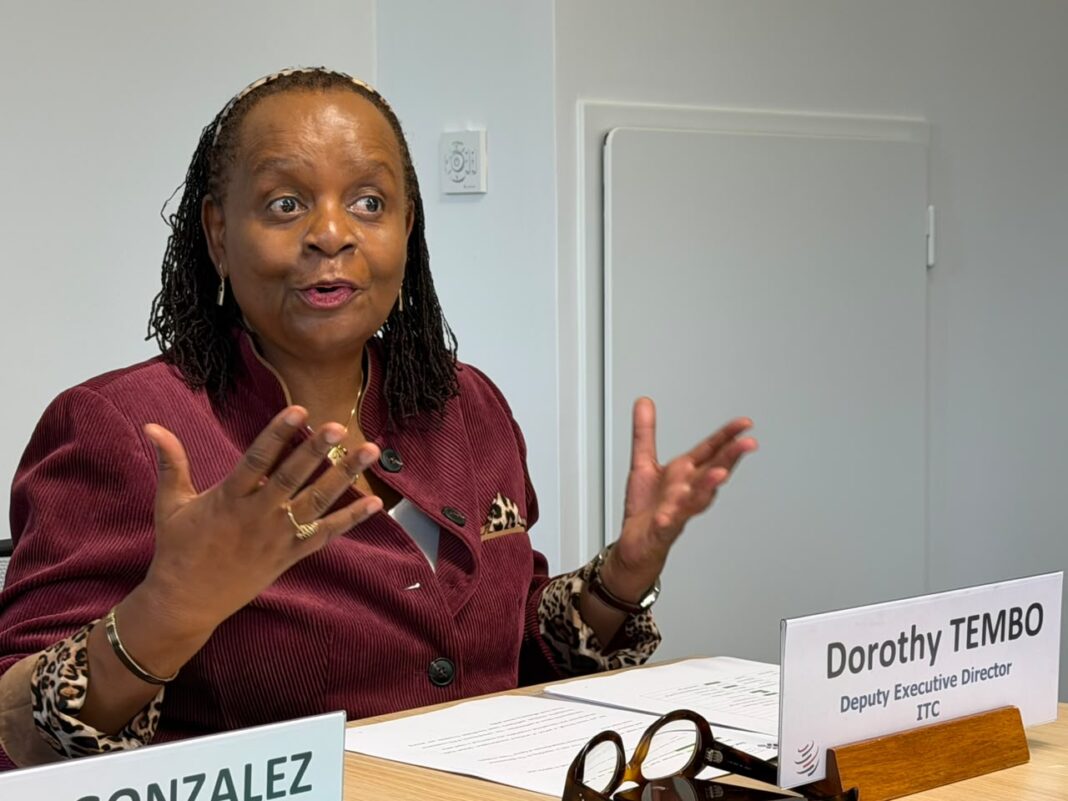
ITC Deputy Executive Director Dorothy Tembo acknowledges shortcomings in project continuity planning, stressing that development assistance must be matched by government commitment to infrastructure, institutional capacity and market access.
GENEVA, SWITZERLAND — The International Trade Centre (ITC) Deputy Executive Director, Dorothy Tembo, has raised questions about the sustainability of internationally funded trade development projects in Lesotho, saying governments must take greater responsibility for maintaining investments after development partners complete their interventions.
Speaking during a media briefing on the sidelines of the 2026 World Trade Organization’s (WTO) Aid for Trade Global Review in Geneva, Tembo acknowledged that more could have been done to secure the long-term sustainability of the Maluti Fresh Produce Market project, which received support through the Enhanced Integrated Framework (EIF) and technical assistance from ITC.
Her remarks followed questions from Newsday Newspapers concerning the continued difficulties faced by small agricultural businesses in Lesotho, particularly the absence of adequate standards and quality assurance infrastructure to enable producers to access international markets.
Tembo said development interventions were frequently implemented without sufficient attention to the broader national strategies and investments needed to sustain them.
“First, I think often at the country level, we tend to look at interventions as an isolated action that is dealing with a specific issue. We don’t look at this within the broader context or strategic positioning of the country. And, because we do that in many instances, part of what is supposed to be follow-up action that would ensure sustainability of that intervention is lost.”
The Maseru horticultural market initiative (Maluti Fresh Produce) was established under the EIF-supported Horticulture Productivity and Trade Development project, which sought to improve agricultural productivity, reduce post-harvest losses and connect smallholder farmers to commercial markets.
The broader project, implemented with ITC technical assistance, received approximately US$2.74 million in funding, according to reporting on the initiative. This amount covered wider horticultural development activities and should not be confused with expenditure solely on the market centre.
The fresh produce facility, situated at Ha Tikoe Industrial Estate, was officially inaugurated in March 2018, with the objective of providing farmers with facilities for cleaning, packaging, cold storage and distribution of agricultural produce.
At the inauguration, the government reported that equipment installed for the market centre was valued at approximately US$2 million.
A separate September 2020 government project report recorded US$400,000 in ITC-supported equipment for the facility, indicating that different official records refer to different equipment valuations or components of the investment.
The initiative was designed to address agricultural post-harvest losses, which the EIF estimated at between 20 and 50 percent, while enabling farmers to supply hotels, supermarkets and potentially regional export markets.
Its associated horticultural programme also introduced greenhouse technology and provided training to hundreds of smallholder farmers, including women and young people, however, the project encountered operational difficulties.
In September 2020, the Office of the Prime Minister reported that the Ha Tikoe facility had not become operational because of the absence of a handling facility required for cleaning, sorting and packaging produce.
The government subsequently directed the responsible ministries to ensure that the market became operational.
The Lesotho National Development Corporation (LNDC) later announced the launch of the Maluti Fresh Produce Market in October 2021, with the intention of attracting private investment and commercially operating the facility.
By 2025, LNDC was again seeking private investors to operate or manage an integrated fresh produce market and fruit and vegetable processing facility involving Litholoana Tsa Basotho. The investment proposal aimed to strengthen agricultural processing, market access and export opportunities.
Tembo acknowledged the contribution made by development partners but questioned whether sufficient national resources and institutional arrangements had been established to sustain the project.
“The question remains; was there follow-up on the part of government to ensure that as part of the planning processes, the sustainability aspect was being entrenched in the resource allocation to ensure that there was continuity,” she said.
She stressed that development agencies could support countries in establishing infrastructure, building institutional capacity and improving market opportunities, but the responsibility for sustaining those investments ultimately depended on national ownership.
“Because it is a fact that whether it’s ITC or any other agency, an intervention is going to come to an end and the continuity of that relies on how much ownership assumption you have on the ground,” Tembo said.
She also acknowledged that development partners themselves needed to strengthen their approach to preparing countries for the conclusion of externally supported projects.
“Perhaps we can try to see how we as an organisation together with others can also try to ensure that we don’t lose the aspects relating to continuity in terms of how we prepare the exit processes,” she said.
Tembo indicated that discussions had taken place with Lesotho’s Minister of Trade on issues related to upcoming projects, although she did not provide details of specific commitments or timelines.
Export standards remain a major obstacle
The exchange highlighted a broader challenge confronting small businesses across developing economies: the gap between improving production capacity and meeting the regulatory requirements necessary to enter international markets.
During the briefing, WTO Trade and Environment Division official Sarah Arrow explained that compliance with food safety, product quality, pesticide residue limits, labelling and other technical regulations remained among the most significant barriers to international trade.
She said that while tariffs had attracted considerable attention amid changes in global trade policies, regulatory compliance costs continued to impose substantial burdens on exporters.
“There is also a distinction between tariffs and regulations that is quite important. Even if a tariff goes up from time-to-time 20 percent, if you pay the duty, you’re in. But if you do not meet a regulatory requirement, you will not get into a certain market,” she explained
Arrow explained that the WTO’s Sanitary and Phytosanitary (SPS) and Technical Barriers to Trade (TBT) agreements provide a framework through which governments can protect consumers, public health and the environment while seeking to avoid unnecessary restrictions on international trade.
ITC outlines support for Lesotho and SADC
Despite the challenges, Tembo said ITC continued to support trade development initiatives in Lesotho, Namibia and the wider Southern African Development Community (SADC).
“We are mapping market entry rules, surveying businesses, and supporting government reforms, as well as developing channels to address the barriers that are identified,” she said.
She added that ITC was supporting business growth through training in branding and e-commerce, as well as trade fairs intended to connect enterprises with commercial opportunities.
She explained that ITC’s approach involved working with governments, regional institutions and private businesses to identify obstacles and translate those findings into practical reforms.
She also emphasised the importance of regional cooperation, particularly where trade barriers extend across national borders.
The organisation is supporting regional value-chain development in sectors including critical minerals and electric vehicle battery production, with work underway in Zambia, Namibia, South Africa and the Democratic Republic of the Congo.
However, she cautioned that this work remained at an early stage, with ITC currently identifying existing activities, potential participants and opportunities for further development.
Summary
- Speaking during a media briefing on the sidelines of the 2026 World Trade Organization’s (WTO) Aid for Trade Global Review in Geneva, Tembo acknowledged that more could have been done to secure the long-term sustainability of the Maluti Fresh Produce Market project, which received support through the Enhanced Integrated Framework (EIF) and technical assistance from ITC.
- In September 2020, the Office of the Prime Minister reported that the Ha Tikoe facility had not become operational because of the absence of a handling facility required for cleaning, sorting and packaging produce.
- Was there follow-up on the part of government to ensure that as part of the planning processes, the sustainability aspect was being entrenched in the resource allocation to ensure that there was continuity,” she said.

Co-Owner and Managing Editor of Newsday Media Lesotho. PEPFAR Media champion, Award wining features journalist, an Investigative journalist, REPSSI CAB member. Maseru, Lesotho Joined November 2009.