Welcome to Newsday Media – Your Trusted Source for News and Insights in Lesotho!
At Newsday Media, we are passionate about delivering accurate, timely, and engaging news and multimedia content to our diverse audience. Founded with the vision of revolutionizing the media landscape in Lesotho, we have grown into a leading hybrid media company that blends traditional journalism with innovative digital platforms.
Our mission is simple: to inform, inspire, and empower our readers by providing comprehensive coverage of local and global events, current affairs, and cultural happenings. Whether you’re looking for breaking news, in-depth analysis, or captivating storytelling, Newsday Media is your go-to destination for all things news-related.
With a dedicated team of journalists, editors, and multimedia experts, we are committed to upholding the highest standards of journalistic integrity and professionalism. We pride ourselves on delivering content that not only informs but also sparks conversation, fosters understanding, and drives positive change in our society.
From our flagship newspaper to our dynamic digital platforms, we offer a wide range of multimedia content to cater to the diverse interests and preferences of our audience. Whether you prefer to stay informed through print, online articles, videos, or podcasts, Newsday Media has something for everyone.
We believe in the power of storytelling to connect people, bridge divides, and inspire action. That’s why we’re dedicated to providing a platform for voices from all walks of life, championing diversity, inclusion, and authenticity in everything we do.
Thank you for visiting Newsday Media. We invite you to explore our website, engage with our content, and join us on our journey to inform, inspire, and empower our community. Together, let’s shape the future of media in Lesotho.
For years, Lesotho was among the very few countries without a corporate governance code of its own. Lesotho was among very few countries without their own corporate governance code.
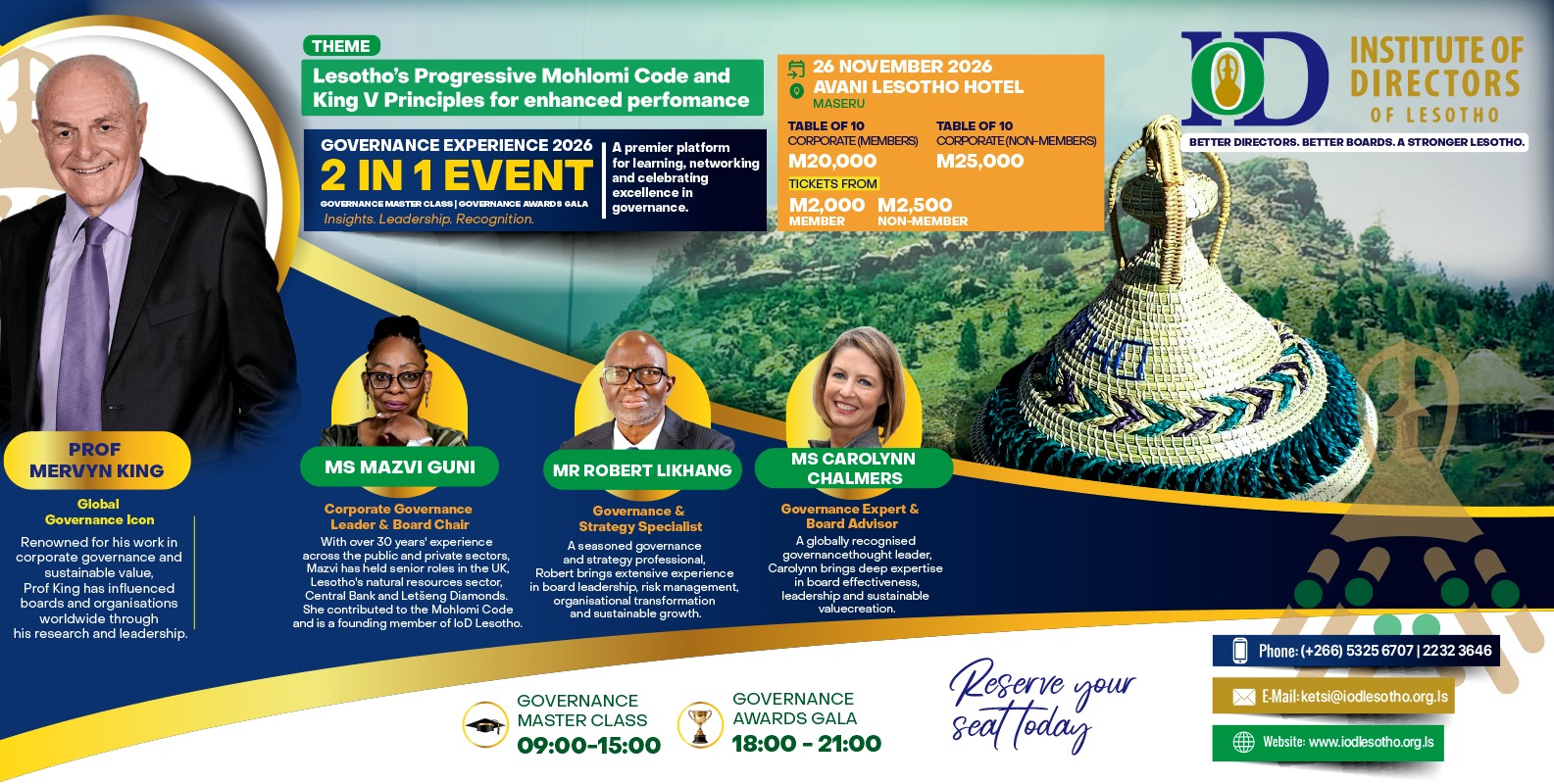
That gap closed in 2021, when the Institute of Directors (IoD) Lesotho launched the Mohlomi Corporate Governance Code. It is named after the 18th-century philosopher who mentored King Moshoeshoe I, and it was built through government with financial assistance from the African Development Bank.
Five years later, the government that helped produce the code still treats it as decoration.
The Prime Minister’s words in May were welcome. Ntsokoane Matekane publicly announced that Cabinet formally endorses the Mohlomi Code as the reference standard for governance conduct across public institutions, State-Owned Enterprises, Government-linked entities and the broader corporate sector.
He also promised to build its principles into the mandates and performance frameworks of public entities.
Yet last week’s announcement of Thabo Moleko as chairperson of the Lesotho Tourism Development Corporation (LTDC) suggests nothing has changed. Moleko may well be a capable public servant, and that is not the point.
The code lobbies for the chairpersons of the boards of state-owned enterprises to be appointed independently. The public has seen no evidence of an open, merit-based process behind this appointment.
The LTDC is hardly a place to hand the benefit of the doubt. In March, Newsday reported that its board overlooked the candidate ranked first by an independent recruitment consultancy for the CEO post, and that reasons for the departure were never disclosed.
In September, there were media reports of board sources alleging that they were pressed to recommend a particular candidate for CEO, with the pressure coming from two people close to the Prime Minister. These are allegations, but they deserve answers, not silence.
Government’s defenders will say the Code is voluntary. They are right. Legal analysts describe it as not yet binding, and even the IoD acknowledges the corporate environment is held back by limited resources, weak enforcement mechanisms, and underdeveloped institutional capacity.
That is exactly why political will matters. A voluntary code lives or dies by whether the biggest player in the economy, the state, sets the example. Public enterprises cannot be told to follow the code when the government itself ignores it.
Governance failures are not abstract. They are the stalled projects, the failed parastatals and the boards that answer to ministers rather than to the public. Investors read appointments and unexplained decisions as signals, and so do ordinary Basotho.
Government should now do four things:
Publish clear, Code-aligned criteria for appointing SOE board chairs and directors, and follow them.
Release the recruitment reports behind senior appointments, starting with the LTDC.
Write Code compliance into performance contracts for every public entity, with consequences for breaches.
Resource the IoD and regulators to monitor compliance, and report annually to Parliament
Mohlomi taught that leaders should serve the people they lead. The code carries that wisdom into the boardroom. Matekane has said the right things. The test now is whether he will bind his own government to them, starting with appointments his ministers make. Endorsing the Code at a conference costs nothing. Honouring it costs control, and that is the price Basotho are waiting for him to pay.
Summary
In March, Newsday reported that its board overlooked the candidate ranked first by an independent recruitment consultancy for the CEO post, and that reasons for the departure were never disclosed.
In September, there were media reports of board sources alleging that they were pressed to recommend a particular candidate for CEO, with the pressure coming from two people close to the Prime Minister.
A voluntary code lives or dies by whether the biggest player in the economy, the state, sets the example.
Welcome to Newsday Media – Your Trusted Source for News and Insights in Lesotho!
At Newsday Media, we are passionate about delivering accurate, timely, and engaging news and multimedia content to our diverse audience. Founded with the vision of revolutionizing the media landscape in Lesotho, we have grown into a leading hybrid media company that blends traditional journalism with innovative digital platforms.
Our mission is simple: to inform, inspire, and empower our readers by providing comprehensive coverage of local and global events, current affairs, and cultural happenings. Whether you’re looking for breaking news, in-depth analysis, or captivating storytelling, Newsday Media is your go-to destination for all things news-related.
With a dedicated team of journalists, editors, and multimedia experts, we are committed to upholding the highest standards of journalistic integrity and professionalism. We pride ourselves on delivering content that not only informs but also sparks conversation, fosters understanding, and drives positive change in our society.
From our flagship newspaper to our dynamic digital platforms, we offer a wide range of multimedia content to cater to the diverse interests and preferences of our audience. Whether you prefer to stay informed through print, online articles, videos, or podcasts, Newsday Media has something for everyone.
We believe in the power of storytelling to connect people, bridge divides, and inspire action. That’s why we’re dedicated to providing a platform for voices from all walks of life, championing diversity, inclusion, and authenticity in everything we do.
Thank you for visiting Newsday Media. We invite you to explore our website, engage with our content, and join us on our journey to inform, inspire, and empower our community. Together, let’s shape the future of media in Lesotho.
To ensure optimal experiences, we utilize technologies such as cookies to store and/or access information from your device. Granting consent to these technologies enables us to process data, including browsing habits or unique identifiers on this website. Conversely, not consenting or revoking consent may negatively impact specific features and functionalities.
Functional
Always active
The technical storage or access is strictly necessary for the legitimate purpose of enabling the use of a specific service explicitly requested by the subscriber or user, or for the sole purpose of carrying out the transmission of a communication over an electronic communications network.
Preferences
The technical storage or access is necessary for the legitimate purpose of storing preferences that are not requested by the subscriber or user.
Statistics
The technical storage or access that is used exclusively for statistical purposes.The technical storage or access that is used exclusively for anonymous statistical purposes. Without a subpoena, voluntary compliance on the part of your Internet Service Provider, or additional records from a third party, information stored or retrieved for this purpose alone cannot usually be used to identify you.
Marketing
The technical storage or access is required to create user profiles to send advertising, or to track the user on a website or across several websites for similar marketing purposes.