
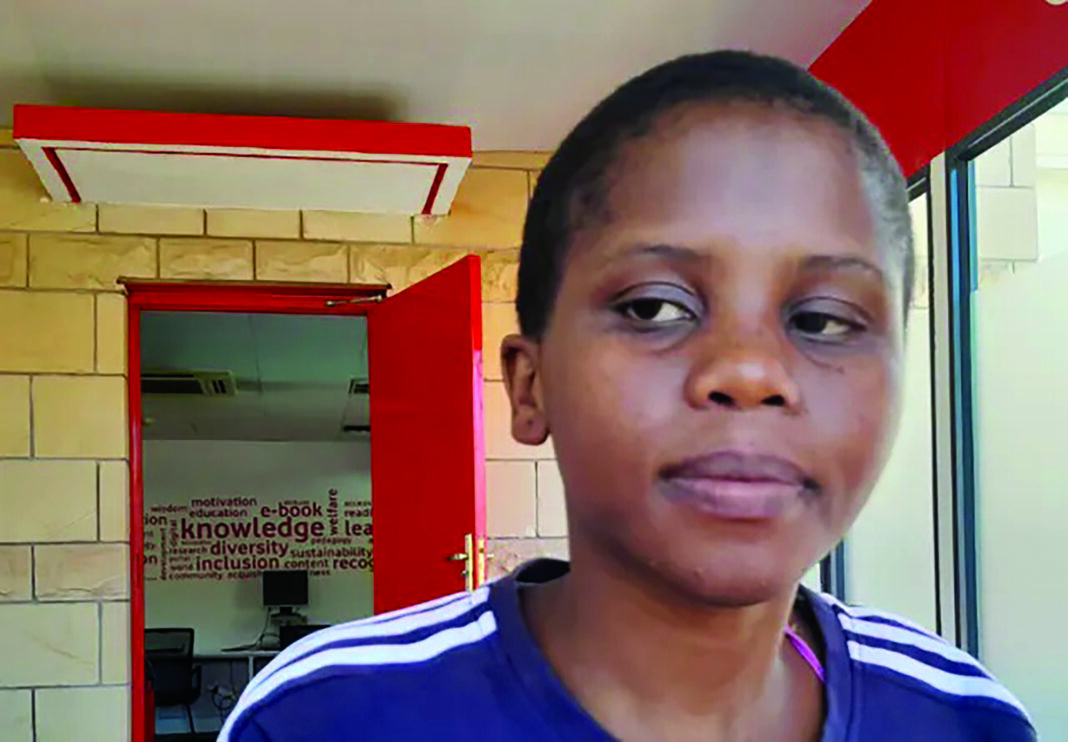
In Lesotho, progress on global efforts to end HIV are being hampered because people with disabilities are being left out of prevention services. Young activists are trying to rectify this.
Ntsoaki Motaung
Mpeo Kherehloa is concerned by health information that does not attempt to include people with disabilities. Kherehloa is herself living with disability. At 23, Kherehloa is an advocate for youth, adolescent girls and young women with disabilities. She was elected to the National AIDS Commission Youth Consortium after its formation last year in October to represent people with disabilities.
“The consortium was formed after the National AIDS Commission (NAC) appreciated that, to fight new HIV infections amongst youth, they have to engage the youth to better understand how they need things done for them as well as better programming for them,” she said.
A lot to be done
She said people with disabilities are often left behind when educational messages around HIV are developed. This leaves them at a greater risk because of lack of knowledge and information.
“There is a lot that needs to be done, however, a starting point could be that the government should ensure that in every [health] facility there is someone whose main job is to look after the disabled persons. Facilities should make sure that people with disabilities can also move around their buildings without any hindrance,” she says.
People with disabilities are at high risk of HIV due to a number of intersecting issues including high levels of gender-based violence (GBV) and high levels of poverty. According to Kherehloa the most affected population of people with disabilities is in the remote areas of Lesotho in hard-to-reach areas where people still struggle to get information or health services.
This is why to successfully end HIV by 2030, people with disabilities need to be included in other key programmatic areas, such as gender-based violence and social protection.
Inclusion in decision-making
Peer educator and Her Voice ambassador for Lesotho, Nthabeleng Nts’ekalle explained that from the Global Fund, the country gets about 70 million USD targeted towards addressing HIV as well as TB. With these resources available “it is very important that adolescent girls and young women, especially those with disabilities, are included in decision-making” over how funds are spent.
Rabasotho Moeletsi, project coordinator at the Lesotho National Federation of Organizations of the Disabled (LNFOD) explained that in spite the fact that people with disabilities have a right to equal access to education and HIV information, in practice people with disabilities are often denied access to educational programmes, prevention programmes about HIV as well as treatment programmes and services.
“I think for Lesotho to be successful in the fight against HIV there is a need to involve persons with disabilities in the response,” he said.
On what the National AIDS Commission (NAC) is doing to bridge the gap, NAC Programs Manager Tiisetso Piet said NAC is deliberate in its efforts to ensure the involvement of people with disability in the HIV response, such as: Involvement of people with disabilities during the National HIV and AIDS Strategic Plan (NHASP – 2023/24 – 2027/28) development process.
“NAC also hosts quarterly meetings for all implementing partners where people with disabilities through their various organizations including the LNFOD, are participating,” Piet explained.
While NAC has tried to involve people with disabilities as much as possible, Piet underscored that it has not been able to cater for them in print messages.
“Discussions are ongoing with other partners to seek ways and means to cater for people with disabilities, especially for written messages. The country has scaled up sign language for the deaf community for ease of communication.”
HIV in focus
This news story was first published by Be In The Know as part of their HIV in focus news network. This is a network of writers and journalists from focus countries, dedicated to delivering news on HIV and sexual health. The network aims to amplify the voices of communities most affected by HIV and share the stories that matter to them. Read the original story on https://www.beintheknow.org.
Summary
- Rabasotho Moeletsi, project coordinator at the Lesotho National Federation of Organizations of the Disabled (LNFOD) explained that in spite the fact that people with disabilities have a right to equal access to education and HIV information, in practice people with disabilities are often denied access to educational programmes, prevention programmes about HIV as well as treatment programmes and services.
- “I think for Lesotho to be successful in the fight against HIV there is a need to involve persons with disabilities in the response,” he said.
- On what the National AIDS Commission (NAC) is doing to bridge the gap, NAC Programs Manager Tiisetso Piet said NAC is deliberate in its efforts to ensure the involvement of people with disability in the HIV response, such as.
Welcome to Newsday Media – Your Trusted Source for News and Insights in Lesotho!
At Newsday Media, we are passionate about delivering accurate, timely, and engaging news and multimedia content to our diverse audience. Founded with the vision of revolutionizing the media landscape in Lesotho, we have grown into a leading hybrid media company that blends traditional journalism with innovative digital platforms.
Our mission is simple: to inform, inspire, and empower our readers by providing comprehensive coverage of local and global events, current affairs, and cultural happenings. Whether you’re looking for breaking news, in-depth analysis, or captivating storytelling, Newsday Media is your go-to destination for all things news-related.
With a dedicated team of journalists, editors, and multimedia experts, we are committed to upholding the highest standards of journalistic integrity and professionalism. We pride ourselves on delivering content that not only informs but also sparks conversation, fosters understanding, and drives positive change in our society.
From our flagship newspaper to our dynamic digital platforms, we offer a wide range of multimedia content to cater to the diverse interests and preferences of our audience. Whether you prefer to stay informed through print, online articles, videos, or podcasts, Newsday Media has something for everyone.
We believe in the power of storytelling to connect people, bridge divides, and inspire action. That’s why we’re dedicated to providing a platform for voices from all walks of life, championing diversity, inclusion, and authenticity in everything we do.
Thank you for visiting Newsday Media. We invite you to explore our website, engage with our content, and join us on our journey to inform, inspire, and empower our community. Together, let’s shape the future of media in Lesotho.