
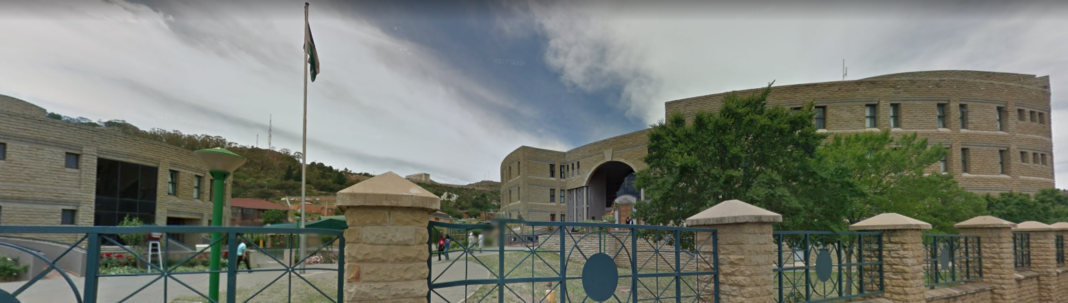
Defence lawyer Advocate Lepeli Molapo has told the High Court that Lesotho Mounted Police Service (LMPS) Sub-Inspector Mokheseng Ramahloko was fatally shot by soldiers because he refused to surrender and instead returned fire.
Adv. Molapo made the claim on Monday while cross-examining crown witness Sergeant Mokete Litulo of the LMPS. He argued that Ramahloko refused to surrender, “but instead, retaliated by shooting at the soldiers using his firearm.”
Molapo is one of the defence lawyers representing the accused in the treason trial arising from the army’s storming of police headquarters (PHQ) in Maseru on August 29, 2014, when Ramahloko was shot dead.
Several Lesotho Defence Force (LDF) members, including then Army Commander Lieutenant General Tlali Kamoli, face treason and related charges. The other LDF accused are Captain Litekanyo Nyakane and Lance Corporals Motloheloa Ntsane and Leutsoa Motsieloa.
Politicians Mothetjoa Metsing of the Lesotho Congress for Democracy (LCD) and Selibe Mochoboroane of the Movement for Economic Change (MEC) are also accused in the trial.
All the accused face multiple charges, including murder, attempted murder, risk of injury or death, and aggravated assault. They have pleaded not guilty.
The court has heard that Ramahloko was shot dead by a group of soldiers who assaulted police officers on duty at PHQ that night.
Led in his testimony by prosecutor Adv. Rethabile Setlojane, Sgt Litulo told the court he was on a night shift from 6:00pm on August 29 to 6:00am the next day. He said he was on duty with Lance Sergeant Thamae when Ramahloko came into the radio room to request a telephone.
Litulo explained that Ramahloko was attached to the Special Operations Unit (SOU) but was working a shift at the headquarters guardroom, controlling movement in and out of PHQ. The guardroom is next to the main gate for that purpose.
Litulo said that as Ramahloko arrived, the radio room received a call from one Senior Assistant Commissioner of Police (SACP) Loke, who urgently wanted to speak to Ramahloko. Ramahloko took the call in the same office, and Loke told him the army was on its way to PHQ.
Litulo said Ramahloko then rushed back towards the guardroom, “but he returned quickly to inform us that the soldiers were already at the main gate,” Litulo testified.
Ramahloko also told them that soldiers were already assaulting the police officers deployed with him there. Asked how they knew the intruders were soldiers, Litulo said they wore army uniform, “although they all covered their faces with scarves and black hats,” he said.
While Litulo, Thamae and Ramahloko were still in the radio room, they were joined by Mahanetsa, who was accompanied by two soldiers.
“He (Mahanetsa) stormed into the radio room with soldiers. With him were two soldiers armed with AK-47 rifles. They were on both his sides, left and right, and their rifle muzzles were pointed at us in the radio room. The rifle muzzles were visible from Mahanetsa’s shoulders as the two soldiers drove him inside the radio room,” Litulo told the court
He said the soldiers ordered the four men, Ramahloko, Thamae, Mahanetsa and himself, out of the radio room to join other officers at the main gate. They were made to walk through the entire headquarters building until they were outside.
“Immediately when we were outside the building, we were ordered to stop walking and forced to roll on our bodies while we were being kicked and beaten at the same time,” Litulo narrated.
As they neared the main gate in the same manner, Litulo said, he realised there were many soldiers in the headquarters yard, “heavily armed with AK-47 rifles but covering their faces with scarves and black hats”.
The four were made to join other police officers seated in a line along the guardroom walls. Litulo estimated the time at about 4:00am, “and there were already passersby visible from outside the yard.”
He said the soldiers asked the police officers held hostage to identify almost everyone passing by. Their intention, he explained, was to arrest every police officer who happened to be around the headquarters at that moment.
Mahanetsa also testified about the fatal shooting of Ramahloko in the radio room, saying soldiers shot him and then dragged his body from the radio room to the main gate.
Litulo said he later saw Ramahloko’s lifeless body at the main gate. He, Police Constable Nkhabu and Thamae were then instructed to lift the body into a car boot and drive it to Makoanyane Military Hospital.
Both Mahanetsa and Litulo have told the court that Ramahloko hid an AK-47 rifle under the table in the radio room and hid his sidearm at his back.
Litulo maintained that Ramahloko never used his gun to shoot at the soldiers. Adv. Molapo countered that Ramahloko had fired shots before hiding his sidearm, “if it was availed by the police as an exhibit for court, Ramahloko’s firearm would be taken for ballistic tests and the results would indicate that the firearm had been used shortly before Ramahloko could try to hide it.”
Molapo claimed that Ramahloko’s firearm was among the evidence items tampered with by the police in an attempt to conceal why the sub-inspector was fatally shot.
He also alleged that the police tampered with evidence by replacing the door to the Commissioner’s Secretary’s office, which he said was shot at during crossfire.
“During the crossfire, the door was shot and had holes in it,” Molapo claimed. He said the door ought to have been presented in court as an exhibit, but the police authorities replaced it. He accused them of doing so “knowing well enough that the door was subject of the court in this continuing trial”.
Litulo acknowledged that the door and the radio room wall panel, both shot at during the incident, had been replaced. He said his superiors did this to refurbish offices, “not tempering with evidence as you put it,” Litulo explained.
He added that the refurbishment happened after the court had carried out a site inspection of the scene.
Molapo rejected that explanation, saying that even after the site inspection, “the property remained subject of trial as exhibit, until this trial is finalised, the police authorities know this better, and you (he referred to Litulo), as an officer of the law of your experience, know this,” Molapo charged.
Molapo further alleged that police continued to tamper with the court’s evidence when they allegedly confiscated a spent bullet and fragments from a broken cabinet and failed to present them in court as an exhibit.
He maintained that the police authorities tampered with the evidence knowingly, to conceal why the army fatally shot Ramahloko.
Summary
- Molapo is one of the defence lawyers representing the accused in the treason trial arising from the army’s storming of police headquarters (PHQ) in Maseru on August 29, 2014, when Ramahloko was shot dead.
- He said the soldiers ordered the four men, Ramahloko, Thamae, Mahanetsa and himself, out of the radio room to join other officers at the main gate.
- As they neared the main gate in the same manner, Litulo said, he realised there were many soldiers in the headquarters yard, “heavily armed with AK-47 rifles but covering their faces with scarves and black hats”.
I am a journalist based in Maseru, Lesotho, renowned for investigative reporting. Over the years, my work has been published both locally and internationally, including in South Africa through the Amabhungane Centre for Investigative Journalism and the Daily Maverick, among other publications.
In Lesotho, I have served as a senior reporter for several leading weekly newspapers, including the Lesotho Times, Public Eye, and Sunday Express. My reporting has focused on uncovering issues of public interest, promoting accountability, and giving voice to underreported stories.
In 2016, I co-founded the MNN Centre for Investigative Journalism in Maseru, an initiative dedicated to strengthening investigative journalism and fostering a culture of transparency and public-interest reporting in Lesotho.