Authored by our expert team of writers and editors, with thorough research.
Sends Basotho health data to Washington until 2050
No exit for Lesotho, highways out for the U.S.
U.S. embassy defends the deal
A draft copy of a Memorandum of Understanding (MoU) between Lesotho and the United States, obtained by Newsday, reveals that in exchange for critical health funding, Lesotho could be compelled to surrender its citizens’ biological samples and highly sensitive national health data to the United States government for up to 25 years, binding the country until 2050.
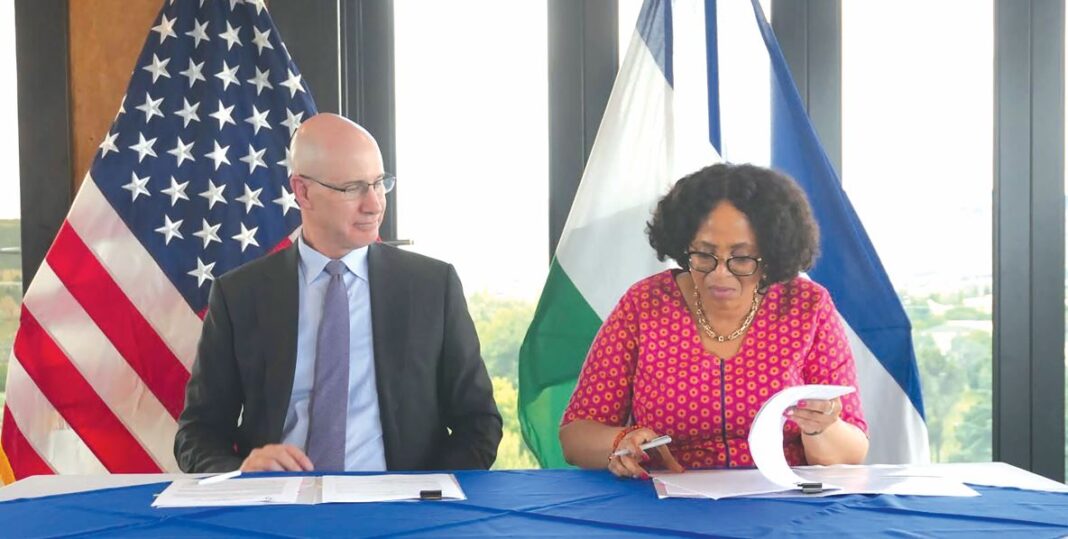
On Wednesday last week, the United States signed separate five-year bilateral health cooperation MoUs with Uganda and Lesotho, aimed at advancing Washington’s “America First Global Health Strategy” and building what it described as “resilient, self-reliant, and durable health systems” in both countries.
In Kampala, the United States and Uganda concluded a nearly US$2.3 billion health cooperation agreement. Under that deal, Washington plans to invest up to US$1.7 billion over five years to fight HIV/AIDS, tuberculosis (TB), malaria, and other infectious diseases, while strengthening Uganda’s health system.
The Ugandan government, in turn, committed to co-invest more than US$500 million in line with its National Development Plan IV and Vision 2040.
In Maseru, the United States and Lesotho signed a five-year health MoU valued at US$364 million.
Through this agreement, the U.S. State Department, working with Congress, intends to provide up to US$232 million to support Lesotho’s HIV/AIDS response, strengthen the health workforce, improve data systems, and enhance disease surveillance and outbreak response.
The Government of Lesotho has committed to invest US$132 million toward its domestic HIV/AIDS programme.
“From internet connectivity for health clinics to advanced robotics delivery of life-saving medical products, the US$364 million MoU opens the door to innovations that mutually advance health care and the local economy,” said Thomas “Tommy” Pigott, the State Department’s Deputy Spokesperson, in a statement.
However, Newsday has reviewed the 23-page draft MoU that was formally transmitted to the Ministry of Foreign Affairs and International Relations on 13 November, ahead of negotiations held at Mpilo Boutique Hotel on 14 and 15 November, and its fine print raises serious red flags.
In a diplomatic note accompanying the draft, the U.S. Embassy invited Minister Lejone Mpotjoane to attend the negotiations.
The Embassy of the United States of America presents its compliments to the Ministry of Foreign Affairs and International Relations of the Kingdom of Lesotho and has the honour to invite Honourable Minister Lejone Mpotjoane to attend Memorandum of Understanding (MoU) negotiations regarding the funding and management of Foreign Assistance for Health Programs in Lesotho,”
It added that Deputy Assistant Secretary for Health Policy and Diplomacy Mamadi Yilla would lead the U.S. delegation and that a copy of the proposed MoU was enclosed for review.
Buried deep in the draft, however, are provisions that critics say point to long-term dependency, erosion of sovereignty, and what some health and governance experts are describing as a “neo-colonial pipeline” for Basotho genetic material and health intelligence.
Section 2.1.2 of the draft MoU provides for a 25-year specimen-sharing arrangement with the United States.
“The United States and Lesotho plan to negotiate a specimen sharing arrangement that includes the elements set out in Appendix 4 for the purpose of providing physical specimens and related data, including genetic sequence data, of detected pathogens with epidemic potential to the United States within five days of detection. Both participants intend this specimen sharing arrangement to continue for twenty-five (25) years,” reads the document.
In practical terms, this means if a new virus, drug-resistant bacteria, or unknown fever emerges in Mohale’s Hoek or Mokhotlong, samples taken from Basotho patients must be packaged and flown to U.S. laboratories within a week. Every time. For a generation.
Equally alarming is the mandated 25-year health data sharing agreement outlined in Section 2.5.2.
Under this clause, Lesotho would be required to transmit extensive national health data, including disease surveillance information and treatment outcomes, to the U.S. government for reporting to the American Congress.
“The United States and Lesotho intend to negotiate a data-sharing arrangement that includes the elements set out in Appendix 5 for the purpose of exchanging data on the long-term performance of this MOU and for accountability to the United States Congress for appropriated funds. Both participants expect this data sharing arrangement to continue for twenty-five (25) years,” reads the document.
The draft offers no detailed provisions on how this data will be anonymised, stored, or protected from misuse or breaches. In an era of digital espionage and commercial data mining, critics warn that Basotho’s health privacy is being bargained away.
Although framed as a technical health agreement, the MOU effectively binds not only the current government but future administrations that were not party to the negotiations, may pursue different public health strategies, and could operate under entirely different geopolitical conditions.
Newsday was unable to independently verify, at the time of publication, whether the final signed MoU materially differs from the draft circulated ahead of negotiations.
While the agreement was signed on behalf of the people of Lesotho by the Minister of Finance and Development Planning, Dr Retšelisitsoe Matlanyane, the document has not been made public, raising further concerns about transparency and accountability.
Efforts by this publication to obtain a comment from Dr Matlanyane were unsuccessful yesterday. Minister Mpotjoane, to whom the draft was transmitted and who was invited to the negotiations, was also unreachable at the time of going to print.
When contacted, the United States Embassy in Maseru said it would not comment on or release the text of what it described as private diplomatic communications.
In a written response sent via email, the embassy spokesperson said: “We will not comment on or provide the text of private diplomatic communications, including purported drafts or the final MoU text. The agreement belongs to the Government of Lesotho as well as the Government of the United States, and it would be inappropriate of us to publicise it without their consent.”
The spokesperson added that the United States stands by the final negotiated agreement, saying it would “greatly benefit both our nations.”
The embassy sought to allay concerns over data sovereignty and privacy, explaining that the United States and Lesotho have long-standing and well-established data-sharing practices that are limited to aggregated, programmatic data.
According to the embassy, such data is required for planning, monitoring progress, and reporting to the U.S. Congress on the impact of American health investments.
The spokesperson further stated that the MoU would increase the Government of Lesotho’s ownership of public health data and would phase out parallel data systems currently maintained by implementing partners.
“While the details of the data-sharing agreement are pending further discussion, it is anticipated that the agreement will not create any new data-sharing requirements,” the spokesperson said.
The embassy stressed that under the agreement no personally identifiable information (PII) would be shared, and that Lesotho would retain full ownership and control of all data in accordance with its laws.
“All data-sharing processes will continue to be governed by Lesotho’s policies, laws, and approval mechanisms,” the spokesperson emphasised.
The embassy added that the same type of aggregated, de-identified data that the Government of Lesotho has shared with key stakeholders and donors for years to demonstrate programme results would continue to be shared for a limited period, to ensure transparency and accountability for both U.S. and Lesotho taxpayer funds.
“The U.S. will continue supporting Lesotho to strengthen data systems and protect PII through secure systems and data governance,” the spokesperson said. “The agreement maintains long-standing practices and helps ensure strong, secure data systems that benefit Lesotho’s health sector while also ensuring the highest level of accountability for funds provided by U.S. and Lesotho taxpayers.”
The spokesperson further stated that the MoU does not create new legal obligations for either government and that all programmes will continue to operate within existing national legal frameworks.
The imbalance created by the MOU deepens in Section 4, which grants the United States sweeping audit and enforcement powers over Lesotho’s health system, while offering Lesotho little reciprocal leverage.
Section 4.2 states: “Lesotho acknowledges that so long as the U.S. government is providing any funding in support of activities described in this MOU, the U.S. government has a significant and material interest in ensuring the process metrics outlined in Sections 1.2 and 1.3 are accurately collected, complete and maintained.
“To this end, Lesotho commits to provide the U.S. government with any data access, on-site access, or other information needed to audit the process metrics in Sections 1.2 and 1.3 in up to five percent of randomly selected and/or specific health facilities, clinics, labs, or programs identified by the U.S. government.”
This means that U.S. officials or their designated agents can demand access to randomly selected clinics, patient records (with data access), and operational data. Lesotho has no reciprocal right to audit U.S. processes or implementing partners in the same way.
Section 4.4 further gives the U.S. the right to scrutinise Lesotho’s government spending and logistics to ensure no U.S. funds are misused and that Lesotho is meeting its co-funding promises.
It states: “Lesotho acknowledges that so long as the U.S. government is providing any funding in support of activities described in Section 2.2, 2.3, and/or 2.4 of this MOU, the U.S. government has a significant and material interest in ensuring Lesotho is making its committed co-investment.
“To this end, Lesotho commits to provide the U.S. government with any data access or information needed to audit any accounts from which or to which co-investment funding is being provided.”
There is no clause allowing Lesotho to audit the administrative overhead or efficiency of the U.S. funding mechanisms.
Responding to these concerns, the U.S. Embassy in Maseru said yesterday that the agreement was co-developed through what it described as robust negotiations and reflects the priorities of both governments, including protecting citizens of both countries while strengthening Lesotho’s health system through increased domestic financing.
The embassy maintained that the MoU reinforces, rather than undermines, Lesotho’s sovereignty by supporting the country to assume full ownership of its health systems.
“Lesotho retains full authority over all decisions, systems, and funds,” the spokesperson said.
“The United States is providing Lesotho with up to US$232 million through this agreement, while Lesotho is also committing additional funding to its own health system. No other country provides anywhere near this level of support for saving the lives of Basotho, and this comes on top of more than US$1 billion in U.S. health assistance over the past two decades.”
The embassy added that officials who negotiated the MoU were involved at every stage of the process and would also lead its implementation, with a clear understanding that every cent must be used responsibly to meet the agreement’s ambitious goals.
According to the embassy, the MoU is designed to strengthen Lesotho’s institutional capacity and includes performance benchmarks and audit mechanisms to ensure the proper use of both American and Lesotho taxpayer funds.
“Both governments have agreed to the creation of robust audit mechanisms to regulate implementation over the five-year period. If, beyond that, the Government of Lesotho wishes to conduct further audits, that would be welcomed,” the spokesperson said.
The embassy further argued that the MoU marks a shift away from the traditional donor model, moving instead toward direct government-to-government collaboration and co-investment.
“We agree that the Government of the Kingdom of Lesotho should have full knowledge and oversight of health-related activities within its borders,” the spokesperson said.
The MoU provides the United States with multiple, clearly defined exit points to reduce or terminate funding, placing the risk of breach almost entirely on Lesotho.
Section 4.6 (Effect of Failure to Provide Data) states that: “Lesotho acknowledges that failure to provide the data access or information requested under 4.2, 4.3, 4.4, or 4.5 could result in changes in the planned assistance … and/or discontinuation of this MoU by the U.S. Government.”
Section 4.7 applies the same sanction to Lesotho’s failure to honour the long-term specimen and data-sharing commitments under Sections 2.1.2 and 2.5.2, allowing the U.S. to alter or withdraw funding.
Section 5.1 (Co-Investment Requirements) is even more explicit: “In the event that Lesotho does not make the required co-investment outlined in Sections 2.2.3, 2.3.3 and/or 2.4.3 within the specified calendar year, the U.S. Government may unilaterally reduce or cease providing funding to Lesotho under this MoU in future years.”
Similarly, Section 5.2 (Performance Incentives) allows the U.S. to “substantially decrease or eliminate funding” if Lesotho fails to meet agreed health outcome targets.
Together, these provisions establish a regime of strict conditionality for Lesotho. The United States, however, faces no equivalent penalties. Its central obligation, funding, is explicitly qualified rather than guaranteed.
The U.S. Embassy in Maseru said Lesotho “is free to withdraw from the agreement at any time” and that the MoU is intended to serve the interests of both countries.
“We believe it is in both our nations’ interests to maintain this agreement, including U.S. foreign assistance and co-investment from the Government of Lesotho, with support and knowledge sharing to ease the transition to the Government of Lesotho maintaining full responsibility for its healthcare system after 2030,” the embassy said.
Also, by contrast, U.S. funding commitments are shielded by Section 6.8, which makes all assistance “subject to the availability of funds, personnel, and other resources,” a clause that turns funding promises into conditional intentions rather than guarantees.
Section 6.8 states: “Participants acknowledge that this MOU is intended to exclusively cover activities funded by the U.S. Department of State and Lesotho. All activities described in and/or pursued by the participants under this MOU are subject to the availability of funds, personnel, and other resources.”
This means that every dollar promised is prefaced with ‘if we have it.’ This standard clause gives the U.S. a built-in justification for not delivering full funding, based on its own internal budgetary processes.
Lesotho’s co-investment commitments (Sections 2.2.3, 2.4.3) are framed as firm obligations, not subject to a similar ‘if our budget allows’ caveat.
Section 6.9 (Legal Status), the most critical clause states: “This MOU is not an international agreement and does not give rise to legal rights and obligations under international or domestic law.”
This is the cornerstone of the imbalance. The U.S.’s audit powers, termination rights, and Lesotho’s compliance duties are all framed within an operational document that carries no legal weight for the U.S.
If the U.S. were to breach the MOU, for example, by not providing promised funds, Lesotho has no legal recourse in international or U.S. courts.
Conversely, the U.S. can enforce Lesotho’s compliance through the very real, immediate threat of withdrawing assistance, as detailed in Sections 4.6, 4.7, and 5.1.
The enforcement mechanism is practical (aid withdrawal), not legal, and it is a tool that only one party holds.
Finally, the MOU demands that Lesotho change its domestic legal and regulatory framework to align with U.S. interests.
Section 2.7, second bullet, states: “Lesotho commits to modify its regulations and/or laws by December 31, 2026, to recognise approval from the United States Food & Drug Administration (FDA) as meeting all similarly required regulatory approvals by the Lesotho Medical Regulatory Authority (LEMERA).”
This undermines the sovereignty and purpose of LEMERA.
It turns the U.S. FDA into the de facto regulator for Lesotho for any medical products. It prioritises U.S. regulatory timelines and decisions over Lesotho’s own capacity to assess what is safe and appropriate for its population.
This is a profound concession of national regulatory autonomy.
Taken together, the draft MOU reveals an agreement that offers short-term health funding at the cost of long-term sovereignty, regulatory independence, and control over biological and health data.
Summary
A draft copy of a Memorandum of Understanding (MoU) between Lesotho and the United States, obtained by Newsday, reveals that in exchange for critical health funding, Lesotho could be compelled to surrender its citizens’ biological samples and highly sensitive national health data to the United States government for up to 25 years, binding the country until 2050.
The Embassy of the United States of America presents its compliments to the Ministry of Foreign Affairs and International Relations of the Kingdom of Lesotho and has the honour to invite Honourable Minister Lejone Mpotjoane to attend Memorandum of Understanding (MoU) negotiations regarding the funding and management of Foreign Assistance for Health Programs in Lesotho,”.
“The United States and Lesotho plan to negotiate a specimen sharing arrangement that includes the elements set out in Appendix 4 for the purpose of providing physical specimens and related data, including genetic sequence data, of detected pathogens with epidemic potential to the United States within five days of detection.
To ensure optimal experiences, we utilize technologies such as cookies to store and/or access information from your device. Granting consent to these technologies enables us to process data, including browsing habits or unique identifiers on this website. Conversely, not consenting or revoking consent may negatively impact specific features and functionalities.
Functional
Always active
The technical storage or access is strictly necessary for the legitimate purpose of enabling the use of a specific service explicitly requested by the subscriber or user, or for the sole purpose of carrying out the transmission of a communication over an electronic communications network.
Preferences
The technical storage or access is necessary for the legitimate purpose of storing preferences that are not requested by the subscriber or user.
Statistics
The technical storage or access that is used exclusively for statistical purposes.The technical storage or access that is used exclusively for anonymous statistical purposes. Without a subpoena, voluntary compliance on the part of your Internet Service Provider, or additional records from a third party, information stored or retrieved for this purpose alone cannot usually be used to identify you.
Marketing
The technical storage or access is required to create user profiles to send advertising, or to track the user on a website or across several websites for similar marketing purposes.