
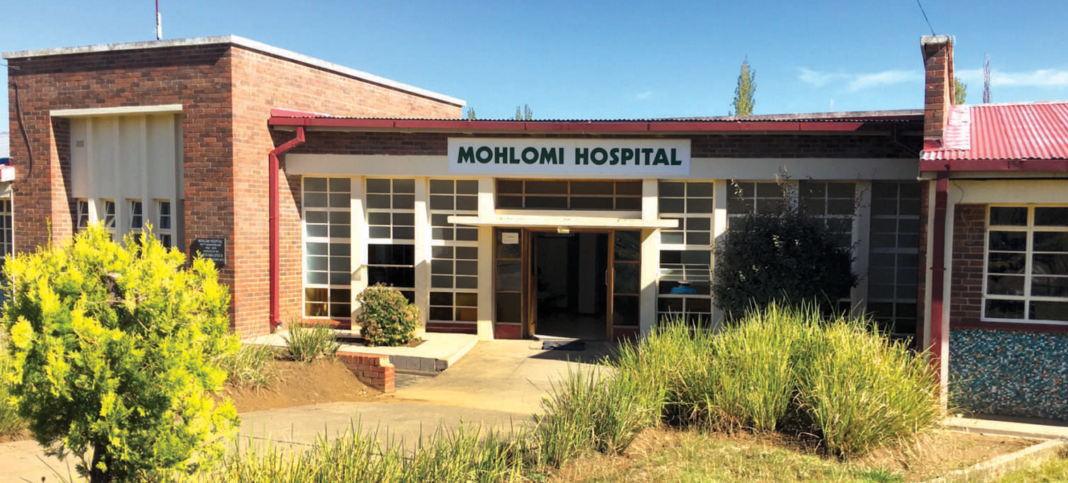
Stepping off the taxi by the main gate, the world immediately takes on a different rhythm. Inside the yard of Mohlomi Mental Institution, groups of people linger under the open sky.
In the morning quiet, it is impossible to tell who they are. Are they patients taking in the early air? Are they anxious relatives waiting to see loved ones admitted to the wards? Or perhaps they are hospital workers or visitors drawn here for a dozen other reasons. The uncertainty hangs in the air, a quiet prelude to a day of profound observation.
I walked toward the reception desk to report my presence. I was here as a journalist, tasked with covering an event organised by the Crime Prevention Rehabilitation and Reintegration of Ex-Offenders Association (CRROA).
They had scheduled a visit to the hospital’s Forensic Department to commemorate Men’s Mental Health Month a critical initiative in a country where men’s psychological struggles are so often swept beneath the rug.
The reception area, which doubles as the main waiting room, felt heavy. A biting chill gripped the indoor air, leaving the people sitting on the benches looking visibly cold and miserable. Outside, those waiting in the yard were far more fortunate, they were actively basking in the warmth of the morning sun.
Shortly after checking in, a hospital staff member volunteered to accompany me to the Forensic Department.
As we navigated a labyrinth of long corridors, the persistent cold followed us. Yet, despite the low temperature, the facility was immaculately clean. The floors gleamed, looking as though they had just been meticulously scrubbed.
As we neared the forensic gate, the silence shattered. Shouts and chaotic noises echoed. Drawing closer, a specific voice cut through the noise. It belonged to a guard or perhaps a member of the Lesotho Correctional Services (LCS) who was stationed at the gate to regulate movement.
“He lona banna ha reeng lebaleng!” (Hey men, let’s go to the ground!) he shouted, handling a large stick covered with sharp thorns.
We approached the gate and explained the purpose of my visit. The guard looked blank, he clearly had no idea that an event was scheduled for that morning. Instructing us to wait, he walked away to consult his superior.
When he returned, he informed my guide that while the event was indeed expected, it had not yet begun. I was instructed to return to the reception area and wait until someone came to fetch me.
On our way back through the spotless corridors, we encountered a large group of people. I assumed they were patients, moving in tandem with their caregivers. Among them were two women wearing medical scrubs the universal uniform that marked them out as nurses.
Unable to endure the shivering cold of the indoor reception area, I opted to wait outside and bask in the sun.
As I stood there, the distant sound of voices drifted across the yard. A group was singing gospel hymns, their voices rising loud and clear into the morning air. They walked in a slow procession around the grounds, a routine that seemed to be their daily morning ritual.
As the singers passed directly in front of the reception area, I witnessed something that shook me to my core. In my mind, I realised I had subconsciously expected to see dull, listless individuals, people drained of energy, wearing the exhaustion of chronic illness plainly on their faces.
Instead, looking at them, you would swear that I was the patient. They looked genuinely happy. They sang with fierce energy, their bodies moving in rhythm to the music. Most of the patients leading this vibrant, musical parade were middle-aged women.
Soon, it was time to head back to the forensic unit. Upon arrival, I waited outside the gate alongside representatives from CRROA and various other non-governmental organizations. Before the heavy doors opened, we were thoroughly briefed and given strict instructions on how to behave once we stepped inside the inner yard of the unit.
When we finally entered, we were greeted by rows of bright, expectant faces. Sitting on their chairs, eager to hear from the visitors, were nearly one hundred men and a small group of no more than five women.
The program commenced with a moment of solemn spirituality. One of the patients stood up to lead a hymn and offer a opening prayer. He prayed deeply for better days, asking God for the spiritual strength to endure, and pleaded with the world outside to never give up on them.
Following the prayer, the Executive Director of CRROA, Nkalimeng Mothobi, took the stand. He explained that the core objective of their visit during Men’s Mental Health Month was to extend love and solidarity to the individuals housed within the forensic unit.
Mothobi openly acknowledged the staggering challenges facing both the patients and their healthcare providers.
He promised that his association, in partnership with other stakeholders, is actively working to resolve these systemic issues, particularly the deteriorating living conditions and the heartbreaking reality of individuals who have remained confined to the unit for more than thirty years.
“We all know that workers here operate under unbearable conditions, which makes it seem like they are also serving time,” Mothobi noted grimly, highlighting the shared burden of the staff.
The emotional peak of the day arrived when a choir of about ten male patients stood up to perform.
They sang entirely from the bottom of their hearts. The Sesotho hymns, “O re nehe ho thabela tseo u li ratang kaofel” (Grant us to delight in all that You love) and “Kena le molisa ke tlabe ke hlokang” (The Lord is my shepherd, I shall not want) , carried a profound, haunting weight in that high-security space.
Next, Suping Mokapane from MVAL, an association formed by retired members of the Lesotho Defense Force (LDF), addressed the gathering. He reminded the patients that regardless of the circumstances that brought them behind these high walls, they remain inherently important human beings who matter to society.
Mokapane urged the patients to actively protect their emotional well-being and to seek help whenever life becomes overwhelming.
He concluded with a powerful message aimed at breaking traditional stigmas, “Gone are the days when men were expected never to complain or cry, or told to simply take it like a man.'”
The day concluded with remarks from the Acting Director of Mental Health from the Ministry of Health Thabo Mokhothu. He expressed deep gratitude to the visiting associations, noting his profound happiness that the public is beginning to understand that mental health is not solely the responsibility of the government, but requires coordinated, collective efforts from all sectors of society.
Walking away from Mohlomi, the echoing hymns stayed with me, a stark reminder of the humanity thriving behind the cold gates.
Summary
- They had scheduled a visit to the hospital’s Forensic Department to commemorate Men’s Mental Health Month a critical initiative in a country where men’s psychological struggles are so often swept beneath the rug.
- It belonged to a guard or perhaps a member of the Lesotho Correctional Services (LCS) who was stationed at the gate to regulate movement.
- Unable to endure the shivering cold of the indoor reception area, I opted to wait outside and bask in the sun.
Ntsoaki Motaung is an award-winning health journalist from Lesotho, specializing in community health stories with a focus on sexual and reproductive health and rights, as well as HIV. She has contributed to platforms like “Be in the KNOW,” highlighting issues such as the exclusion of people with disabilities from HIV prevention efforts in Lesotho.
In addition to her journalism, Ntsoaki serves as the Country Coordinator for the Regional Media Action Plan Support Network (REMAPSEN). She is also a 2023 CPHIA Journalism Fellow.